







Question: (a) Explain how the coagulation process helps with solid separation. (b) Experimental data for the filtration of CaCO3 slurry in water at 25C are presented
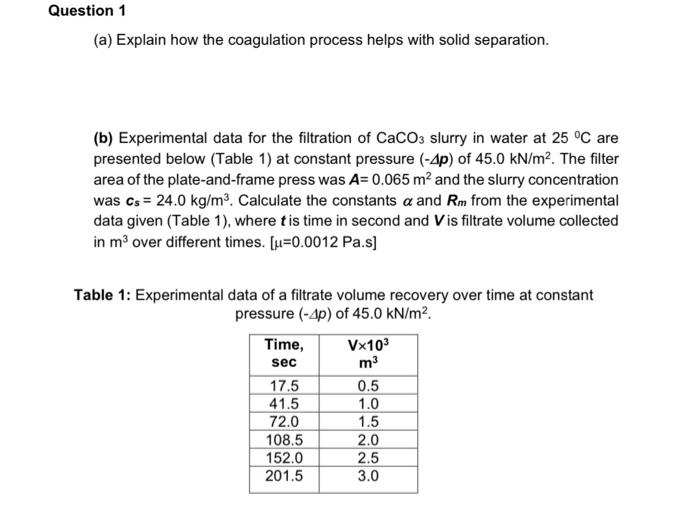
(a) Explain how the coagulation process helps with solid separation. (b) Experimental data for the filtration of CaCO3 slurry in water at 25C are presented below (Table 1) at constant pressure (p) of 45.0kN/m2. The filter area of the plate-and-frame press was A=0.065m2 and the slurry concentration was cs=24.0kg/m3. Calculate the constants and Rm from the experimental data given (Table 1), where t is time in second and V is filtrate volume collected in m3 over different times. [=0.0012 Pa.s ] Table 1: Experimental data of a filtrate volume recovery over time at constant pressure (p) of 45.0kN/m2. (a) Explain how the coagulation process helps with solid separation. (b) Experimental data for the filtration of CaCO3 slurry in water at 25C are presented below (Table 1) at constant pressure (p) of 45.0kN/m2. The filter area of the plate-and-frame press was A=0.065m2 and the slurry concentration was cs=24.0kg/m3. Calculate the constants and Rm from the experimental data given (Table 1), where t is time in second and V is filtrate volume collected in m3 over different times. [=0.0012 Pa.s ] Table 1: Experimental data of a filtrate volume recovery over time at constant pressure (p) of 45.0kN/m2
Step by Step Solution
There are 3 Steps involved in it

Get step-by-step solutions from verified subject matter experts
 Study Help