







Question: a) Explain the title of the first case study on pages 102-104. What are the big opportunities of doing business in China? What are the
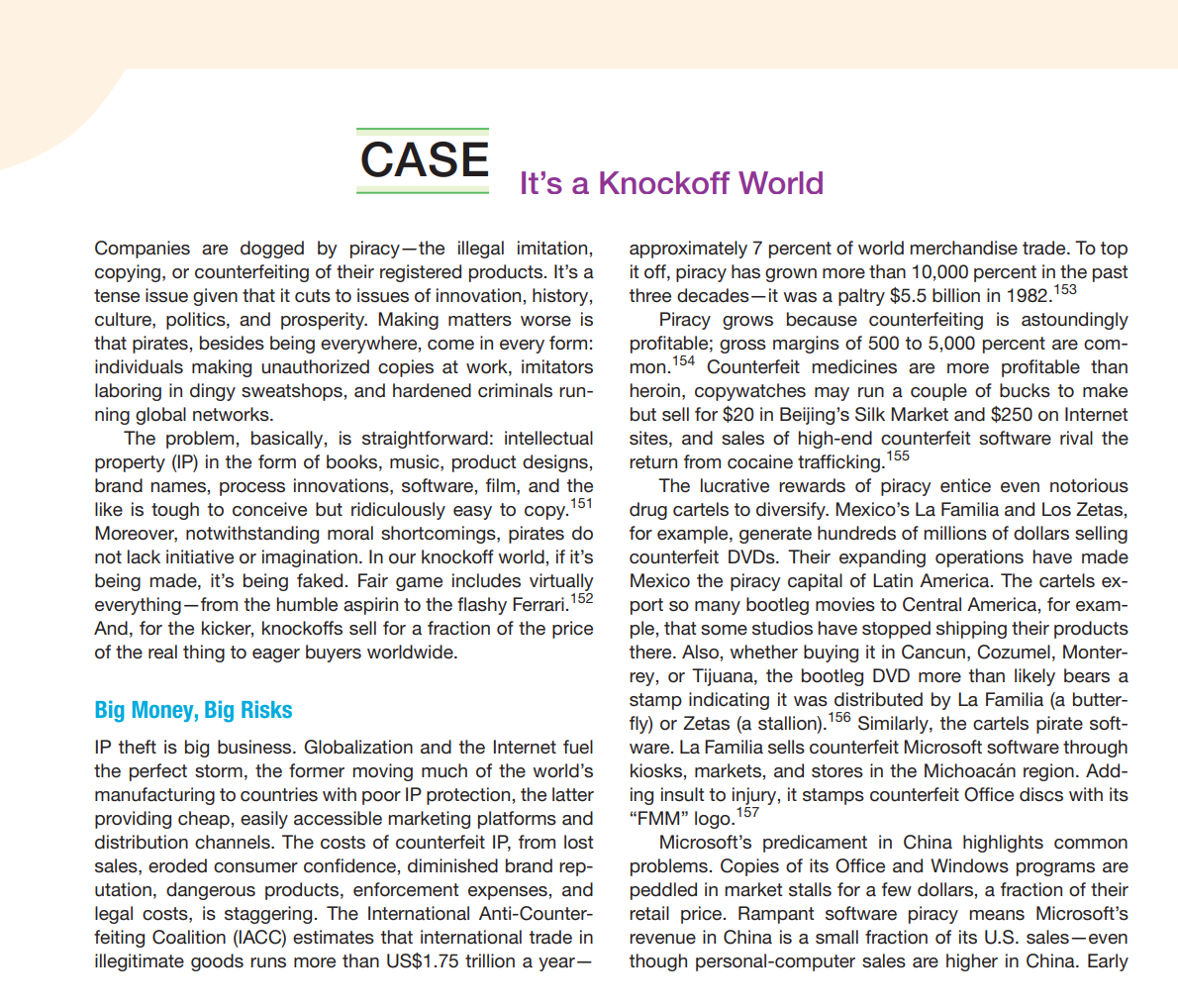
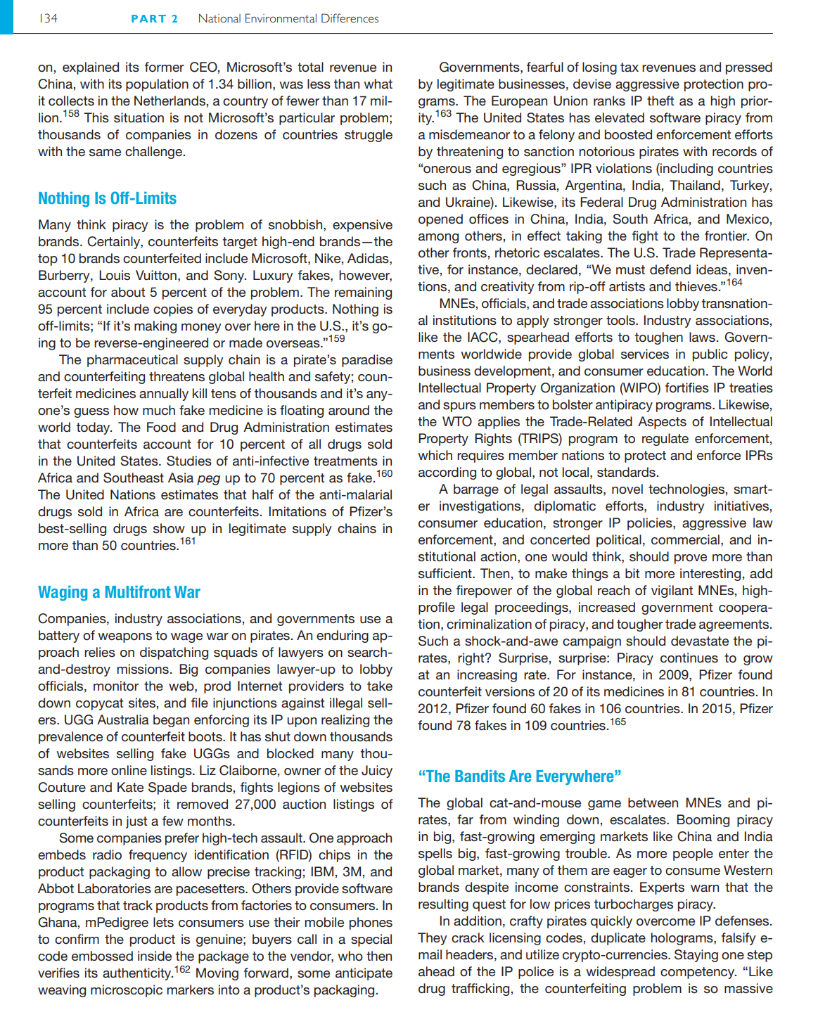
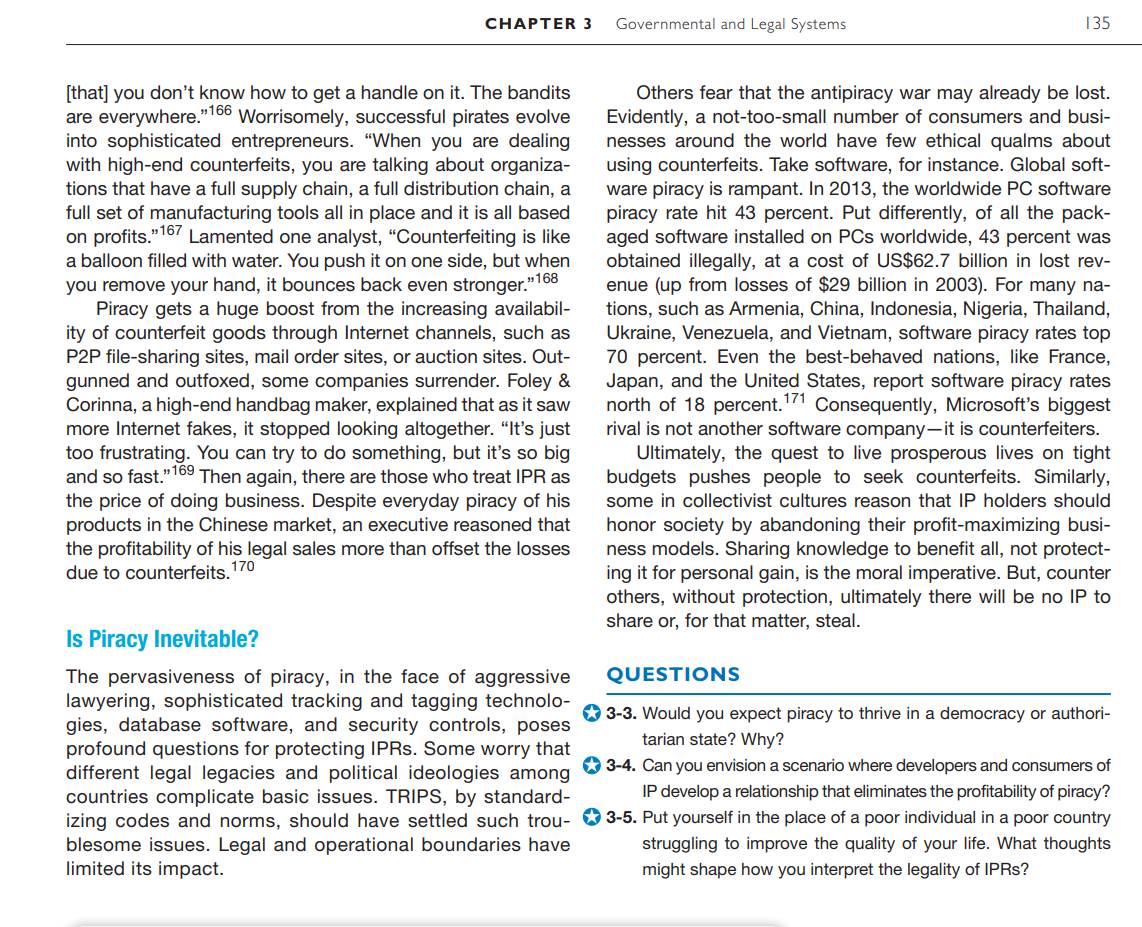 a) Explain the title of the first case study on pages 102-104. What are the "big opportunities" of doing business in China? What are the "complicated risks" of doing business in China? On a scale of 1-10 (1 is worst, 10 is best), how would you rate doing business in China? Would you recommend that a multi-national company do business in China? Why/why not? [If it helps, you can write this from the position of a consultant talking to a client that wants to do business in China.]
b) Based on the case, Its a Knockoff World" (pages 133-135), what would you recommend to an international business about piracy and intellectual property rights? Is the antipriacy war already lost? Or is there something that an international business can do to protect its intellectual property and products?
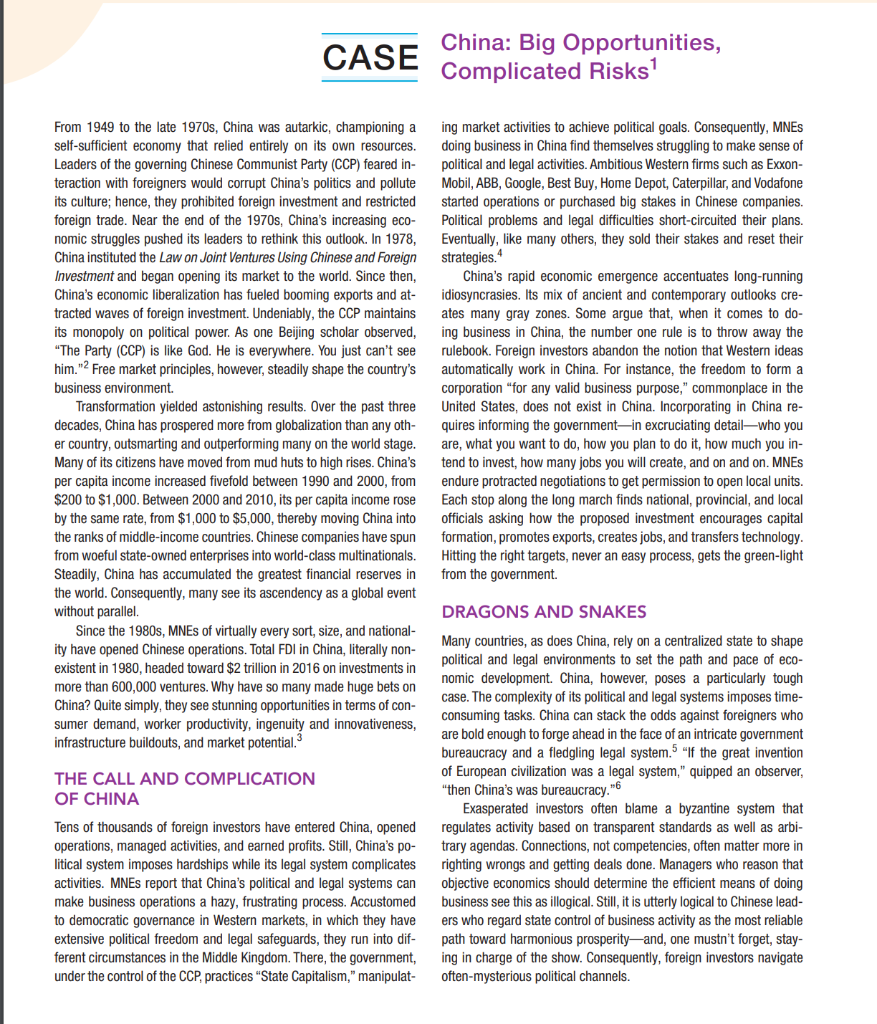
CASE It's a Knockoff World Companies are dogged by piracy-the illegal imitation, approximately 7 percent of world merchandise trade. To top copying, or counterfeiting of their registered products. It's a it off, piracy has grown more than 10,000 percent in the past tense issue given that it cuts to issues of innovation, history, three decades-it was a paltry $5.5 billion in 1982 . 153 culture, politics, and prosperity. Making matters worse is Piracy grows because counterfeiting is astoundingly that pirates, besides being everywhere, come in every form: profitable; gross margins of 500 to 5,000 percent are comindividuals making unauthorized copies at work, imitators mon. 154 Counterfeit medicines are more profitable than laboring in dingy sweatshops, and hardened criminals run- heroin, copywatches may run a couple of bucks to make ning global networks. but sell for $20 in Beijing's Silk Market and $250 on Internet The problem, basically, is straightforward: intellectual sites, and sales of high-end counterfeit software rival the property (IP) in the form of books, music, product designs, return from cocaine trafficking. 155 brand names, process innovations, software, film, and the The lucrative rewards of piracy entice even notorious like is tough to conceive but ridiculously easy to copy.. 151 drug cartels to diversify. Mexico's La Familia and Los Zetas, Moreover, notwithstanding moral shortcomings, pirates do for example, generate hundreds of millions of dollars selling not lack initiative or imagination. In our knockoff world, if it's counterfeit DVDs. Their expanding operations have made being made, it's being faked. Fair game includes virtually Mexico the piracy capital of Latin America. The cartels exeverything -from the humble aspirin to the flashy Ferrari. 152 port so many bootleg movies to Central America, for examAnd, for the kicker, knockoffs sell for a fraction of the price ple, that some studios have stopped shipping their products of the real thing to eager buyers worldwide. there. Also, whether buying it in Cancun, Cozumel, Monterrey, or Tijuana, the bootleg DVD more than likely bears a Big Money, Big Risks stamp indicating it was distributed by La Familia (a butterfly) or Zetas (a stallion). 156 Similarly, the cartels pirate softIP theft is big business. Globalization and the Internet fuel ware. La Familia sells counterfeit Microsoft software through the perfect storm, the former moving much of the world's kiosks, markets, and stores in the Michoacn region. Addmanufacturing to countries with poor IP protection, the latter ing insult to injury, it stamps counterfeit Office discs with its providing cheap, easily accessible marketing platforms and "FMM" logo. 157 distribution channels. The costs of counterfeit IP, from lost Microsoft's predicament in China highlights common sales, eroded consumer confidence, diminished brand rep- problems. Copies of its Office and Windows programs are utation, dangerous products, enforcement expenses, and peddled in market stalls for a few dollars, a fraction of their legal costs, is staggering. The International Anti-Counter- retail price. Rampant software piracy means Microsoft's feiting Coalition (IACC) estimates that international trade in revenue in China is a small fraction of its U.S. sales-even illegitimate goods runs more than US $1.75 trillion a year - though personal-computer sales are higher in China. Early [that] you don't know how to get a handle on it. The bandits Others fear that the antipiracy war may already be lost. are everywhere."166 Worrisomely, successful pirates evolve Evidently, a not-too-small number of consumers and busiinto sophisticated entrepreneurs. "When you are dealing nesses around the world have few ethical qualms about with high-end counterfeits, you are talking about organiza- using counterfeits. Take software, for instance. Global softtions that have a full supply chain, a full distribution chain, a ware piracy is rampant. In 2013, the worldwide PC software full set of manufacturing tools all in place and it is all based piracy rate hit 43 percent. Put differently, of all the packon profits."167 Lamented one analyst, "Counterfeiting is like aged software installed on PCs worldwide, 43 percent was a balloon filled with water. You push it on one side, but when obtained illegally, at a cost of US $62.7 billion in lost revyou remove your hand, it bounces back even stronger."168 enue (up from losses of $29 billion in 2003). For many naPiracy gets a huge boost from the increasing availabil- tions, such as Armenia, China, Indonesia, Nigeria, Thailand, ity of counterfeit goods through Internet channels, such as Ukraine, Venezuela, and Vietnam, software piracy rates top P2P file-sharing sites, mail order sites, or auction sites. Out- 70 percent. Even the best-behaved nations, like France, gunned and outfoxed, some companies surrender. Foley \& Japan, and the United States, report software piracy rates Corinna, a high-end handbag maker, explained that as it saw north of 18 percent. 171 Consequently, Microsoft's biggest more Internet fakes, it stopped looking altogether. "It's just rival is not another software company-it is counterfeiters. too frustrating. You can try to do something, but it's so big Ultimately, the quest to live prosperous lives on tight and so fast."169 Then again, there are those who treat IPR as budgets pushes people to seek counterfeits. Similarly, the price of doing business. Despite everyday piracy of his some in collectivist cultures reason that IP holders should products in the Chinese market, an executive reasoned that honor society by abandoning their profit-maximizing busithe profitability of his legal sales more than offset the losses ness models. Sharing knowledge to benefit all, not protectdue to counterfeits. 170 ing it for personal gain, is the moral imperative. But, counter others, without protection, ultimately there will be no IP to share or, for that matter, steal. Is Piracy Inevitable? The pervasiveness of piracy, in the face of aggressive QUESTIONS lawyering, sophisticated tracking and tagging technolo- 3-3. Would you expect piracy to thrive in a democracy or authorigies, database software, and security controls, poses profound questions for protecting IPRs. Some worry that tarian state? Why? different legal legacies and political ideologies among 3-4. Can you envision a scenario where developers and consumers of countries complicate basic issues. TRIPS, by standardIP develop a relationship that eliminates the profitability of piracy? 3-5. Put yourself in the place of a poor individual in a poor country blesome issues. Legal and operational boundaries have struggling to improve the quality of your life. What thoughts limited its impact. might shape how you interpret the legality of IPRs? self-interests at the expense of the collective. Foreign investors, nat- skeptical bureaucrats, and cross the modern-day Rubicon, they face urally, wondered how blending Confucian virtues, ideals of Li, and the daunting task of interpreting China's political and legal systems. social harmony might regulate their rights. 16 Despite intimidating political difficulties and confusing legal questions, legions of foreign investors profitably answer the siren call of QUESTIONS China. Whether driven by bright forecasts, confidence in continued 3-1. Recommend a perspective an MNE could use to make sense progress, or desperation to ride this megatrend, many foreign compaof the political situation in China. nies leave the sanctuary of predictable markets for the distinctive ways 3-2. How would you advise an MNE to manage the intricacies of of the Middle Kingdom. Then, once they clear immigration, convince China's legal environment
Step by Step Solution
There are 3 Steps involved in it

Get step-by-step solutions from verified subject matter experts
 Study Help