







Question: (a) Explain what is wrong with the given code. Describe the fault precisely by proposing a modification to the code. (b) If possible, give
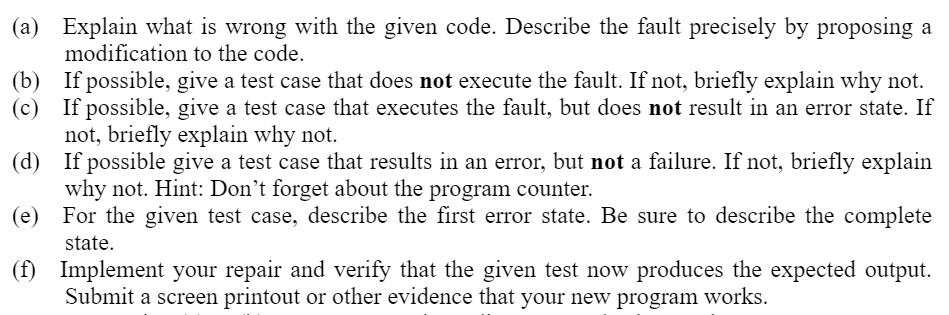
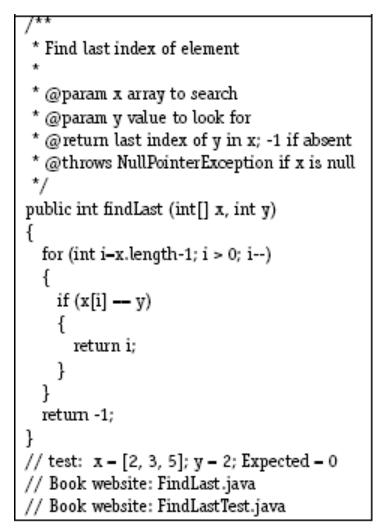
(a) Explain what is wrong with the given code. Describe the fault precisely by proposing a modification to the code. (b) If possible, give a test case that does not execute the fault. If not, briefly explain why not. If possible, give a test case that executes the fault, but does not result in an error state. If not, briefly explain why not. (c) (d) If possible give a test case that results in an error, but not a failure. If not, briefly explain why not. Hint: Don't forget about the program counter. (e) For the given test case, describe the first error state. Be sure to describe the complete state. (f) Implement your repair and verify that the given test now produces the expected output. Submit a screen printout or other evidence that your new program works. Find last index of element @param x array to search @param y value to look for @return last index of y in x; -1 if absent @throws NullPointerException if x is null public int findLast (int[] x, int y) { for (int i-x.length-1; i > 0; i--) { if (x[i]-y) { return i; } } } retum -1; // test: x [2, 3, 5]; y-2; Expected - 0 // Book website: FindLast.java // Book website: FindLastTest.java
Step by Step Solution
There are 3 Steps involved in it

Get step-by-step solutions from verified subject matter experts
 Study Help