







Question: A father is now planning a savings program to put his daughter through college. She is 13, plans to enroll at the university in 5
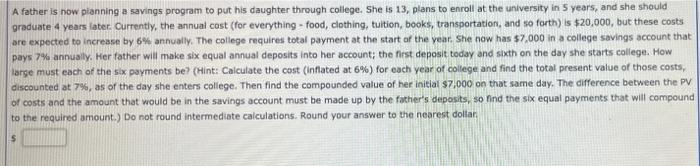
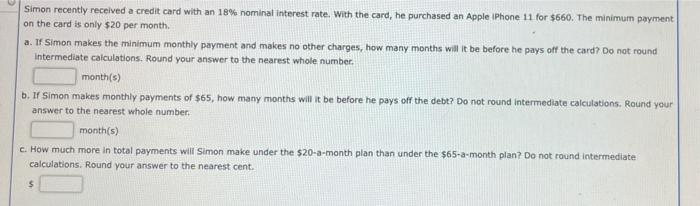
A father is now planning a savings program to put his daughter through college. She is 13, plans to enroll at the university in 5 years, and she should graduate 4 years later. Currently, the annual cost (for everything - food, clothing, tuition, books, transportation, and so forth) is $20,000, but these costs are expected to increase by 6% annually. The college requires total payment at the start of the year. She now has $7,000 in a college savings account that pays 7% annually. Her father will make six equal annual deposits into her account; the first deposit today and sixth on the day she starts college. How arge must each of the six payments be? (Hint: Calculate the cost (inflated at 6%) for each year of college and find the total present value of those costs, discounted at 7%, as of the day she enters college. Then find the compounded value of her initial $7,000 on that same day. The difference between the PV of costs and the amount that would be in the savings account must be made up by the father's deposits, so find the six equal payments that will compound to the required amount.) Do not found intermediate calculations. Round your answer to the nearest dollar $ Simon recently received a credit card with an 18% nominal interest rate. With the card, he purchased an Apple iPhone 11 for $660. The minimum payment on the card is only $20 per month a. If Simon makes the minimum monthly payment and makes no other charges, how many months will it be before he pays off the card? Do not round Intermediate calculations. Round your answer to the nearest whole number. month(s) b. If Simon makes monthly payments of $65, how many months will it be before he pays off the debt? Do not round intermediate calculations. Round your answer to the nearest whole number month(s) c. How much more in total payments will Simon make under the $20-a-month plan than under the $65-a-month plan? Do not round intermediate calculations. Round your answer to the nearest cent. $ A father is now planning a savings program to put his daughter through college. She is 13, plans to enroll at the university in 5 years, and she should graduate 4 years later. Currently, the annual cost (for everything - food, clothing, tuition, books, transportation, and so forth) is $20,000, but these costs are expected to increase by 6% annually. The college requires total payment at the start of the year. She now has $7,000 in a college savings account that pays 7% annually. Her father will make six equal annual deposits into her account; the first deposit today and sixth on the day she starts college. How arge must each of the six payments be? (Hint: Calculate the cost (inflated at 6%) for each year of college and find the total present value of those costs, discounted at 7%, as of the day she enters college. Then find the compounded value of her initial $7,000 on that same day. The difference between the PV of costs and the amount that would be in the savings account must be made up by the father's deposits, so find the six equal payments that will compound to the required amount.) Do not found intermediate calculations. Round your answer to the nearest dollar $ Simon recently received a credit card with an 18% nominal interest rate. With the card, he purchased an Apple iPhone 11 for $660. The minimum payment on the card is only $20 per month a. If Simon makes the minimum monthly payment and makes no other charges, how many months will it be before he pays off the card? Do not round Intermediate calculations. Round your answer to the nearest whole number. month(s) b. If Simon makes monthly payments of $65, how many months will it be before he pays off the debt? Do not round intermediate calculations. Round your answer to the nearest whole number month(s) c. How much more in total payments will Simon make under the $20-a-month plan than under the $65-a-month plan? Do not round intermediate calculations. Round your answer to the nearest cent. $
Step by Step Solution
There are 3 Steps involved in it

Get step-by-step solutions from verified subject matter experts
 Study Help