



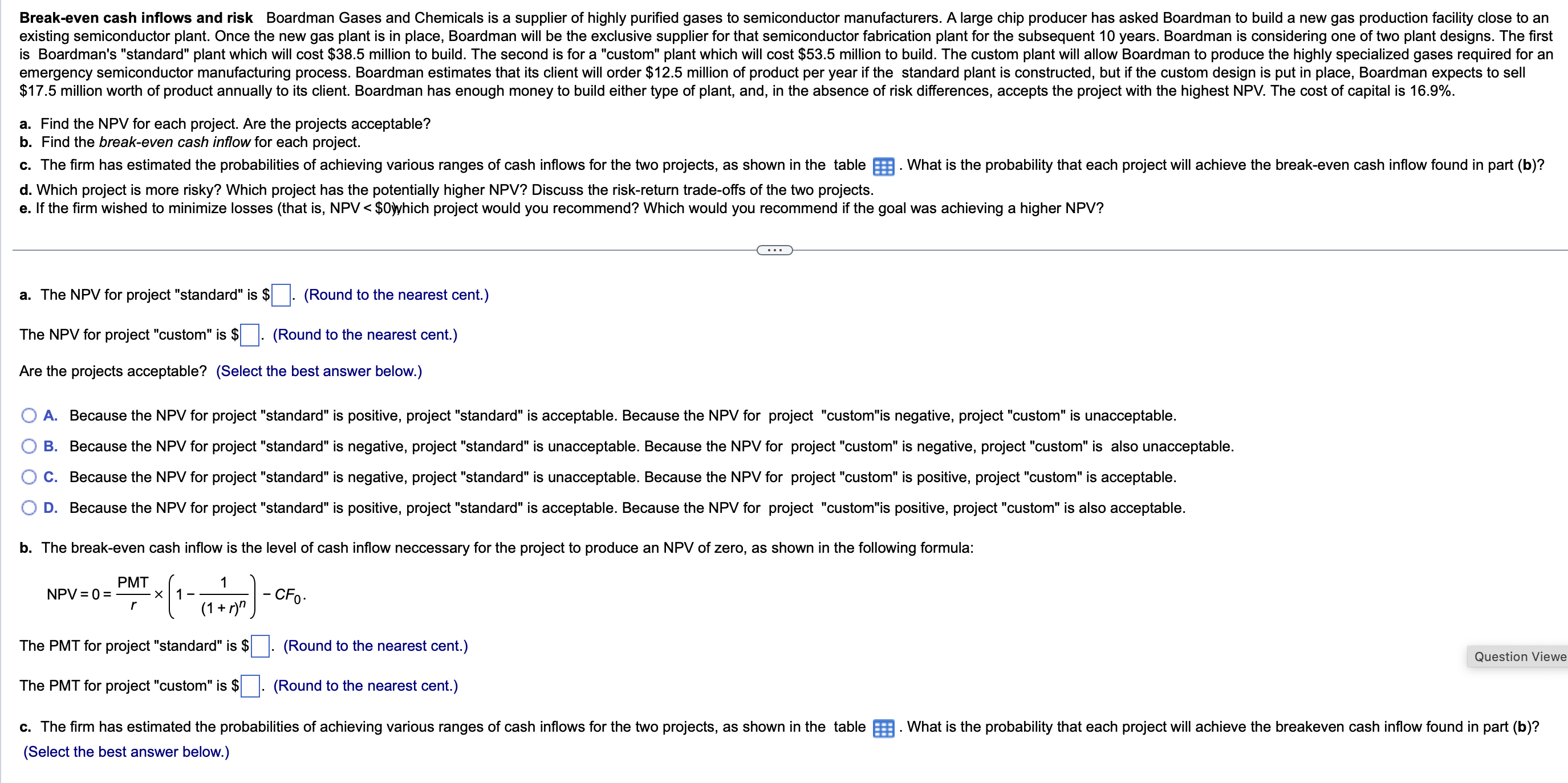
Question: a . Find the NPV for each project. Are the projects acceptable? b . Find the break - even cash inflow for each project. d
a Find the NPV for each project. Are the projects acceptable? b Find the breakeven cash inflow for each project. d Which project is more risky? Which project has the potentially higher NPV Discuss the riskreturn tradeoffs of the two projects. e If the firm wished to minimize losses that is NPV $yhich project would you recommend? Which would you recommend if the goal was achieving a higher NPV a The NPV for project "standard" is $ Round to the nearest cent. The NPV for project "custom" is $ Round to the nearest cent. Are the projects acceptable? Select the best answer below. A Because the NPV for project "standard" is positive, project "standard" is acceptable. Because the NPV for project "custom"is negative, project "custom" is unacceptable. B Because the NPV for project "standard" is negative, project "standard" is unacceptable. Because the NPV for project "custom" is negative, project "custom" is also unacceptable. C Because the NPV for project "standard" is negative, project "standard" is unacceptable. Because the NPV for project "custom" is positive, project "custom" is acceptable. D Because the NPV for project "standard" is positive, project "standard" is acceptable. Because the NPV for project "custom"is positive, project "custom" is also acceptable. b The breakeven cash inflow is the level of cash inflow neccessary for the project to produce an NPV of zero, as shown in the following formula: mathrmNPVfracmathrmPMTrtimesleftfracrnrightC F The PMT for project "standard" is $ Round to the nearest cent. The PMT for project "custom" is $ Round to the nearest cent. c The firm has estimated the probabilities of achieving various ranges of cash inflows for the two projects, as shown in the table What is the probability that each project will achieve the breakeven cash inflow found in part bSelect the best answer below. d Which project is more risky? Which project has the potentially higher NPV Discuss the riskreturn tradeoffs of the two projects. Select the best answer below.
A Both project"standard" and project "custom" are equally highly risky.
B Both project "standard" and project "custom" are equally low risk projects.
A If the firm wishes to minimize losses, it should choose project "custom"; to achieve higher NPV choose project "standard".
B If the firm wishes to minimize losses, it can choose either project "standard" or project "custom".
C If the firm wishes to minimize losses, it should choose project "standard"; to achieve higher NPV choose project "custom".
D If the firm wishes to achieve higher NPV it can choose either project "standard" or project "custom". Data table
begintabularlll
hline multirowbRange of cash inflow $ millions & multicolumncProbability of achieving cash inflow in given range
hline & Standard Plant & Custom Plant
hline $ to $ & &
hline $ to $ & &
hline $ to $ & &
hline $ to $ & &
hline $ to $ & &
hline $ to $ & &
hline Above $ & &
hline
endtabular
Step by Step Solution
There are 3 Steps involved in it
1 Expert Approved Answer
Step: 1 Unlock

Question Has Been Solved by an Expert!
Get step-by-step solutions from verified subject matter experts
Step: 2 Unlock
Step: 3 Unlock