







Question: a) Find the protein, which corresponds to the reference sequence NP 013406.1. What protein does the sequence corresponds to? What organism does the protein belong
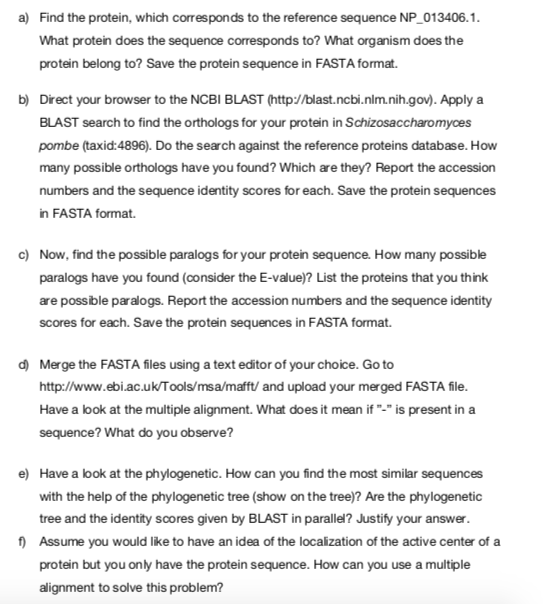
a) Find the protein, which corresponds to the reference sequence NP 013406.1. What protein does the sequence corresponds to? What organism does the protein belong to? Save the protein sequence in FASTA format. b) Direct your browser to the NCBI BLAST (http//blast.ncbi.nlm.nih.gov). Apply a BLAST search to find the orthologs for your protein in Schizosaccharomyces pombe (taxid:4896). Do the search against the reference proteins database. How many possible orthologs have you found? Which are they? Report the accession numbers and the sequence identity scores for each. Save the protein sequences in FASTA format. c) Now, find the possible paralogs for your protein sequence. How many possible paralogs have you found (consider the E-value)? List the proteins that you think are possible paralogs. Report the accession numbers and the sequence identity scores for each. Save the protein sequences in FASTA format. d) Merge the FASTA files using a text editor of your choice. Go to http://www.ebi.ac.uk/Tools/msa/mafft/ and upload your merged FASTA file. Have a look at the multiple alignment. What does it mean ifis present in a sequence? What do you observe? Have a look at the phylogenetic. How can you find the most similar sequences with the help of the phylogenetic tree (show on the tree)? Are the phylogenetic tree and the identity scores given by BLAST in parallel? Justify your answer. Assume you would like to have an idea of the localization of the active center of a protein but you only have the protein sequence. How can you use a multiple alignment to solve this problem? e) a) Find the protein, which corresponds to the reference sequence NP 013406.1. What protein does the sequence corresponds to? What organism does the protein belong to? Save the protein sequence in FASTA format. b) Direct your browser to the NCBI BLAST (http//blast.ncbi.nlm.nih.gov). Apply a BLAST search to find the orthologs for your protein in Schizosaccharomyces pombe (taxid:4896). Do the search against the reference proteins database. How many possible orthologs have you found? Which are they? Report the accession numbers and the sequence identity scores for each. Save the protein sequences in FASTA format. c) Now, find the possible paralogs for your protein sequence. How many possible paralogs have you found (consider the E-value)? List the proteins that you think are possible paralogs. Report the accession numbers and the sequence identity scores for each. Save the protein sequences in FASTA format. d) Merge the FASTA files using a text editor of your choice. Go to http://www.ebi.ac.uk/Tools/msa/mafft/ and upload your merged FASTA file. Have a look at the multiple alignment. What does it mean ifis present in a sequence? What do you observe? Have a look at the phylogenetic. How can you find the most similar sequences with the help of the phylogenetic tree (show on the tree)? Are the phylogenetic tree and the identity scores given by BLAST in parallel? Justify your answer. Assume you would like to have an idea of the localization of the active center of a protein but you only have the protein sequence. How can you use a multiple alignment to solve this problem? e)
Step by Step Solution
There are 3 Steps involved in it

Get step-by-step solutions from verified subject matter experts
 Study Help