







Question: a. For the following C++ code: int LimSquare (x) int y; { } Compiler Construction /* returns y squared, but never more than 100
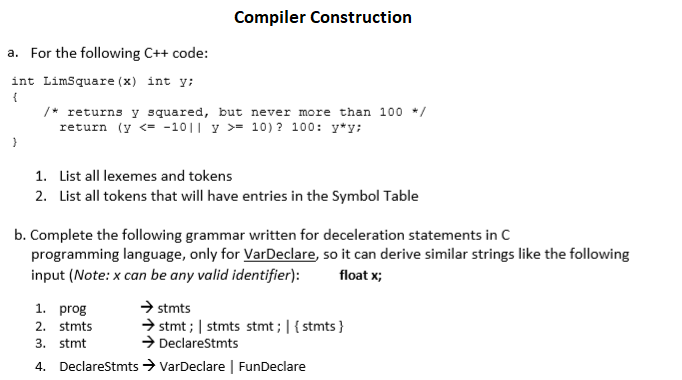
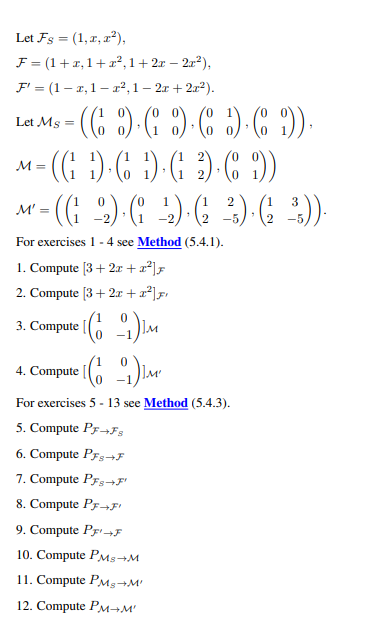
a. For the following C++ code: int LimSquare (x) int y; { } Compiler Construction /* returns y squared, but never more than 100 */ return (y = 10) ? 100: y*y; 1. List all lexemes and tokens 2. List all tokens that will have entries in the Symbol Table b. Complete the following grammar written for deceleration statements in C programming language, only for VarDeclare, so it can derive similar strings like the following input (Note: x can be any valid identifier): float x; 1. prog 2. stmts 3. stmt stmts stmt; | stmts stmt; | { stmts} DeclareStmts 4. DeclareStmts VarDeclare | FunDeclare Let Fs = (1,1, x), F = (1 + x, 1+z, 1+2r - 2r), F' = (1-z, 1-, 1-2x + 2x). Let Ms = (6 7) ( ) ( ) ( 9)), - (( ). ( ). ( )(9) M = ((12)( 2) (3) ( )). 2 -5 M' = For exercises 1 - 4 see Method (5.4.1). 1. Compute [3 + 2x + x] 2. Compute [3 + 2x + x] 3. Compute (1) 4. Compute M For exercises 5-13 see Method (5.4.3). 5. Compute PFFs 6. Compute PF+F 7. Compute PF+F 8. Compute PFF 9. Compute PF 10. Compute PMs+M 11. Compute PMs M' 12. Compute PM+M'
Step by Step Solution
There are 3 Steps involved in it

Get step-by-step solutions from verified subject matter experts
 Study Help