







Question: a Force Field Analysis on a specific problem/change within the organization of your choosing. Be sure to identify: the status quo the desired change forces
a Force Field Analysis on a specific problem/change within the organization of your choosing.
Be sure to identify:
- the status quo
- the desired change
- forces for the change
- forces against the change (i.e., those for the status quo)
- the most powerful of these forces
- what could be done to reduce the forces pushing for the status quo.
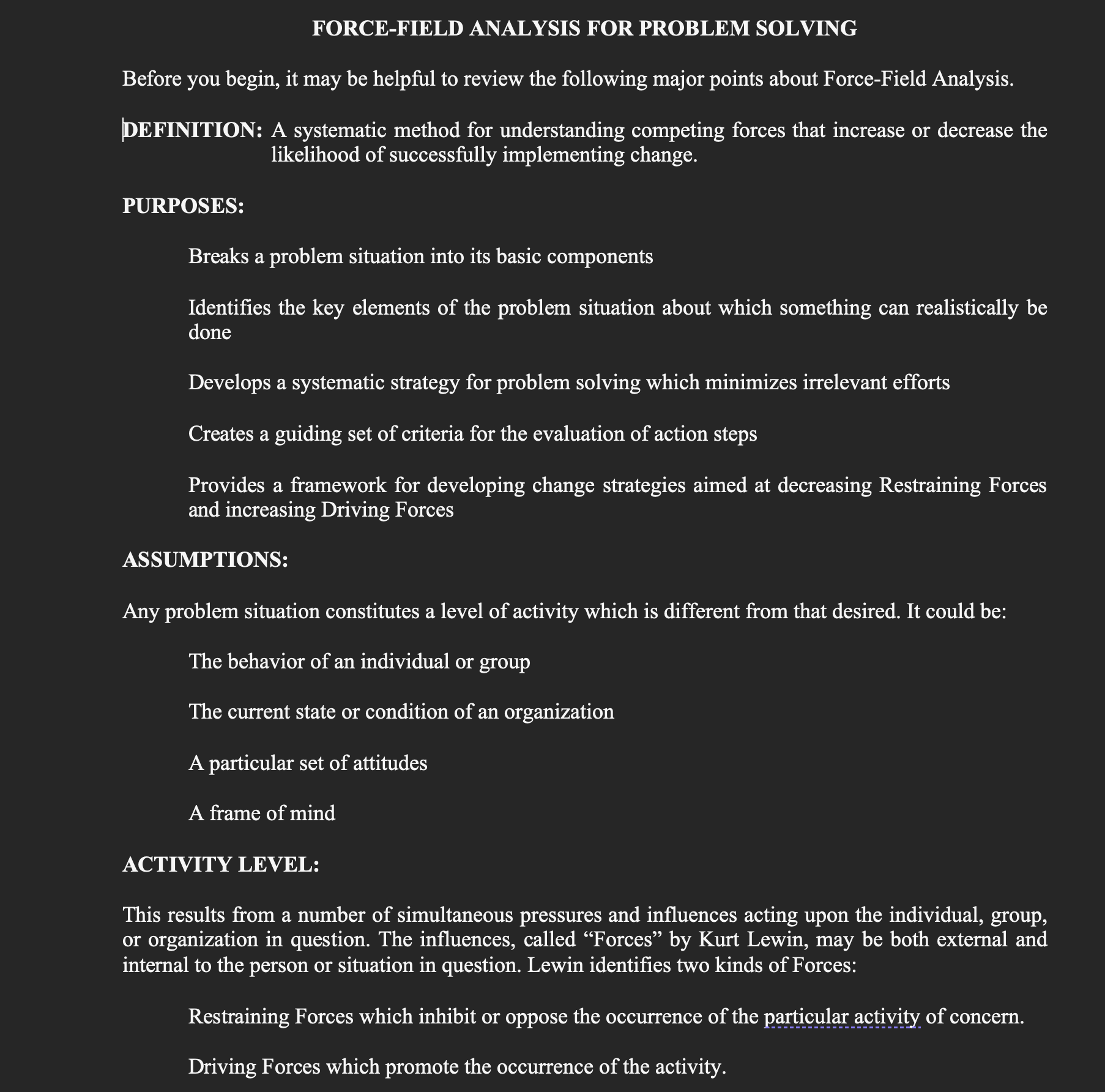
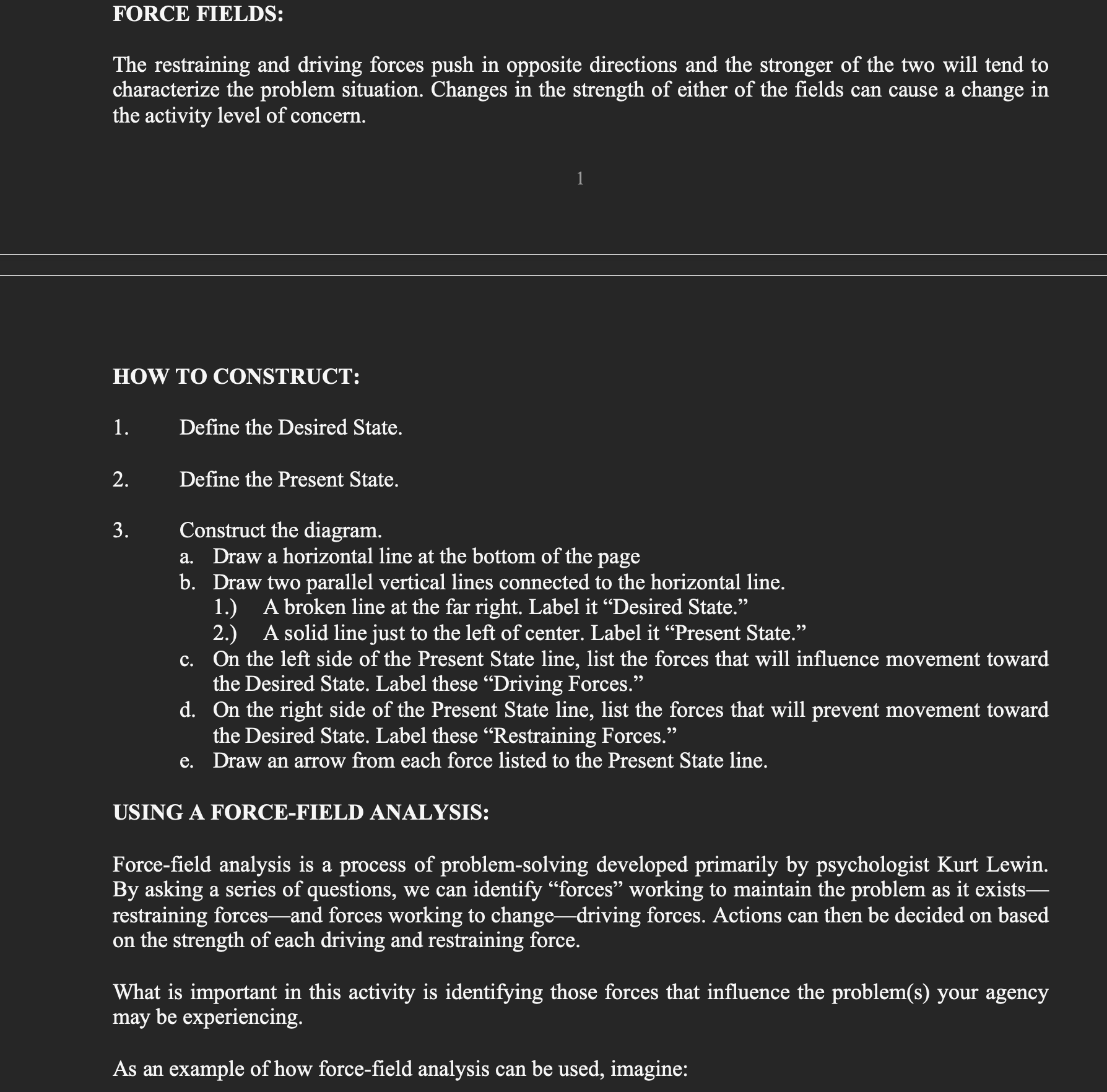
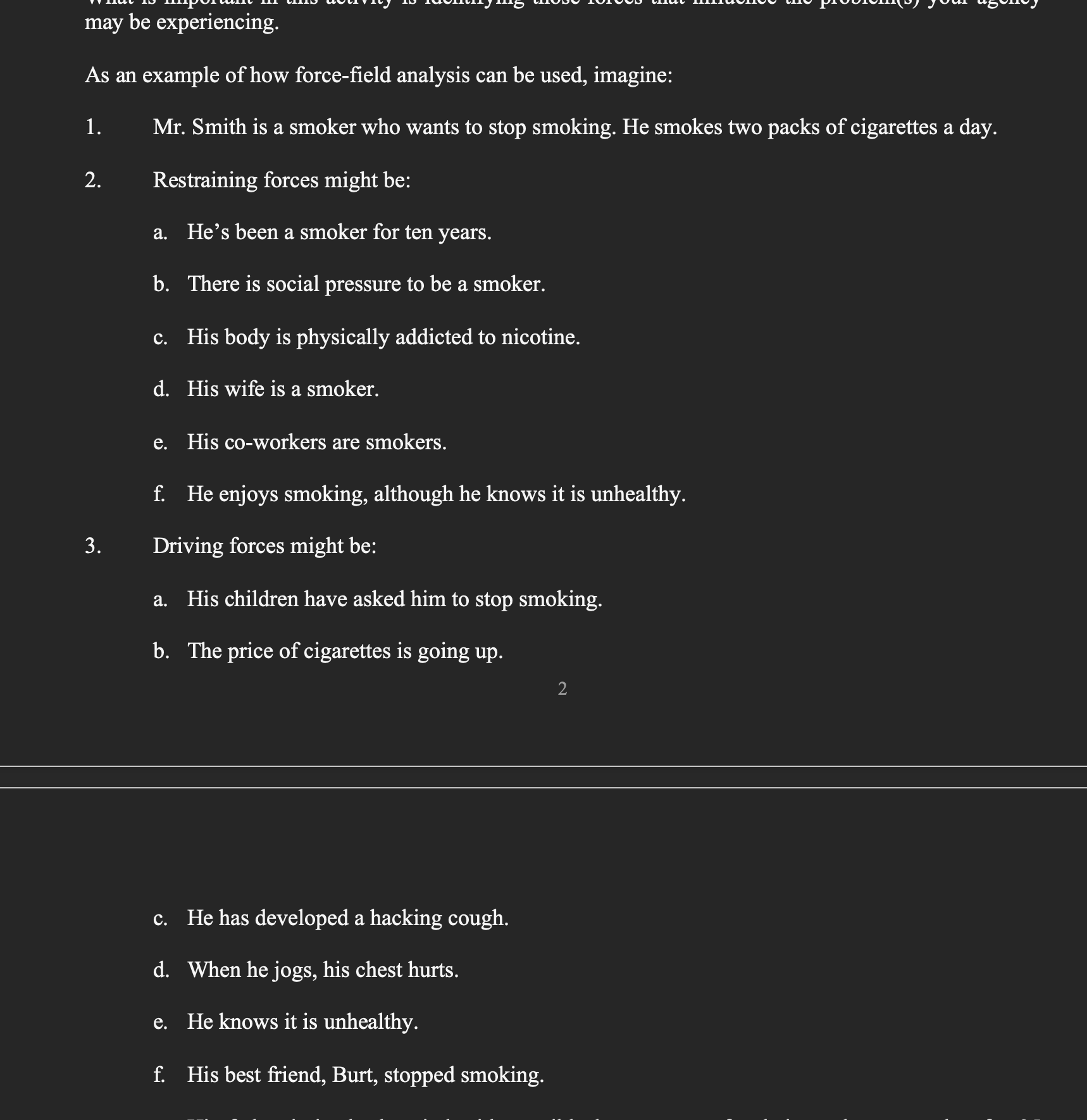
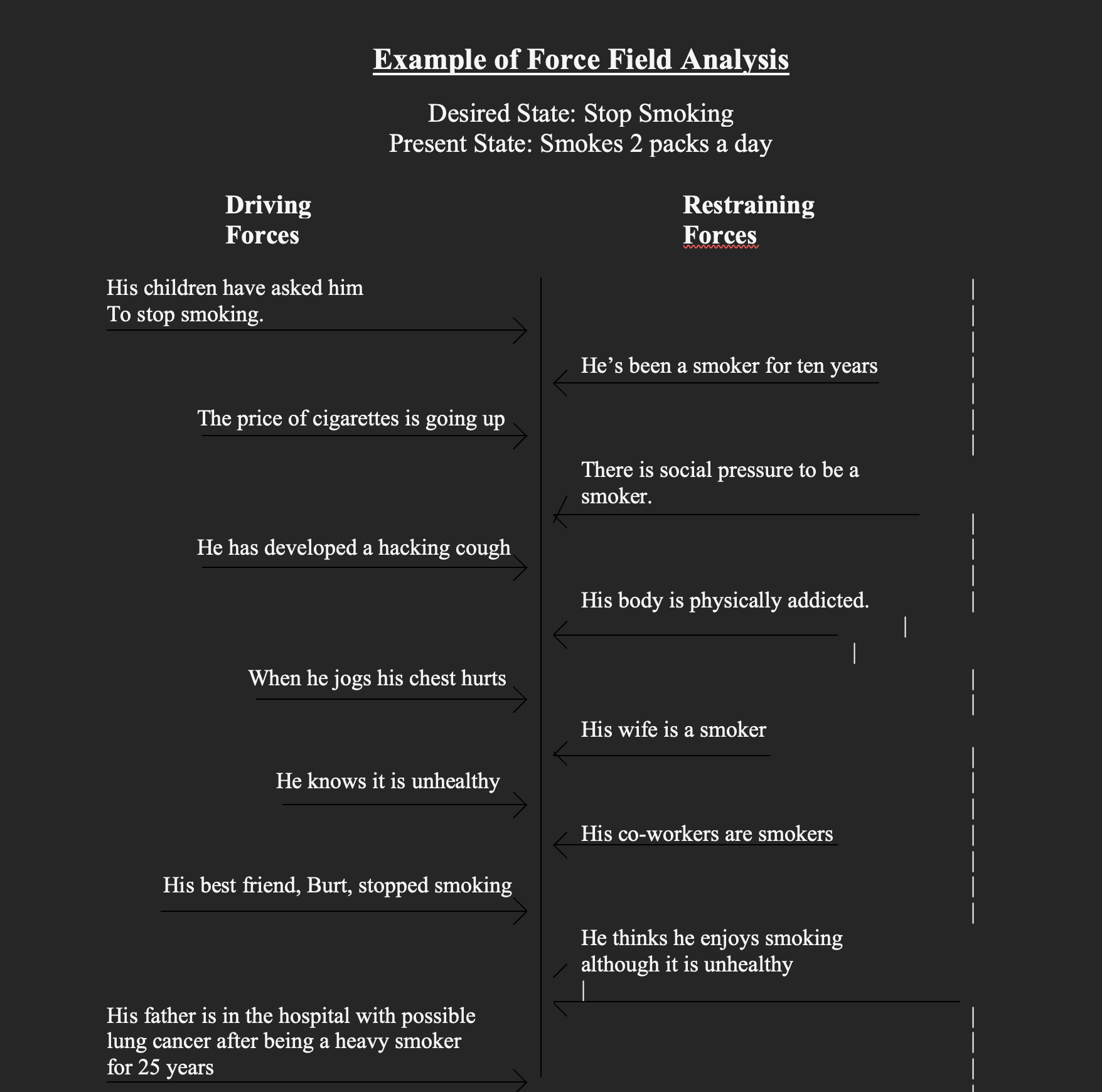
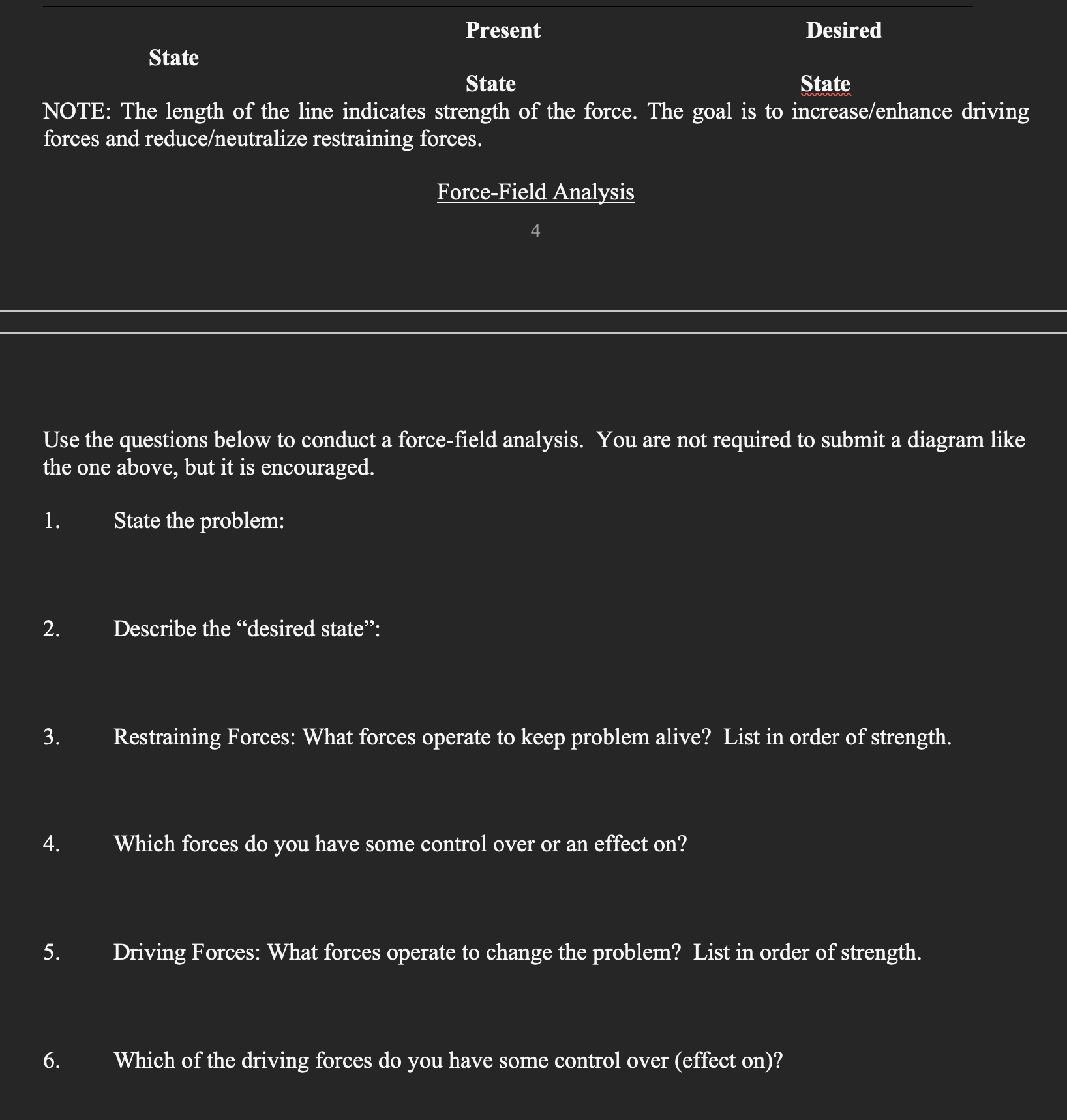
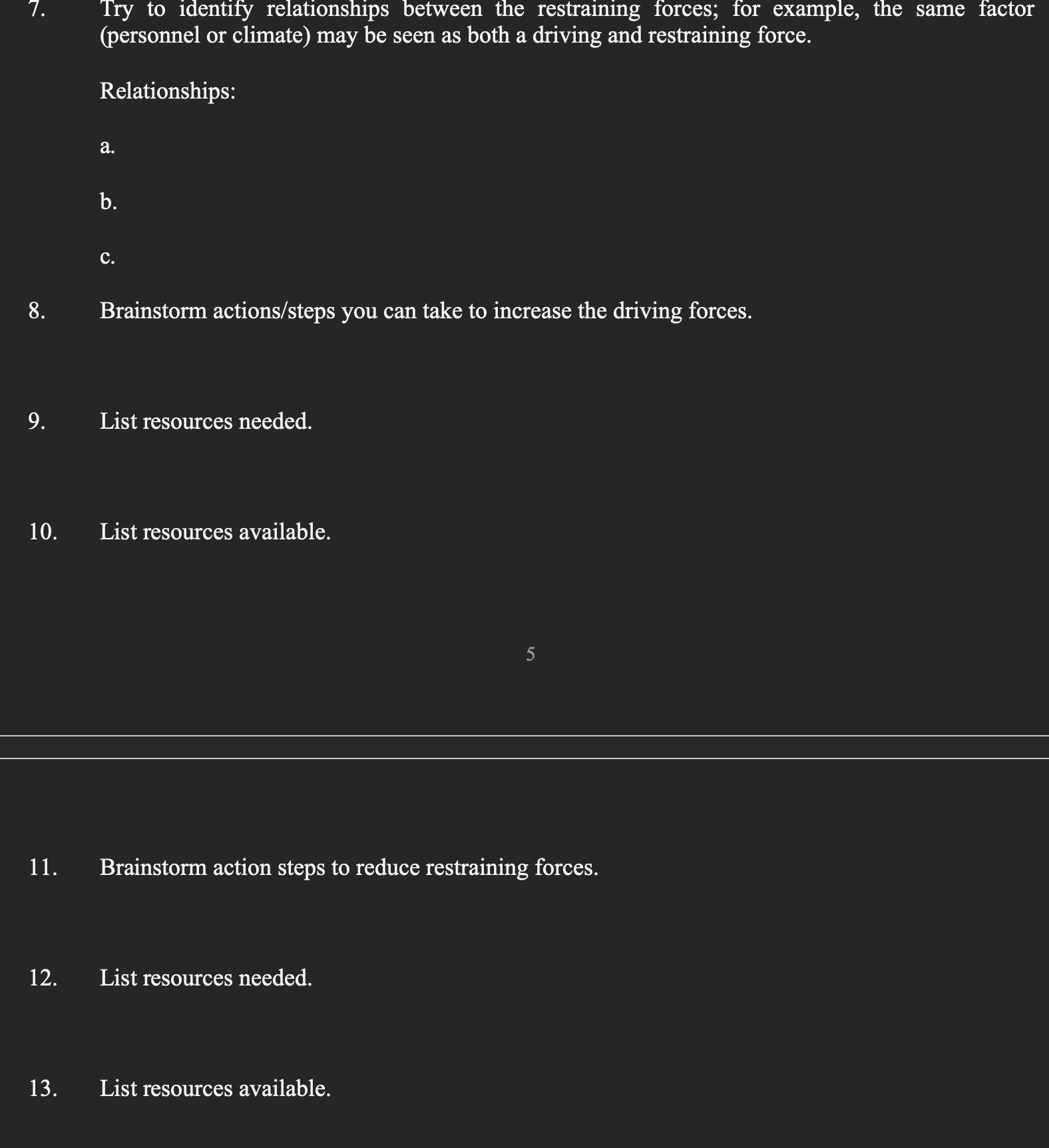
FORCE-FIELD ANALYSIS FOR PROBLEM SOLVING Before you begin, it may be helpful to review the following major points about Force-Field Analysis. IDEFINITION: A systematic method for understanding competing forces that increase or decrease the likelihood of successfully implementing change. PURPOSES: Breaks a problem situation into its basic components Identifies the key elements of the problem situation about which something can realistically be done Develops a systematic strategy for problem solving which minimizes irrelevant efforts Creates a guiding set of criteria for the evaluation of action steps Provides a framework for developing change strategies aimed at decreasing Restraining Forces and increasing Driving Forces ASSUMPTIONS: Any problem situation constitutes a level of activity which is different from that desired. It could be: The behavior of an individual or group The current state or condition of an organization A particular set of attitudes A frame of mind ACTIVITY LEVEL: This results from a number of simultaneous pressures and influences acting upon the individual, group, or organization in question. The influences, called \"Forces\" by Kurt Lewin, may be both external and internal to the person or situation in question. Lewin identifies two kinds of Forces: Restraining Forces which inhibit or oppose the occurrence of the particular activity of concern. Driving Forces which promote the occurrence of the activity. FORCE FIELDS: The restraining and driving forces push in opposite directions and the stronger of the two will tend to characterize the problem situation. Changes in the strength of either of the fields can cause a change in the activity level of concern. HOW TO CONSTRUCT: B Define the Desired State. 2. Define the Present State. Construct the diagram. a. Draw a horizontal line at the bottom of the page b. Draw two parallel vertical lines connected to the horizontal line. 1.) A broken line at the far right. Label it \"Desired State.\" 2.)) A solid line just to the left of center. Label it \"Present State.\" c. On the left side of the Present State line, list the forces that will influence movement toward the Desired State. Label these \"Driving Forces.\" d. On the right side of the Present State line, list the forces that will prevent movement toward the Desired State. Label these \"Restraining Forces.\" e. Draw an arrow from each force listed to the Present State line. USING A FORCE-FIELD ANALYSIS: Force-field analysis is a process of problem-solving developed primarily by psychologist Kurt Lewin. By asking a series of questions, we can identify \"forces\" working to maintain the problem as it exists restraining forcesand forces working to changedriving forces. Actions can then be decided on based on the strength of each driving and restraining force. What is important in this activity is identifying those forces that influence the problem(s) your agency may be experiencing. As an example of how force-field analysis can be used, imagine: may be experiencing. As an example of how force-field analysis can be used, imagine: I8 Mr. Smith is a smoker who wants to stop smoking. He smokes two packs of cigarettes a day. 2. Restraining forces might be: a. He's been a smoker for ten years. b. There is social pressure to be a smoker. His body is physically addicted to nicotine. . His wife is a smoker. e. His co-workers are smokers. f. He enjoys smoking, although he knows it is unhealthy. Driving forces might be: a. His children have asked him to stop smoking. b. The price of cigarettes is going up. He has developed a hacking cough. . When he jogs, his chest hurts. He knows it is unhealthy. His best friend, Burt, stopped smoking. Example of Force Field Analysis Desired State: Stop Smoking Present State: Smokes 2 packs a day Driving Restraining Forces Forces His children have asked him To stop smoking. He's been a smoker for ten years The price of cigarettes is going up There is social pressure to be a smoker. He has developed a hacking cough His body is physically addicted. When he jogs his chest hurts His wife is a smoker He knows it is unhealthy His co-workers are smokers His best friend, Burt, stopped smoking He thinks he enjoys smoking although it is unhealthy His father is in the hospital with possible lung cancer after being a heavy smoker for 25 yearsPresent ) 2031 State State State NOTE: The length of the line indicates strength of the force. The goal is to increase/enhance driving forces and reduceeutralize restraining forces. Force-Field Analysis i Use the questions below to conduct a force-field analysis. You are not required to submit a diagram like the one above, but it is encouraged. I8 State the problem: Describe the \"desired state: Restraining Forces: What forces operate to keep problem alive? List in order of strength. Which forces do you have some control over or an effect on? Driving Forces: What forces operate to change the problem? List in order of strength. Which of the driving forces do you have some control over (effect on)? Try to identify relationships between the restraining forces; for example, the same factor (personnel or climate) may be seen as both a driving and restraining force. Relationships: a. b. C. 8. Brainstorm actions/steps you can take to increase the driving forces. 9. List resources needed. 10. List resources available. 5 11. Brainstorm action steps to reduce restraining forces. 12. List resources needed. 13. List resources available
Step by Step Solution
There are 3 Steps involved in it

Get step-by-step solutions from verified subject matter experts
 Study Help