Question: please answer question 3 only. Thanks Case Study: Keller Technology Inc. Introduction Jan Rieter is the new Vice President of Human Resources for Keller Technology
 please answer question 3 only. Thanks
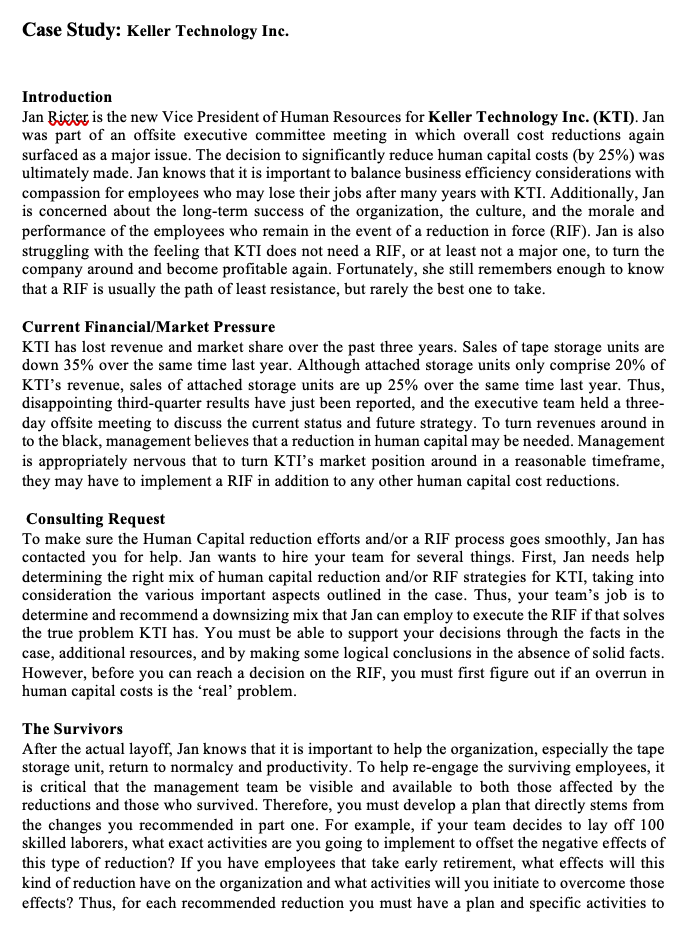
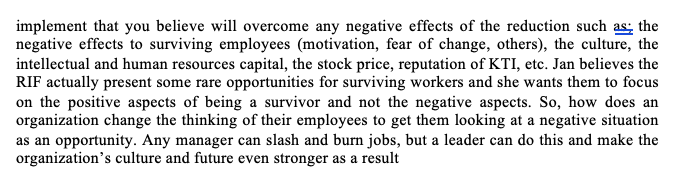
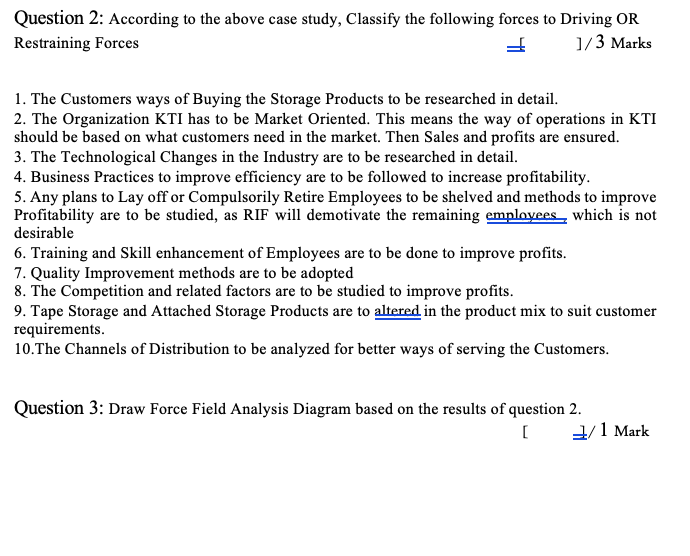
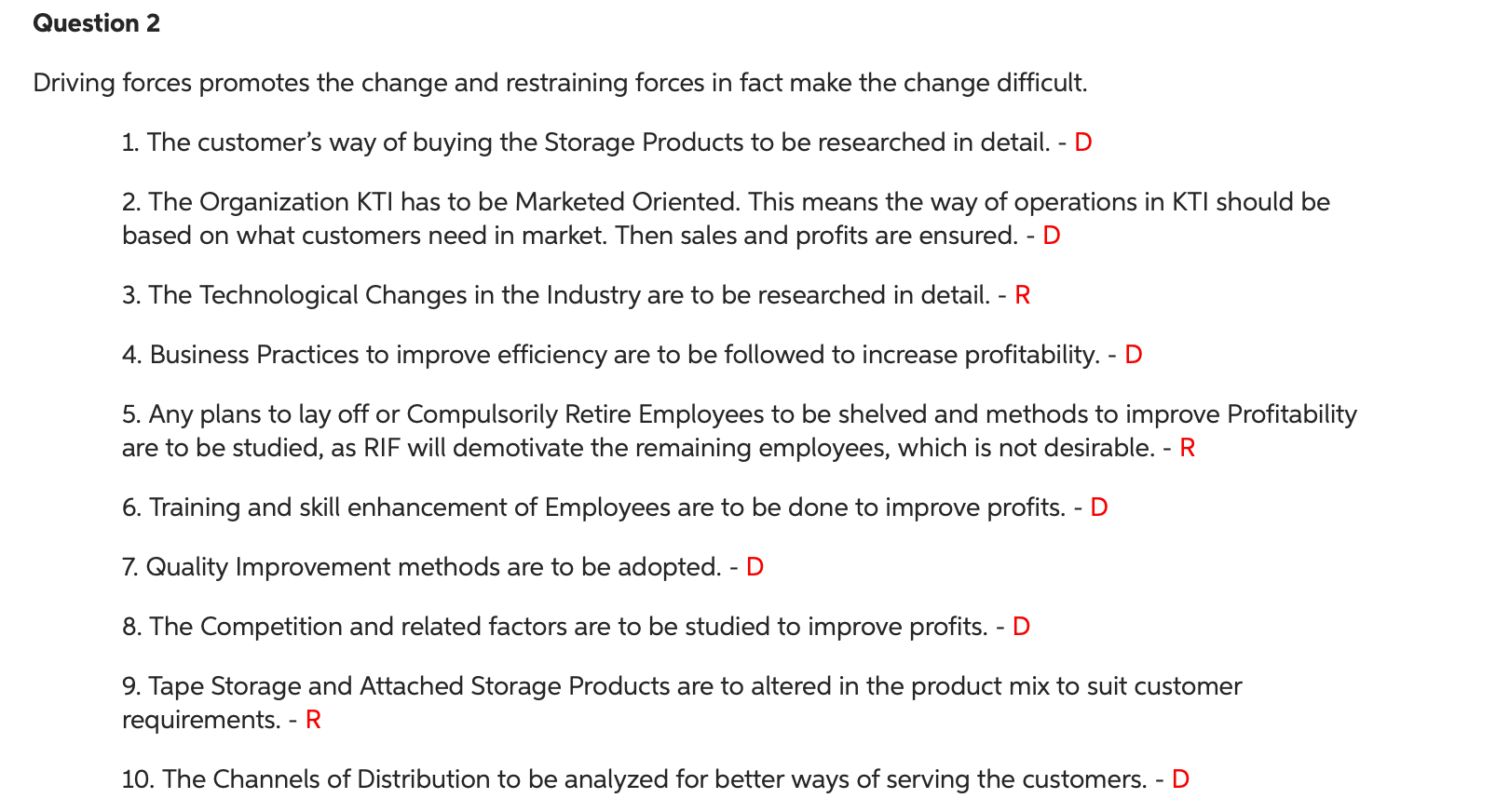
Case Study: Keller Technology Inc. Introduction Jan Rieter is the new Vice President of Human Resources for Keller Technology Inc. (KTT). Jan was part of an offsite executive committee meeting in which overall cost reductions again surfaced as a major issue. The decision to significantly reduce human capital costs (by 25%) was ultimately made. Jan knows that it is important to balance business efficiency considerations with compassion for employees who may lose their jobs after many years with KTI. Additionally, Jan is concerned about the long-term success of the organization, the culture, and the morale and performance of the employees who remain in the event of a reduction in force (RIF). Jan is also struggling with the feeling that KTI does not need a RIF, or at least not a major one, to turn the company around and become profitable again. Fortunately, she still remembers enough to know that a RIF is usually the path of least resistance, but rarely the best one to take. Current Financial/Market Pressure KTI has lost revenue and market share over the past three years. Sales of tape storage units are down 35% over the same time last year. Although attached storage units only comprise 20% of KTI's revenue, sales of attached storage units are up 25% over the same time last year. Thus, disappointing third-quarter results have just been reported, and the executive team held a three- day offsite meeting to discuss the current status and future strategy. To turn revenues around in to the black, management believes that a reduction in human capital may be needed. Management is appropriately nervous that to turn KTI's market position around in a reasonable timeframe, they may have to implement a RIF in addition to any other human capital cost reductions. Consulting Request To make sure the Human Capital reduction efforts and/or a RIF process goes smoothly, Jan has contacted you for help. Jan wants to hire your team for several things. First, Jan needs help determining the right mix of human capital reduction and/or RIF strategies for KTI, taking into consideration the various important aspects outlined in the case. Thus, your team's job is to determine and recommend a downsizing mix that Jan can employ to execute the RIF if that solves the true problem KTI has. You must be able to support your decisions through the facts in the case, additional resources, and by making some logical conclusions in the absence of solid facts. However, before you can reach a decision on the RIF, you must first figure out if an overrun in human capital costs is the 'real' problem. The Survivors After the actual layoff, Jan knows that it is important to help the organization, especially the tape storage unit, return to normalcy and productivity. To help re-engage the surviving employees, it is critical that the management team be visible and available to both those affected by the reductions and those who survived. Therefore, you must develop a plan that directly stems from the changes you recommended in part one. For example, if your team decides to lay off 100 skilled laborers, what exact activities are you going to implement to offset the negative effects of this type of reduction? If you have employees that take early retirement, what effects will this kind of reduction have on the organization and what activities will you initiate to overcome those effects? Thus, for each recommended reduction you must have a plan and specific activities to implement that you believe will overcome any negative effects of the reduction such as the negative effects to surviving employees (motivation, fear of change, others), the culture, the intellectual and human resources capital, the stock price, reputation of KTI, etc. Jan believes the RIF actually present some rare opportunities for surviving workers and she wants them to focus on the positive aspects of being a survivor and not the negative aspects. So, how does an organization change the thinking of their employees to get them looking at a negative situation as an opportunity. Any manager can slash and burn jobs, but a leader can do this and make the organization's culture and future even stronger as a result Question 2: According to the above case study, Classify the following forces to Driving OR Restraining Forces 1/3 Marks 1. The Customers ways of Buying the Storage Products to be researched in detail. 2. The Organization KTI has to be Market Oriented. This means the way of operations in KTI should be based on what customers need in the market. Then Sales and profits are ensured. 3. The Technological Changes in the Industry are to be researched in detail. 4. Business Practices to improve efficiency are to be followed to increase profitability. 5. Any plans to Lay off or Compulsorily Retire Employees to be shelved and methods to improve Profitability are to be studied, as RIF will demotivate the remaining employees, which is not desirable 6. Training and Skill enhancement of Employees are to be done to improve profits. 7. Quality Improvement methods are to be adopted 8. The Competition and related factors are to be studied to improve profits. 9. Tape Storage and Attached Storage Products are to altered in the product mix to suit customer requirements. 10. The Channels of Distribution to be analyzed for better ways of serving the Customers. Question 3: Draw Force Field Analysis Diagram based on the results of question 2. [ 2/1 Mark Question 2 Driving forces promotes the change and restraining forces in fact make the change difficult. 1. The customer's way of buying the Storage Products to be researched in detail. - D 2. The Organization KTI has to be Marketed Oriented. This means the way of operations in KTI should be based on what customers need in market. Then sales and profits are ensured. - D 3. The Technological Changes in the Industry are to be researched in detail. - R 4. Business Practices to improve efficiency are to be followed to increase profitability. - D 5. Any plans to lay off or Compulsorily Retire Employees to be shelved and methods to improve Profitability are to be studied, as RIF will demotivate the remaining employees, which is not desirable. - R 6. Training and skill enhancement of Employees are to be done to improve profits. - D 7. Quality Improvement methods are to be adopted. - D 8. The Competition and related factors are to be studied to improve profits. -D 9. Tape Storage and Attached Storage Products are to altered in the product mix to suit customer requirements. - R 10. The Channels of Distribution to be analyzed for better ways of serving the customers. - D









 Study Help