







Question: A function f and a point P are given. Let 6 correspond to the direction of the directional derivative. Complete parts (a) through (e). f(xy)
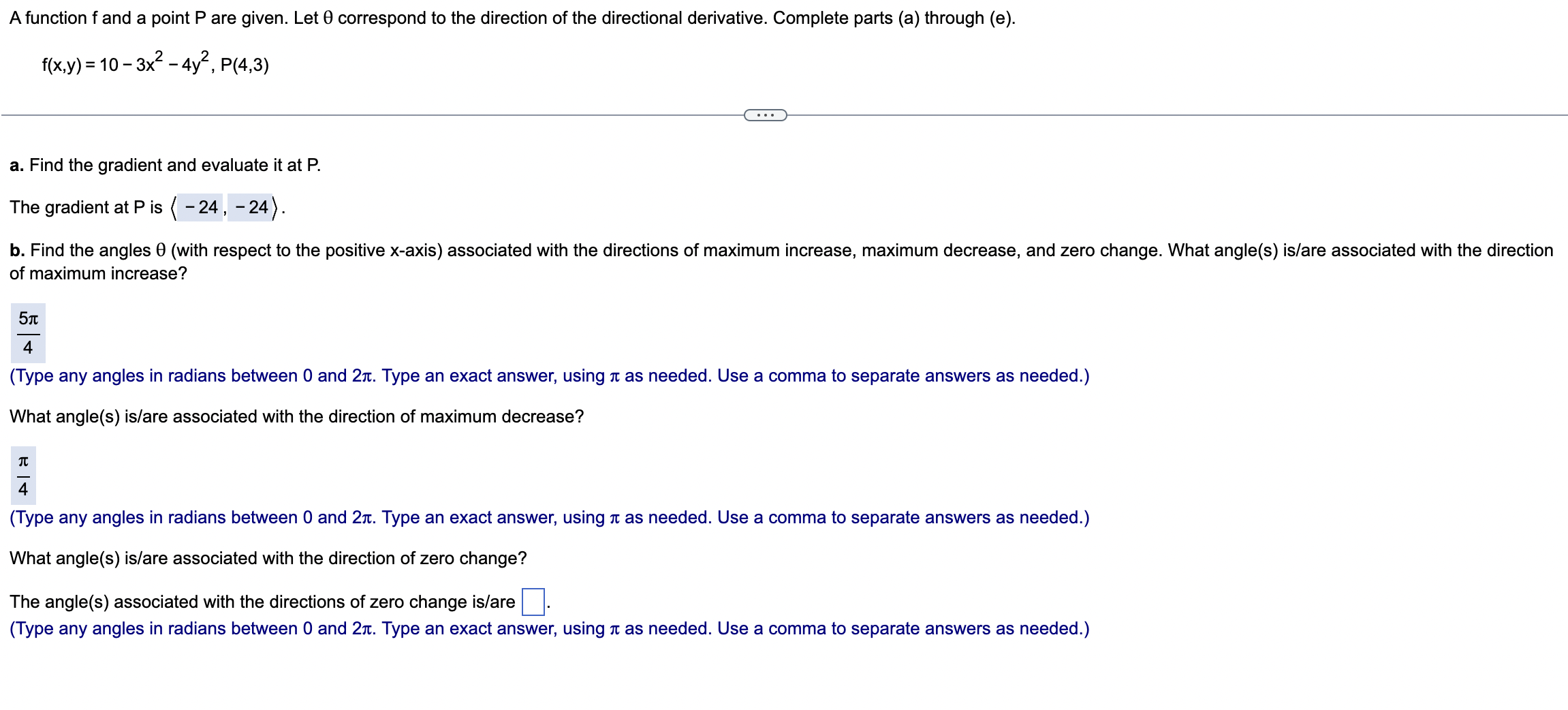
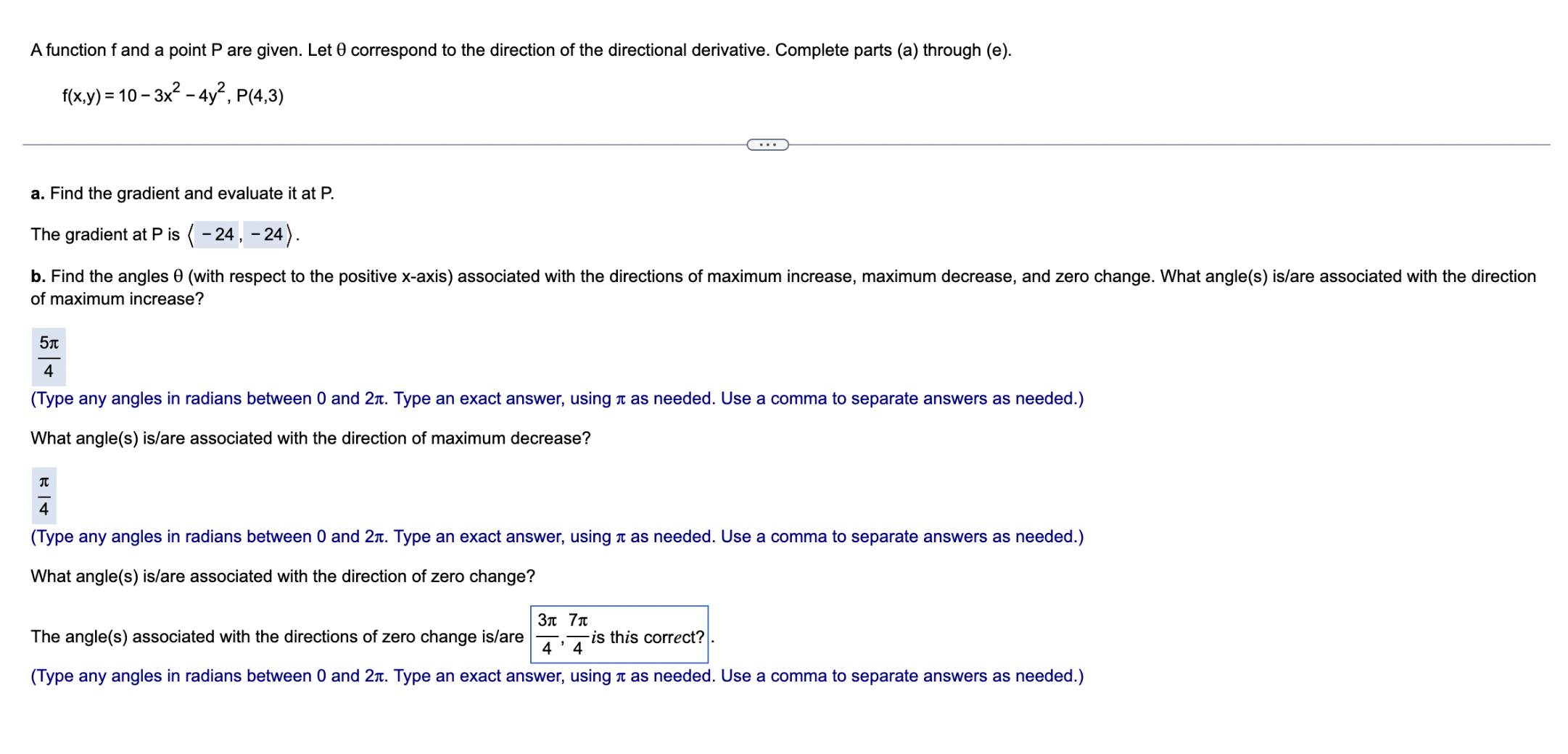
A function f and a point P are given. Let 6 correspond to the direction of the directional derivative. Complete parts (a) through (e). f(xy) =10 - 3x - 4y%, P(4,3) a. Find the gradient and evaluate it at P. The gradientat Pis ( =24, -24). b. Find the angles 0 (with respect to the positive x-axis) associated with the directions of maximum increase, maximum decrease, and zero change. What angle(s) is/are associated with the direction of maximum increase? 5n 4 (Type any angles in radians between 0 and 2x. Type an exact answer, using & as needed. Use a comma to separate answers as needed.) What angle(s) is/are associated with the direction of maximum decrease? b1 4 (Type any angles in radians between 0 and 2x. Type an exact answer, using & as needed. Use a comma to separate answers as needed.) What angle(s) is/are associated with the direction of zero change? The angle(s) associated with the directions of zero change is/are | |. (Type any angles in radians between 0 and 2x. Type an exact answer, using & as needed. Use a comma to separate answers as needed.) A function f and a point P are given. Let 6 correspond to the direction of the directional derivative. Complete parts (a) through (e). fix,y) = 10 - 3% - 4y, P(4,3) a. Find the gradient and evaluate it at P. The gradient at Pis { 24, 24). b. Find the angles 6 (with respect to the positive x-axis) associated with the directions of maximum increase, maximum decrease, and zero change. What angle(s) is/are associated with the direction of maximum increase? 5n 4 (Type any angles in radians between 0 and 2x. Type an exact answer, using & as needed. Use a comma to separate answers as needed.) What angle(s) is/are associated with the direction of maximum decrease? T 4 (Type any angles in radians between 0 and 2x. Type an exact answer, using & as needed. Use a comma to separate answers as needed.) What angle(s) is/are associated with the direction of zero change? 3n Tn The angle(s) associated with the directions of zero change is/are T'Tis this correct?|. (Type any angles in radians between 0 and 2z. Type an exact answer, using as needed. Use a comma to separate answers as needed.)
Step by Step Solution
There are 3 Steps involved in it

Get step-by-step solutions from verified subject matter experts
 Study Help