







Question: A function is said to have a vertical asymptote wherever the limit on the left or right (or both) is either positive or negative
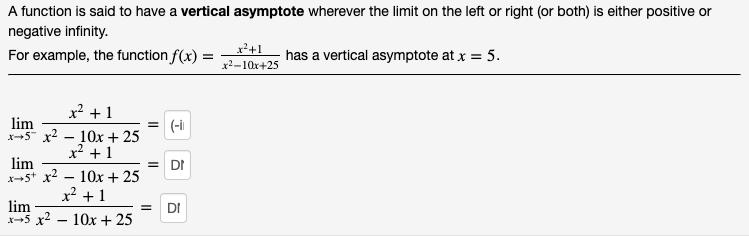
A function is said to have a vertical asymptote wherever the limit on the left or right (or both) is either positive or negative infinity. For example, the function f(x) = x+1 x-10x+25 has a vertical asymptote at x = 5. lim x+1 x-5x210x + 25 x+1 = (-i lim = DI = 10x + 25 lim x+1 x-5x210x + 25 DI
Step by Step Solution
There are 3 Steps involved in it
1 Expert Approved Answer
Step: 1 Unlock

Question Has Been Solved by an Expert!
Get step-by-step solutions from verified subject matter experts
Step: 2 Unlock
Step: 3 Unlock
 Study Help