







Question: a. Given the classical sets, A = (9, 5, 6, 8, 10) B = (1, 2, 3, 7, 9) C = (1, 0) defined
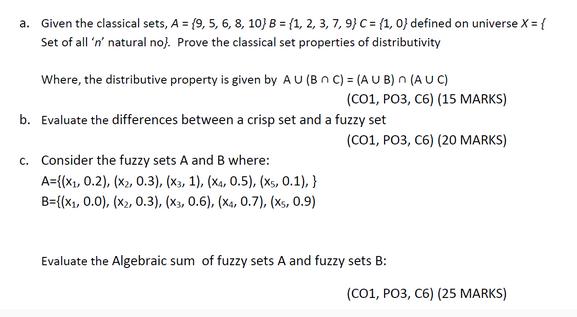
a. Given the classical sets, A = (9, 5, 6, 8, 10) B = (1, 2, 3, 7, 9) C = (1, 0) defined on universe X = { Set of all 'n' natural no). Prove the classical set properties of distributivity Where, the distributive property is given by AU (Bn C) = (AUB) n (AUC) (CO1, PO3, C6) (15 MARKS) b. Evaluate the differences between a crisp set and a fuzzy set c. Consider the fuzzy sets A and B where: A={(x1, 0.2), (x2, 0.3), (X3, 1), (x4, 0.5), (X5, 0.1), } B={(x1, 0.0), (x2, 0.3), (X3, 0.6), (x4, 0.7), (X5, 0.9) (CO1, PO3, C6) (20 MARKS) Evaluate the Algebraic sum of fuzzy sets A and fuzzy sets B: (C01, PO3, C6) (25 MARKS)
Step by Step Solution
There are 3 Steps involved in it

Get step-by-step solutions from verified subject matter experts
 Study Help