







Question: (a) Given the dependent variable, what type of regression model has the analyst estimated? What does the estimated dependent variable measure? (b) Test the overall
(a)Given the dependent variable, what type of regression model has the analyst estimated? What does the estimated dependent variable measure?
(b)Test the overall significance of the model at the 1% significance level. What are the hypotheses, the statistical decision and the conclusion? Be precise.
(c)How well does this model fit to the data? Is the model likely to be useful in predicting whether a man was arrested in 1986? Explain your answer.
(d)Do the slope estimates have the signs you would expect? Why or why not? Develop and test appropriate hypotheses concerning the slope coefficients usingt-tests at the 5% significance level. What do you conclude?
(e)Carefully explain the meanings of the slope coefficients that you deemed significant at the 5% level in the expected direction.
(f)Estimate the probability of being arrested in 1986 for a Californian man who was never arrested and sentenced before and was legally employed throughout 1985.
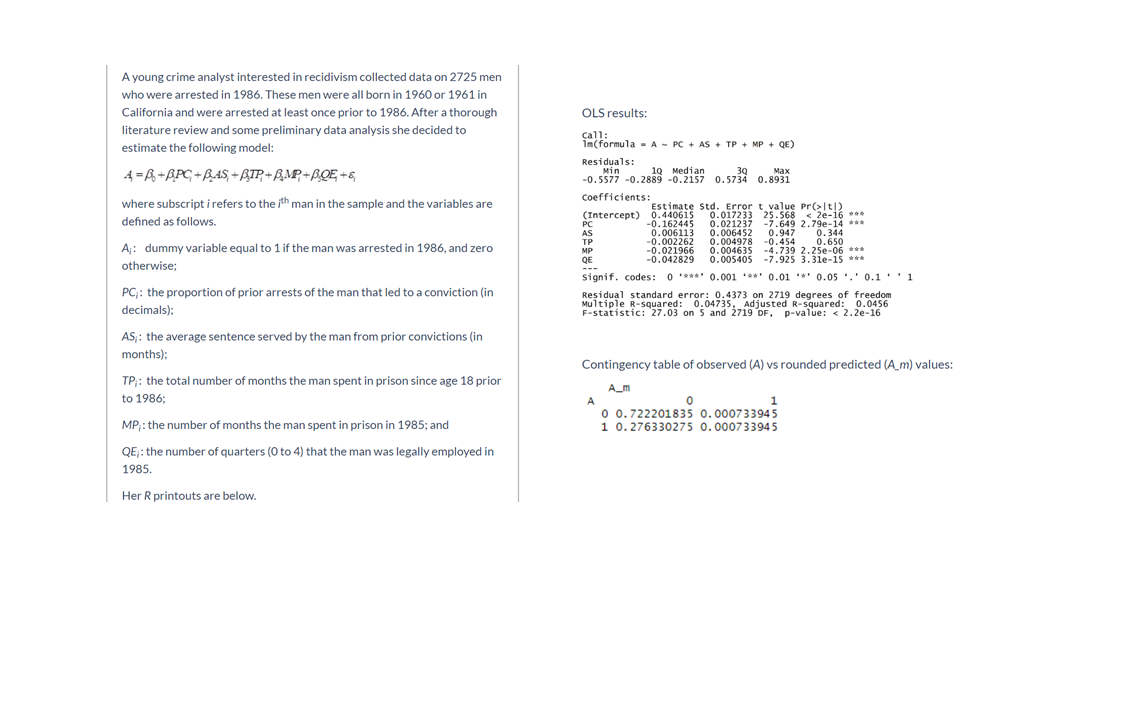
A young crime analyst interested in recidivism collected data on 2725 men who were arrested in 1986. These men were all born in 1960 or 1961 in California and were arrested at least once prior to 1986. After a thorough OLS results: literature review and some preliminary data analysis she decided to estimate the following model: Im(formula = A ~ PC + AS + TP + MP + QE) Residuals: A = A+APC +BAS, +ATP+AMP+BOE +5, Min 1Q Median Max -0.5577 -0.2889 -0.2157 0.5734 0.8931 where subscript i refers to the ith man in the sample and the variables are Coefficients: (Intercept) Estimate Std. Error t value Pr(alt!) defined as follows. 0. 440615 -0. 162445 0.017233 0. 006113 0.021237 25.568
Step by Step Solution
There are 3 Steps involved in it

Get step-by-step solutions from verified subject matter experts
 Study Help