







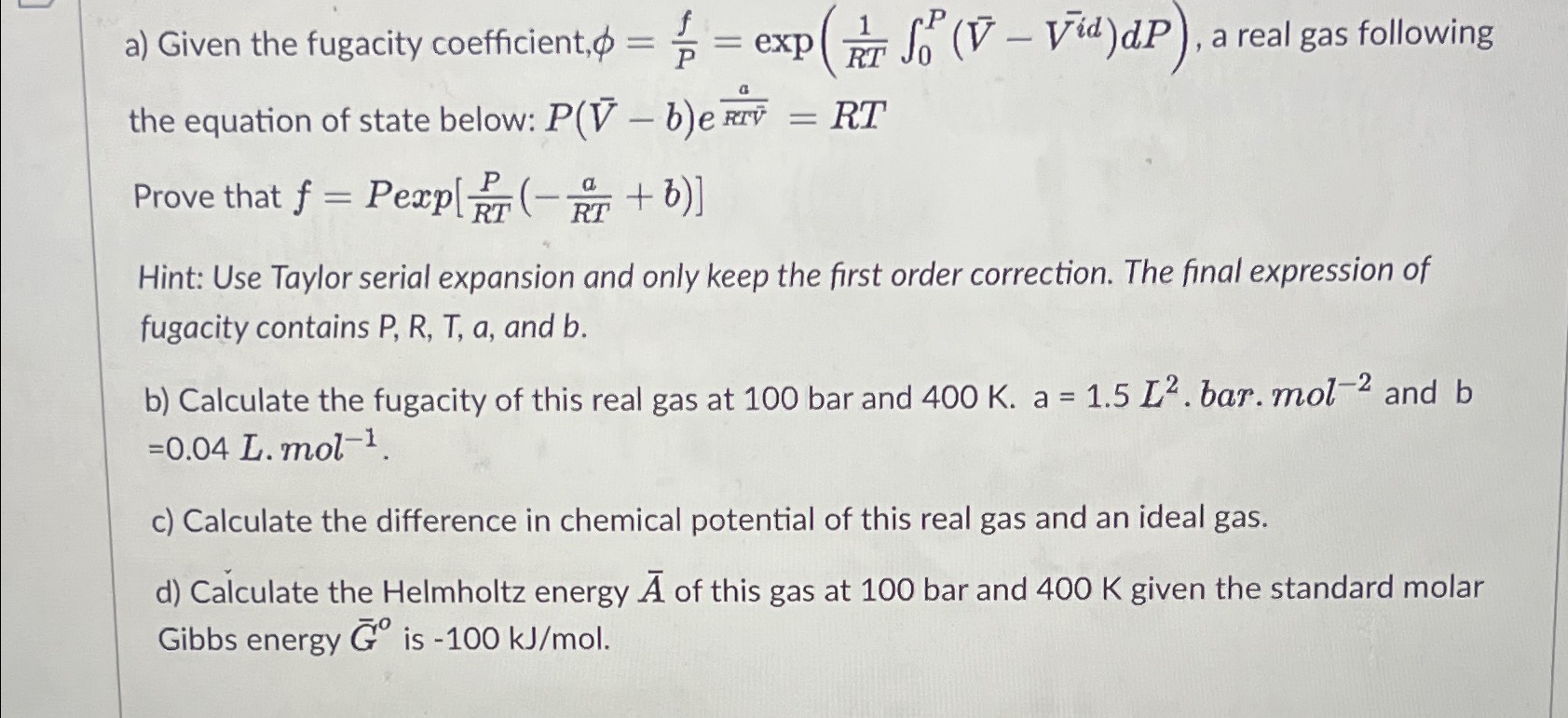
Question: a ) Given the fugacity coefficient, = f P = exp ( 1 R T 0 P ( ( ? b a r ( V
a Given the fugacity coefficient, exp a real gas following the equation of state below:
Prove that Pexp
Hint: Use Taylor serial expansion and only keep the first order correction. The final expression of fugacity contains and
b Calculate the fugacity of this real gas at bar and a bar. and b
c Calculate the difference in chemical potential of this real gas and an ideal gas.
d Calculate the Helmholtz energy of this gas at bar and given the standard molar Gibbs energy is
Step by Step Solution
There are 3 Steps involved in it
1 Expert Approved Answer
Step: 1 Unlock

Question Has Been Solved by an Expert!
Get step-by-step solutions from verified subject matter experts
Step: 2 Unlock
Step: 3 Unlock
 Study Help