



Question: (a) H() = F{h(t)} is an ideal low-pass filter with H(u) = AT for max < l < max and H(u) = 0 otherwise.
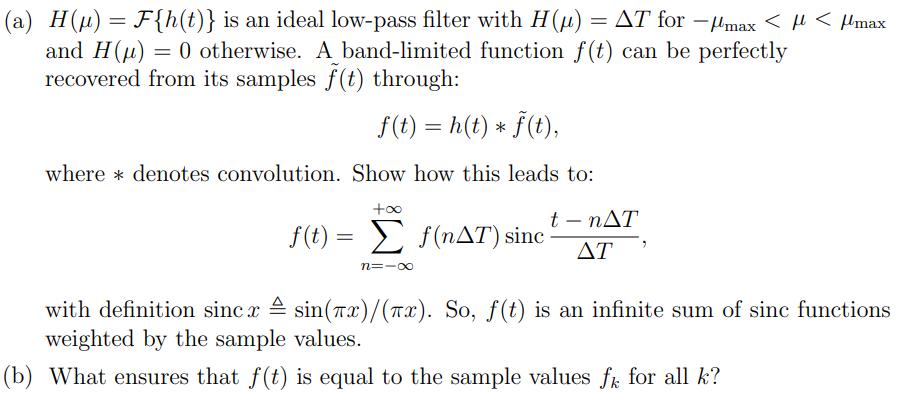
(a) H() = F{h(t)} is an ideal low-pass filter with H(u) = AT for max < l < max and H(u) = 0 otherwise. A band-limited function f(t) can be perfectly recovered from its samples f(t) through: f(t) = h(t) * f(t), where denotes convolution. Show how this leads to: + f(t) = f(n) sinc 8=1x t-nAT " with definition sincx = sin(x)/(x). So, f(t) is an infinite sum of sinc functions weighted by the sample values. (b) What ensures that f(t) is equal to the sample values fk for all k?
Step by Step Solution
There are 3 Steps involved in it
1 Expert Approved Answer
Step: 1 Unlock

Answe... View full answer
Question Has Been Solved by an Expert!
Get step-by-step solutions from verified subject matter experts
Step: 2 Unlock
Step: 3 Unlock