







Question: A hemispherical igloo in the Arctic has an inner radius r i = 4 m and is composed of a composite wall of hardwood tiles
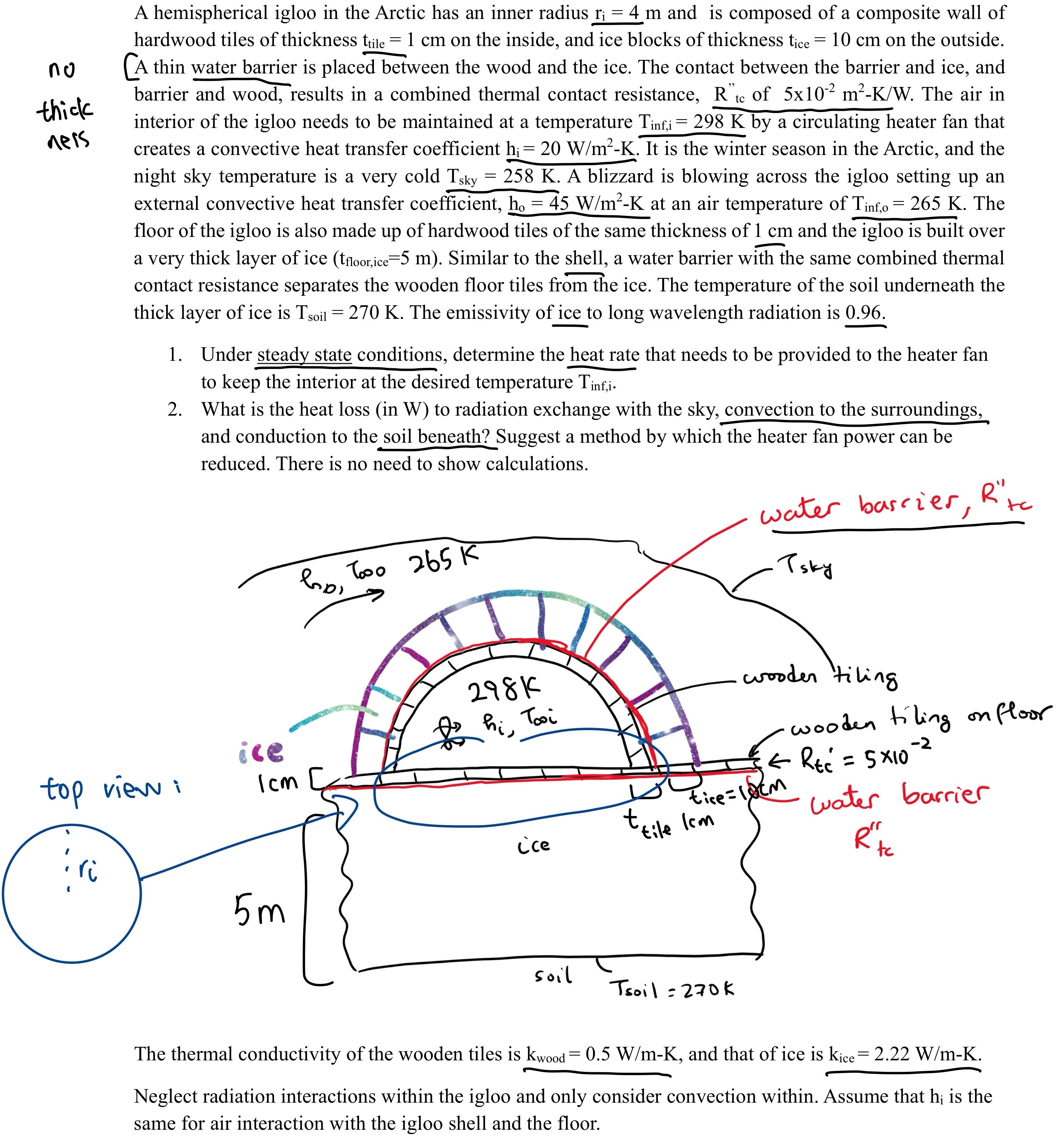
A hemispherical igloo in the Arctic has an inner radius and is composed of a composite wall of hardwood tiles of thickness on the inside, and ice blocks of thickness on the outside.
no
A A thin water barrier is placed between the wood and the ice. The contact between the barrier and ice, and thick barrier and wood, results in a combined thermal contact resistance, of The air in interior of the igloo needs to be maintained at a temperature by a circulating heater fan that creates a convective heat transfer coefficient It is the winter season in the Arctic, and the external convective heat transfer coefficient, at an air temperature of The floor of the igloo is also made up of hardwood tiles of the same thickness of cm and the igloo is built over a very thick layer of ice Similar to the shell, a water barrier with the same combined thermal contact resistance separates the wooden floor tiles from the ice. The temperature of the soil underneath the thick layer of ice is The emissivity of ice to long wavelength radiation is
Under steady state conditions, determine the heat rate that needs to be provided to the heater fan to keep the interior at the desired temperature
What is the heat loss in W to radiation exchange with the sky convection to the surroundings, and conduction to the soil beneath? Suggest a method by which the heater fan power can be reduced. There is no need to show calculations.
The thermal conductivity of the wooden tiles is and that of ice is
Neglect radiation interactions within the igloo and only consider convection within. Assume that is the same for air interaction with the igloo shell and the floor.
Step by Step Solution
There are 3 Steps involved in it
1 Expert Approved Answer
Step: 1 Unlock

Question Has Been Solved by an Expert!
Get step-by-step solutions from verified subject matter experts
Step: 2 Unlock
Step: 3 Unlock
 Study Help