







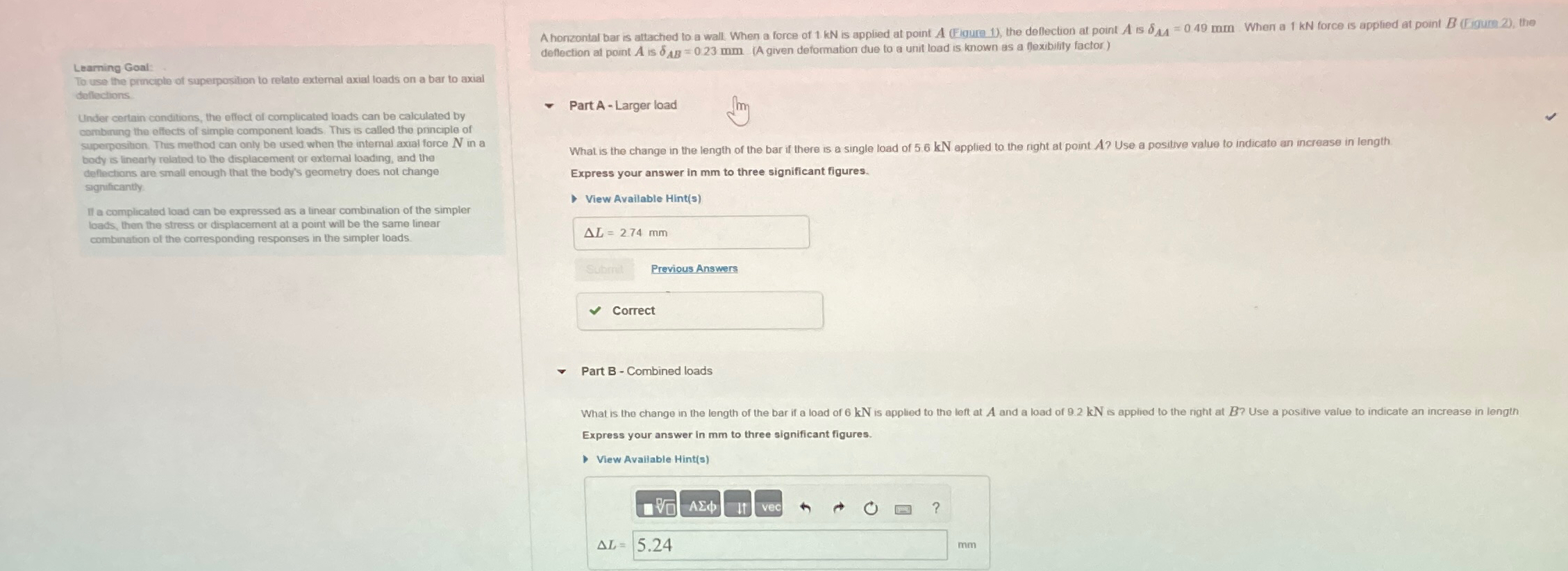
Question: A horizontal bar is attached to a wall. When a force of 1 k N is applsed at point A ( Figure 1 ) ,
A horizontal bar is attached to a wall. When a force of is applsed at point Figure the deflection at point is When a force is applied at point figure the
Learning Goal:
To use the principle of superposition to relate external axial loads on a bar to axial dieflections
Under certain conditions, the effect of complicated loads can be calculated by combining the effects of simple component loads. This is called the principle of superposition. This method can only be used when the intemal axial force in a body is linearty relatod to the displacement or extemal loading, and the deflections are small enough that the body's geometry does not change significantly.
II a complicated load can be expressed as a linear combination of the simpler loads, then the stress or displacement at a point will be the same linear combination of the corresponding responses in the simpter toads
deflection at point is A given deformation due to a unit load is known as a flexibifity factor
Part A Larger load
What is the change in the length of the bar if there is a single load of applied to the right at point Use a positive value to indicate an increase in length
Express your answer in to three significant figures.
Part B Combined loads
What is the change in the length of the bar if a load of is applied to the left at A and a load of is applied to the right at Use a positive value to indicate an increase in length Express your answer in to three significant figures.
Only Part B please
Step by Step Solution
There are 3 Steps involved in it
1 Expert Approved Answer
Step: 1 Unlock

Question Has Been Solved by an Expert!
Get step-by-step solutions from verified subject matter experts
Step: 2 Unlock
Step: 3 Unlock
 Study Help