



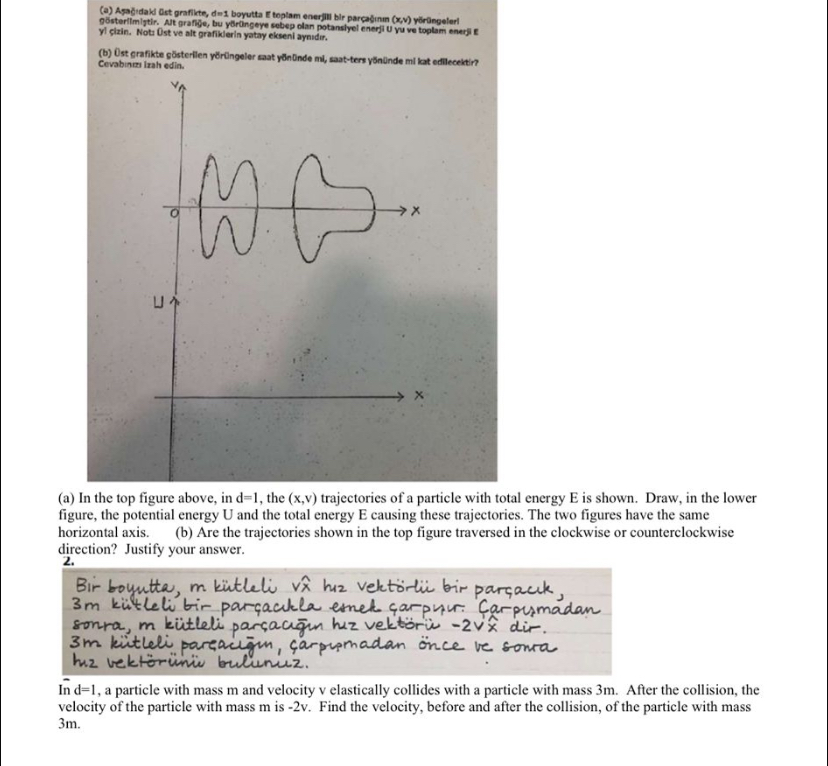
Question: ( a ) In the top figure above, in ( mathrm { d } = 1 ) , the ( (
a In the top figure above, in mathrmd the mathrmxmathrmv trajectories of a particle with total energy E is shown. Draw, in the lower figure, the potential energy U and the total energy E causing these trajectories. The two figures have the same horizontal axis. b Are the trajectories shown in the top figure traversed in the clockwise or counterclockwise direction? Justify your answer.
Bir boyntta, m kuthelic v hatx hiz veltoilii bir pargacik, m kitleli' bir pargacula emeh garphur. Carpusmadan sonra, m ktleli parsacigin haz vektriu v hatx dir. m kiutleli pareacigm, carpurmadan nce ve sowra huz vektoriunic bulunuz.
In mathrmd a particle with mass m and velocity v elastically collides with a particle with mass m After the collision, the velocity of the particle with mass m is v Find the velocity, before and after the collision, of the particle with mass m
Step by Step Solution
There are 3 Steps involved in it
1 Expert Approved Answer
Step: 1 Unlock

Question Has Been Solved by an Expert!
Get step-by-step solutions from verified subject matter experts
Step: 2 Unlock
Step: 3 Unlock