







Question: (a) Insertion Sort (b) Selection Sort (c) Merge Sort Even before we give a robust analysis of Quick Sort, we know a significant lower bound
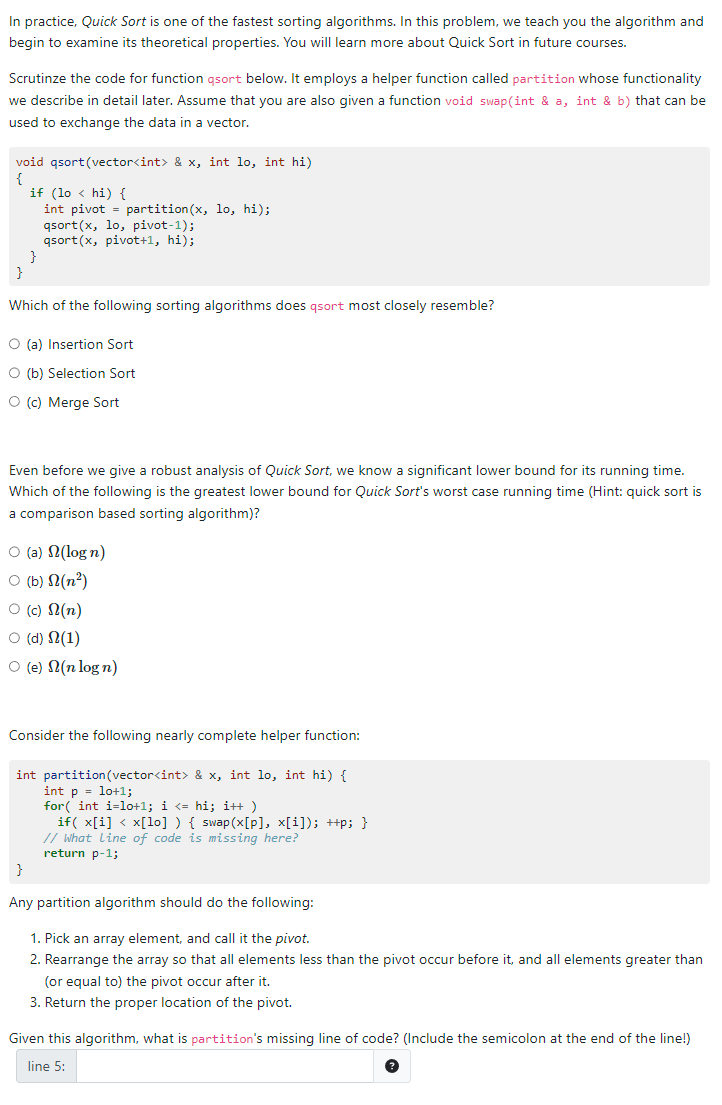
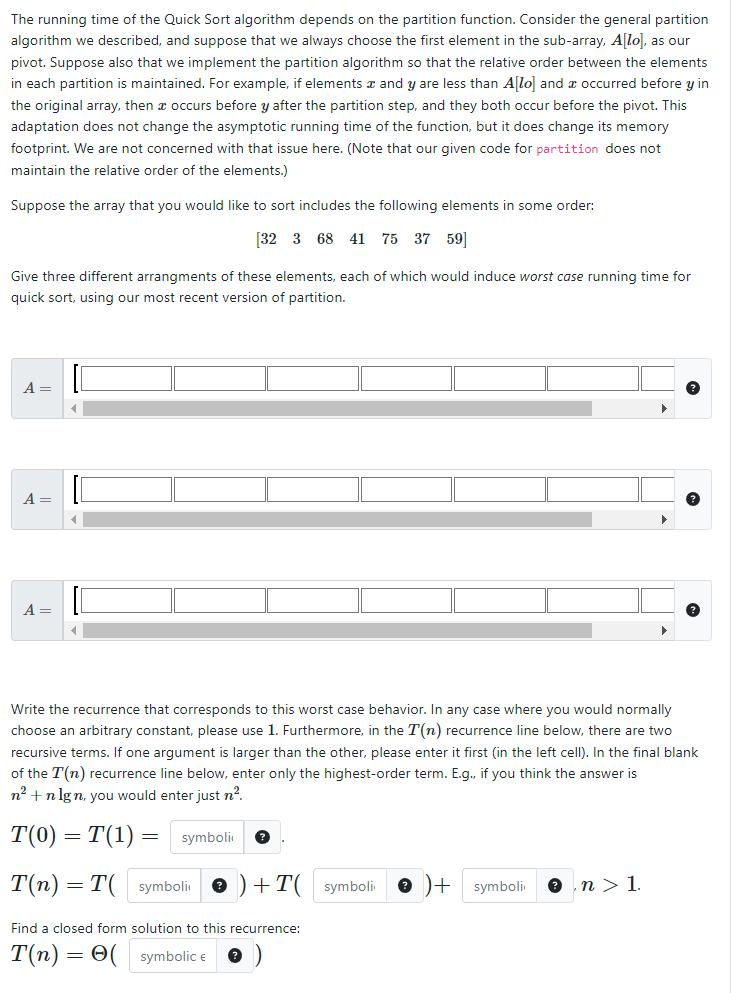
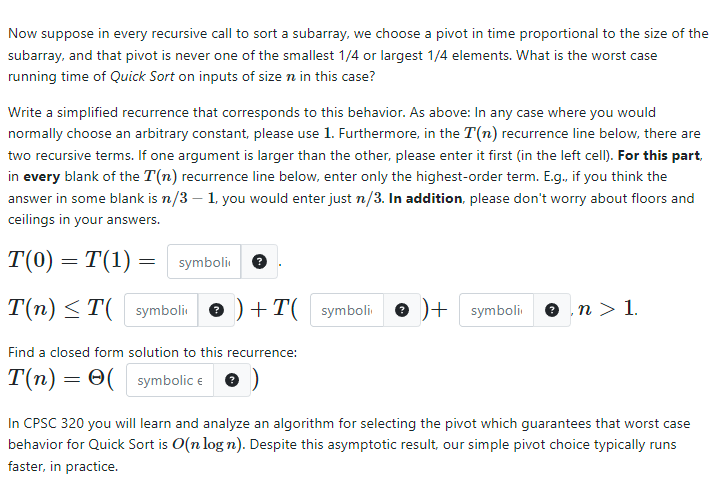
(a) Insertion Sort (b) Selection Sort (c) Merge Sort Even before we give a robust analysis of Quick Sort, we know a significant lower bound for its running time. Which of the following is the greatest lower bound for Quick Sort's worst case running time (Hint: quick sort is a comparison based sorting algorithm)? (a) (logn) (b) (n2) (c) (n) (d) (1) (e) (nlogn) Consider the following nearly complete helper function: int partition(vector int >&x, int 10 , int hi) \{ int p=10+1; for ( int i=10+1;i1. Find a closed form solution to this recurrence: T(n)=() In CPSC 320 you will learn and analyze an algorithm for selecting the pivot which guarantees that worst case behavior for Quick Sort is O(nlogn). Despite this asymptotic result, our simple pivot choice typically runs faster, in practice
Step by Step Solution
There are 3 Steps involved in it

Get step-by-step solutions from verified subject matter experts
 Study Help