







Question: 5. We applied different signals to a system with h(t)=u(t)-u(t-1). What is the zero state response? a. If the input signal is u(t)-r(t), where
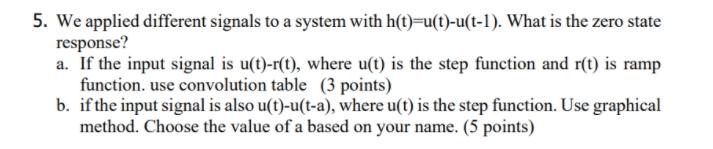
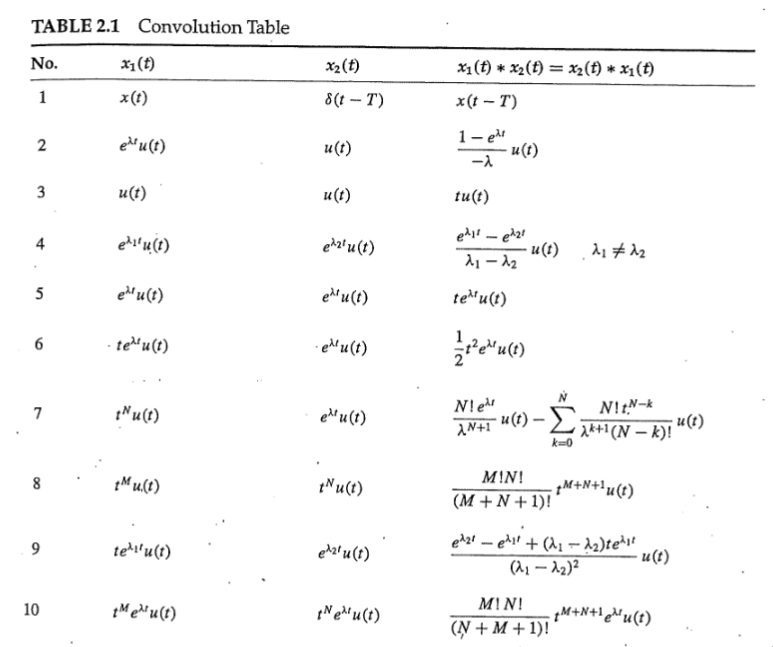
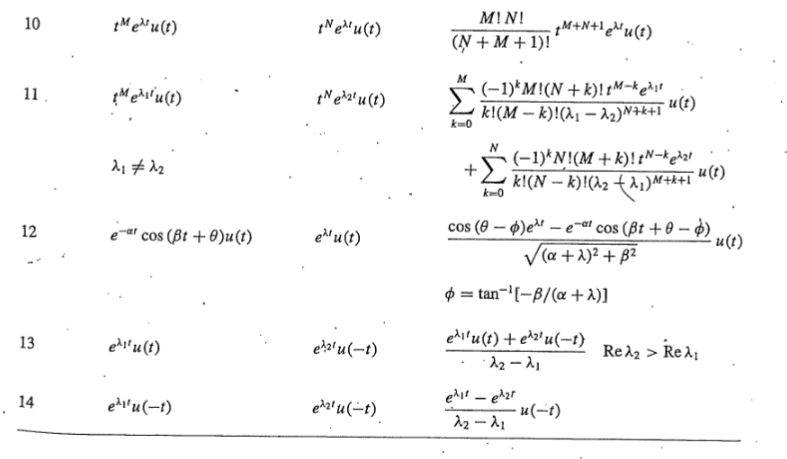
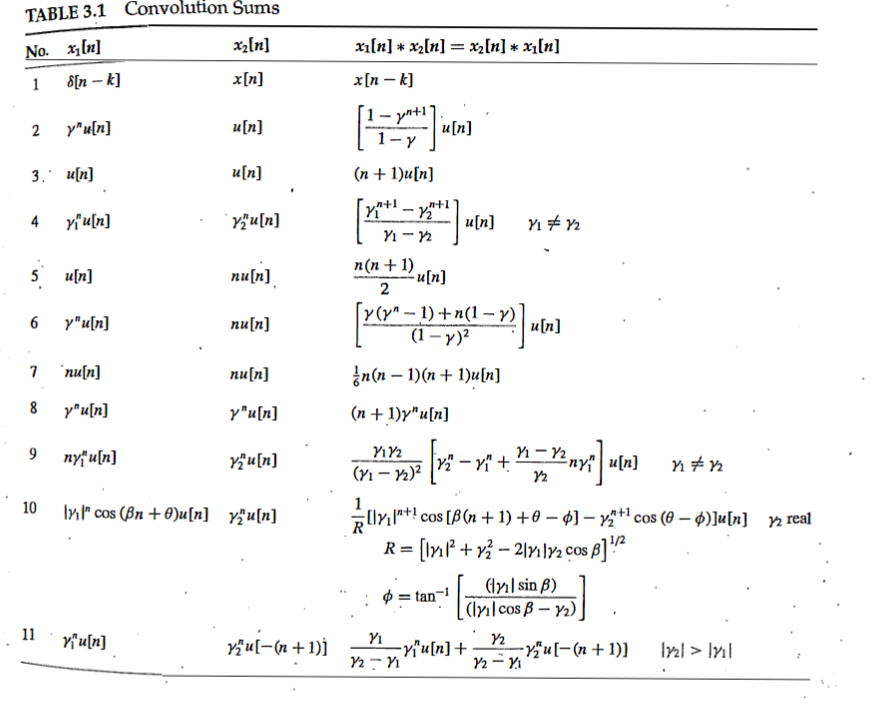
5. We applied different signals to a system with h(t)=u(t)-u(t-1). What is the zero state response? a. If the input signal is u(t)-r(t), where u(t) is the step function and r(t) is ramp function. use convolution table (3 points) b. if the input signal is also u(t)-u(t-a), where u(t) is the step function. Use graphical method. Choose the value of a based on your name. (5 points) TABLE 2.1 Convolution Table x1 (t) x(t) No. 1 2 3 5 6 7 8 9 10 eu(t) u(t) eu(t) e u(t) telu(t) tNu(t) Mu(1) teu(t) tMeu(t) x (t) 8(t-T) u(t) u(t) ed2lu(t) et u(t) -elu(t) et u(t) tNu(t) e^2 u(t) tNetu(t) x (t) * x(t) = x(t) * x(t) x(t-T) 1-et - tu(t) - u(t) edir edar textu(t) eu(1) Ne XN+1 u(t) -u(t)- k=0 MIN! (M + N + 1)! # MIN! (+M+1)! Nit.N-k Ak+1(N-k)! - M+N+1u(t) edased + (-)te - (2-2) - u(t) M+N+1eu(t) u(t) . 10 11. 12 13 14 tMetu(t) Mexiu(t) # cos (Bt + 0)u(t) editu(t) edu(-1) tNetu(t) tNe u(t) e u(t) edu(-1) e2 u(-1). MIN! (N+M+1)! k=0 + M+N+1 @Mu(t) (1)kM!(N +k)! t-ker k!(M k)!( )N+k+1 u(t) km0 (-1)*N!(M+k)!tN-k k!(N k)!( )M+k+1' cos (8-)e-e-at cos (Bt+0-) (x + 2) + B tan[-B/(a + 2)] editu(t) +etu(-1) - edir edar - u(-t) u(t) Re 2 > > Re u(t) TABLE 3.1 Convolution Sums No. x[n] x[n] 1 x[n] 2 4 3. u[n] 6 8[n-k] 9 y"u[n] 10 yu[n] u[n] 7 nu[n] 8 y"u[n] y"u[n] nyu[n] u[n] 11 Yu[n] u[n] Yu[n] nu[n] nu[n] nu[n] Y"u[n] Yu[n] Il cos (Bn+0)u[n] Yu[n] Yu[-(n+1)] x[n] * x[n] = x[n] * x[n] x[n-k] 1- [] (n + 1)u[n] - 7/11/2 n(n+1) 2 u[n] -u[n] [y(y"-1)+n(1-y) (1-y) n(n-1)(n+1)u[n] (n+1)y"u[n] 717/2 (71-72) Y 7/2/1 u[n] = [X=+^= x] [] 1/2 tan-1 71 #Y/2 [ly|+!, cos [B(n+1) +0] -2 cos (0-4)]u[n] 2 real R= [1 + y-2||y2 cos B]/2 u[n] -Yu[n] + (y sin ) (lyl cos B-7) 7/2 1/2 - 1/1 n #12 -Yu[-(n+1)] 1221 > 1211
Step by Step Solution
3.46 Rating (156 Votes )
There are 3 Steps involved in it

Get step-by-step solutions from verified subject matter experts
 Study Help