







Question: A java project. Problem 15-9 Implement a Java class Project5 as specified below to solve the dynamic programming problem described in Page 410, Problem 15-9.
A java project.
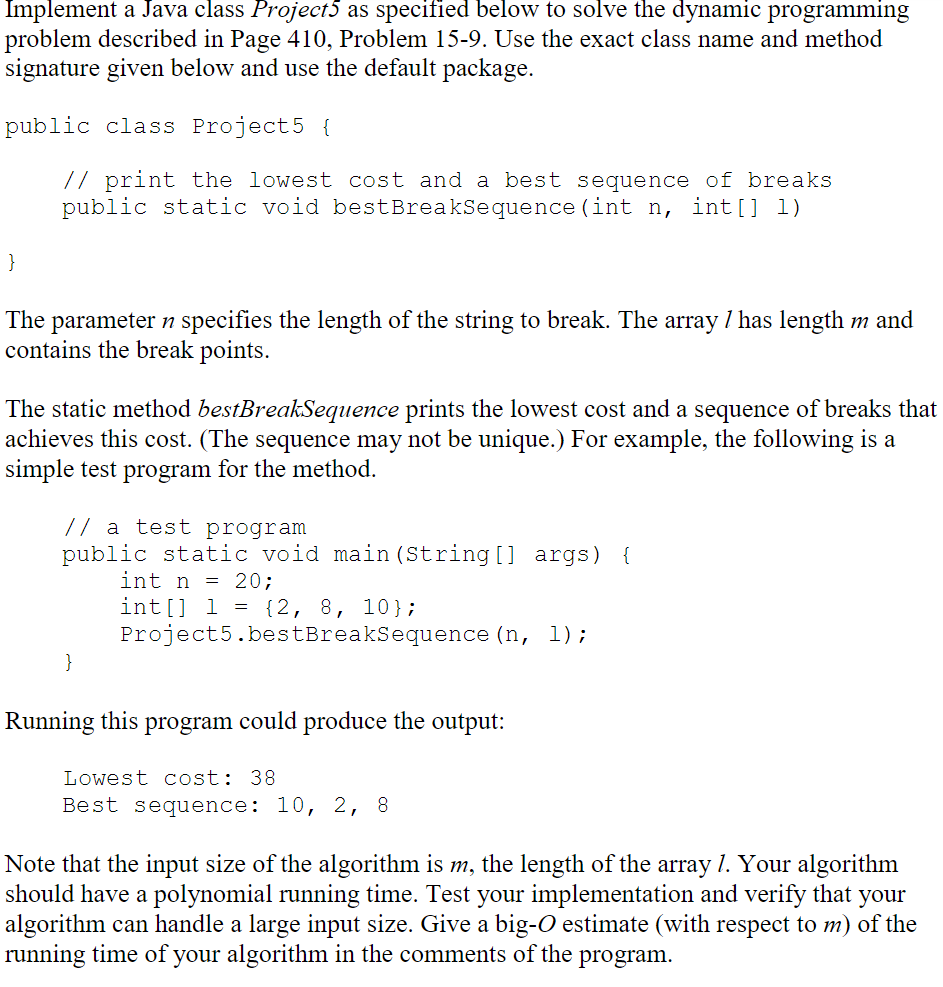
Problem 15-9
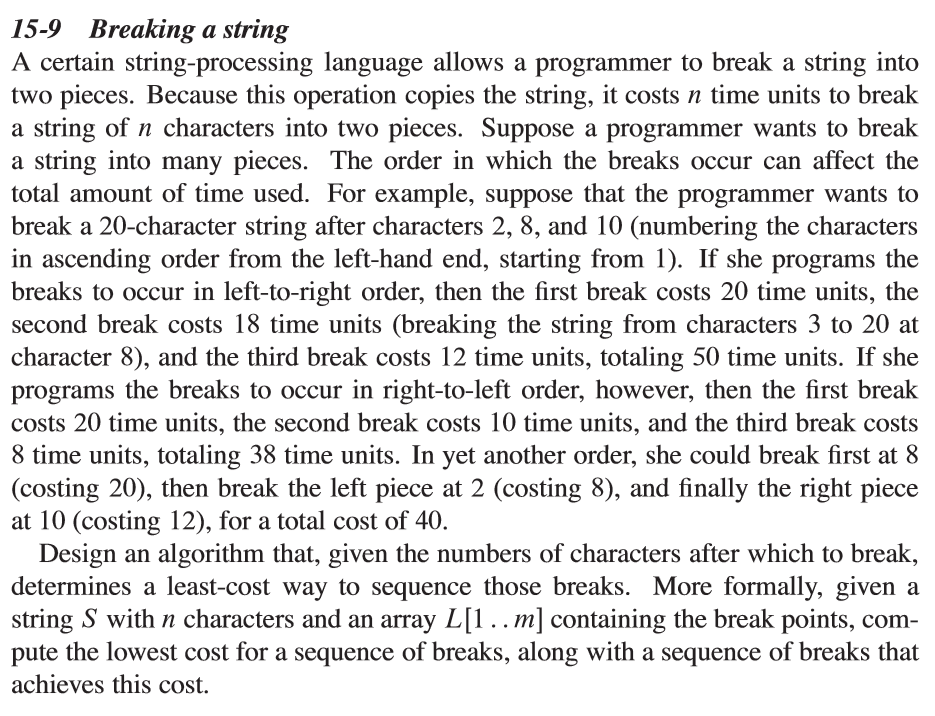
Implement a Java class Project5 as specified below to solve the dynamic programming problem described in Page 410, Problem 15-9. Use the exact class name and method signature given below and use the default package. public class Project5 // print the lowest cost and a best sequence of breaks public static void bestBreakSequence (int n, int[] 1) The parameter n specifies the length of the string to break. The array / has length m and contains the break points. he static method bestBreakSequence prints the lowest cost and a sequence of breaks that achieves this cost. (The sequence may not be unique.) For example, the following is a simple test program for the method //a test program public static void main (String[] args) ( int n = 20; int] l -2, 8, 10) Project5.bestBreakSequence (n, 1); Running this program could produce the output: Lowest cost: 38 Best sequence: 10, 2, 8 Note that the input size of the algorithm is m. the length of the array . Your algorithm should have a polynomial running time. Test your implementation and verify that your algorithm can handle a large input size. Give a big-O estimate (with respect to m) of the running time of your algorithm in the comments of the program Implement a Java class Project5 as specified below to solve the dynamic programming problem described in Page 410, Problem 15-9. Use the exact class name and method signature given below and use the default package. public class Project5 // print the lowest cost and a best sequence of breaks public static void bestBreakSequence (int n, int[] 1) The parameter n specifies the length of the string to break. The array / has length m and contains the break points. he static method bestBreakSequence prints the lowest cost and a sequence of breaks that achieves this cost. (The sequence may not be unique.) For example, the following is a simple test program for the method //a test program public static void main (String[] args) ( int n = 20; int] l -2, 8, 10) Project5.bestBreakSequence (n, 1); Running this program could produce the output: Lowest cost: 38 Best sequence: 10, 2, 8 Note that the input size of the algorithm is m. the length of the array . Your algorithm should have a polynomial running time. Test your implementation and verify that your algorithm can handle a large input size. Give a big-O estimate (with respect to m) of the running time of your algorithm in the comments of the program
Step by Step Solution
There are 3 Steps involved in it

Get step-by-step solutions from verified subject matter experts
 Study Help