



Question: A laboratory report has three main functions: (1) To provide a record of the experiments and raw data included in the report. (2) To provide
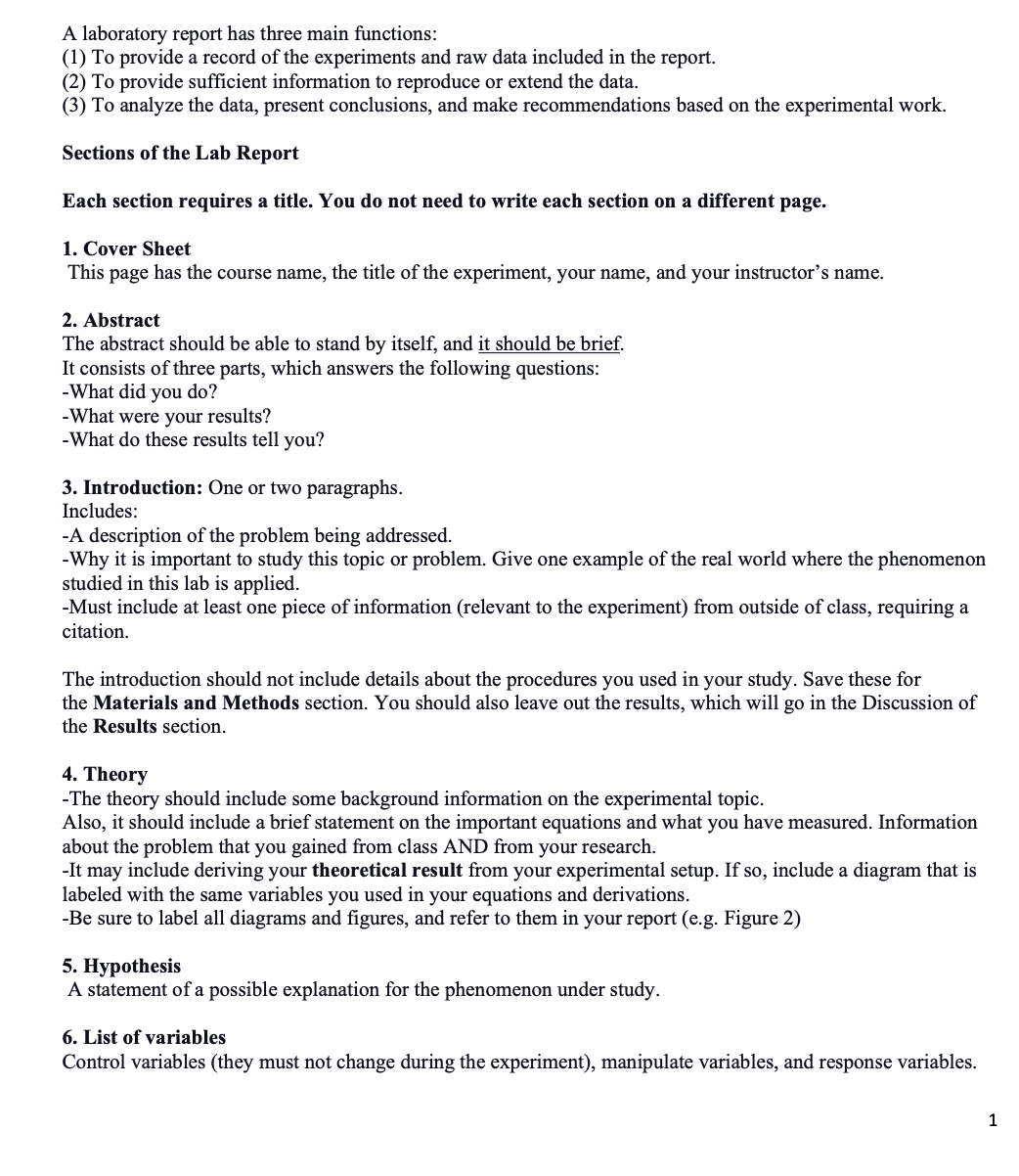
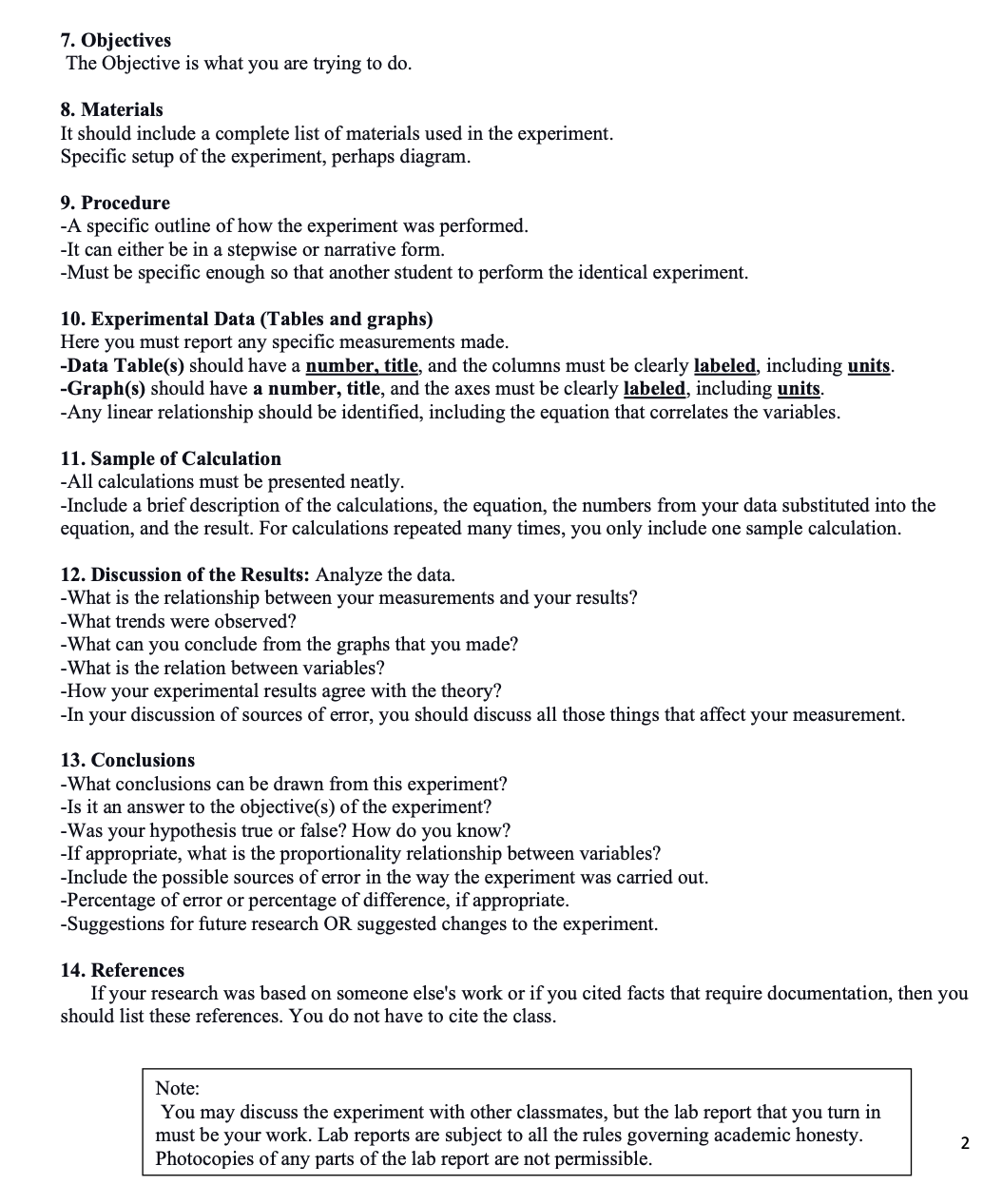
A laboratory report has three main functions: (1) To provide a record of the experiments and raw data included in the report. (2) To provide sufficient information to reproduce or extend the data. (3) To analyze the data, present conclusions, and make recommendations based on the experimental work. Sections of the Lab Report Each section requires a title. You do not need to write each section on a different page. 1. Cover Sheet This page has the course name, the title of the experiment, your name, and your instructor's name. 2. Abstract The abstract should be able to stand by itself, and it should be brief. It consists of three parts, which answers the following questions: -What did you do? -What were your results? -What do these results tell you? 3. Introduction: One or two paragraphs. Includes: -A description of the problem being addressed. -Why it is important to study this topic or problem. Give one example of the real world where the phenomenon studied in this lab is applied. -Must include at least one piece of information (relevant to the experiment) from outside of class, requiring a citation. The introduction should not include details about the procedures you used in your study. Save these for the Materials and Methods section. You should also leave out the results, which will go in the Discussion of the Results section. 4. Theory -The theory should include some background information on the experimental topic. Also, it should include a brief statement on the important equations and what you have measured. Information about the problem that you gained from class AND from your research. -It may include deriving your theoretical result from your experimental setup. If so, include a diagram that is labeled with the same variables you used in your equations and derivations. -Be sure to label all diagrams and figures, and refer to them in your report (e.g. Figure 2) 5. Hypothesis A statement of a possible explanation for the phenomenon under study. 6. List of variables Control variables (they must not change during the experiment), manipulate variables, and response variables. 7. Objectives The Objective is what you are trying to do. 8. Materials It should include a complete list of materials used in the experiment. Specific setup of the experiment, perhaps diagram. 9. Procedure -A specific outline of how the experiment was performed. -It can either be in a stepwise or narrative form. -Must be specific enough so that another student to perform the identical experiment. 10. Experimental Data (Tables and graphs) Here you must report any specific measurements made. -Data Table(s) should have a number, title, and the columns must be clearly labeled, including units. -Graph(s) should have a number, title, and the axes must be clearly labeled, including units. -Any linear relationship should be identified, including the equation that correlates the variables. 11. Sample of Calculation -All calculations must be presented neatly. -Include a brief description of the calculations, the equation, the numbers from your data substituted into the equation, and the result. For calculations repeated many times, you only include one sample calculation. 12. Discussion of the Results: Analyze the data. What is the relationship between your measurements and your results? -What trends were observed? -What can you conclude from the graphs that you made? -What is the relation between variables? How your experimental results agree with the theory? -In your discussion of sources of error, you should discuss all those things that affect your measurement. 13. Conclusions What conclusions can be drawn from this experiment? Is it an answer to the objective(s) of the experiment? Was your hypothesis true or false? How do you know? -If appropriate, what is the proportionality relationship between variables? -Include the possible sources of error in the way the experiment was carried out. -Percentage of error or percentage of difference, if appropriate. Suggestions for future research OR suggested changes to the experiment. 14. References If your research was based on someone else's work or if you cited facts that require documentation, then you should list these references. You do not have to cite the class. Note: You may discuss the experiment with other classmates, but the lab report that you turn in must be your work. Lab reports are subject to all the rules governing academic honesty. 2 Photocopies of any parts of the lab report are not permissible
Step by Step Solution
There are 3 Steps involved in it

Get step-by-step solutions from verified subject matter experts