



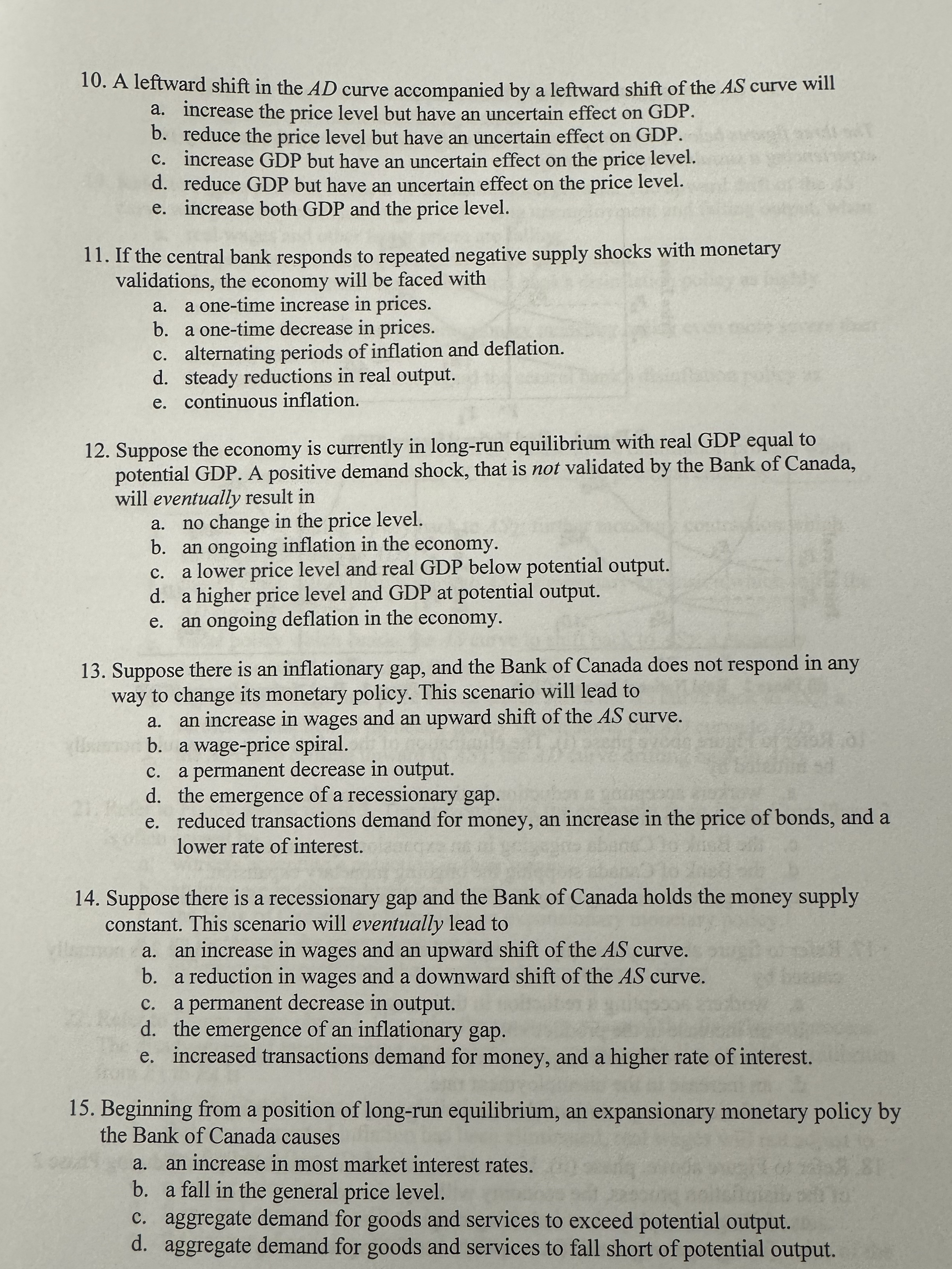
Question: A leftward shift in the A D curve accompanied by a leftward shift of the A S curve will a . increase the price level
A leftward shift in the curve accompanied by a leftward shift of the curve will
a increase the price level but have an uncertain effect on GDP
b reduce the price level but have an uncertain effect on GDP
c increase GDP but have an uncertain effect on the price level.
d reduce GDP but have an uncertain effect on the price level.
e increase both GDP and the price level.
If the central bank responds to repeated negative supply shocks with monetary validations, the economy will be faced with
a a onetime increase in prices.
b a onetime decrease in prices.
c alternating periods of inflation and deflation.
d steady reductions in real output.
e continuous inflation.
Suppose the economy is currently in longrun equilibrium with real GDP equal to potential GDP A positive demand shock, that is not validated by the Bank of Canada, will eventually result in
a no change in the price level.
b an ongoing inflation in the economy.
c a lower price level and real GDP below potential output.
d a higher price level and GDP at potential output.
e an ongoing deflation in the economy.
Suppose there is an inflationary gap, and the Bank of Canada does not respond in any way to change its monetary policy. This scenario will lead to
a an increase in wages and an upward shift of the curve.
b a wageprice spiral.
c a permanent decrease in output.
d the emergence of a recessionary gap.
e reduced transactions demand for money, an increase in the price of bonds, and a lower rate of interest.
Suppose there is a recessionary gap and the Bank of Canada holds the money supply constant. This scenario will eventually lead to
a an increase in wages and an upward shift of the curve.
b a reduction in wages and a downward shift of the curve.
c a permanent decrease in output.
d the emergence of an inflationary gap.
e increased transactions demand for money, and a higher rate of interest.
Beginning from a position of longrun equilibrium, an expansionary monetary policy by the Bank of Canada causes
a an increase in most market interest rates.
b a fall in the general price level.
c aggregate demand for goods and services to exceed potential output.
d aggregate demand for goods and services to fall short of potential output.
Step by Step Solution
There are 3 Steps involved in it
1 Expert Approved Answer
Step: 1 Unlock

Question Has Been Solved by an Expert!
Get step-by-step solutions from verified subject matter experts
Step: 2 Unlock
Step: 3 Unlock