







Question: a) ls l /d1/d2/f1 command: b) cat /d1/d3/f2 command: c) rm /d1/d4/f3 command: d) cp /d1/d2/f4 /d1/f5 command: e) To successfully execute the command /d1/d2/sc1,
a) ls l /d1/d2/f1 command:
b) cat /d1/d3/f2 command:
c) rm /d1/d4/f3 command:
d) cp /d1/d2/f4 /d1/f5 command:
e) To successfully execute the command /d1/d2/sc1, where sc1 is a shell script file:
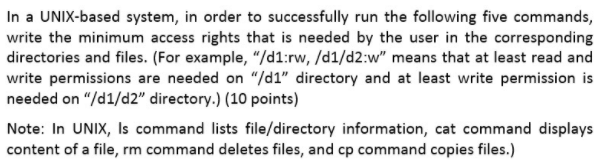
In a UNIX-based system, in order to successfully run the following five commands, write the minimum access rights that is needed by the user in the corresponding directories and files. (For example, "/d1:rw, /d1/d2:w means that at least read and write permissions are needed on "/d1" directory and at least write permission is needed on "/d1/d2" directory.) (10 points) Note: In UNIX, Is command lists file/directory information, cat command displays content of a file, rm command deletes files, and cp command copies files.)
Step by Step Solution
There are 3 Steps involved in it

Get step-by-step solutions from verified subject matter experts
 Study Help