


Question: A manager is trying to decide whether to buy one machihe or two. If only one is purchased and demand proves to be high, the
A manager is trying to decide whether to buy one
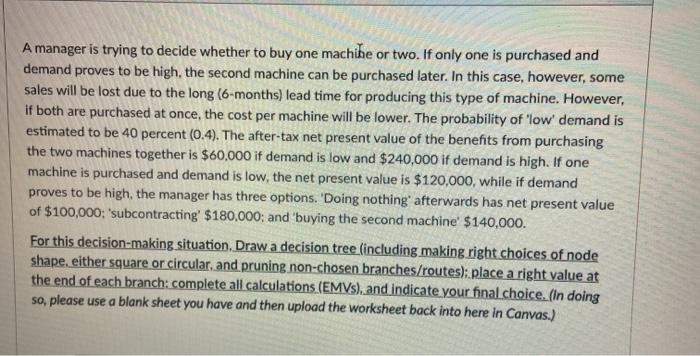
A manager is trying to decide whether to buy one machihe or two. If only one is purchased and demand proves to be high, the second machine can be purchased later. In this case, however, some sales will be lost due to the long (6-months) lead time for producing this type of machine. However, if both are purchased at once, the cost per machine will be lower. The probability of 'low' demand is estimated to be 40 percent (0.4). The after-tax net present value of the benefits from purchasing the two machines together is $60,000 if demand is low and $240,000 if demand is high. If one machine is purchased and demand is low, the net present value is $120,000, while if demand proves to be high, the manager has three options. 'Doing nothing' afterwards has net present value of $100,000: 'subcontracting' $180,000; and buying the second machine' $140,000. For this decision-making situation. Draw a decision tree (including making right choices of node shape, either square or circular, and pruning non-chosen branches/routes); place a right value at the end of each branch: complete all calculations (EMVs), and indicate your final choice. (In doing so, please use a blank sheet you have and then upload the worksheet back into here in Canvas.)

Step by Step Solution

There are 3 Steps involved in it

1 Expert Approved Answer
Step: 1 Unlock blur-text-image

Question Has Been Solved by an Expert!

Get step-by-step solutions from verified subject matter experts

Step: 2 Unlock
Step: 3 Unlock

Students Have Also Explored These Related General Management Questions!