Question: A manufacturing facility produces widgets utilizing four major process steps. You walked the process and captured the following notes: The customer demand for these widgets
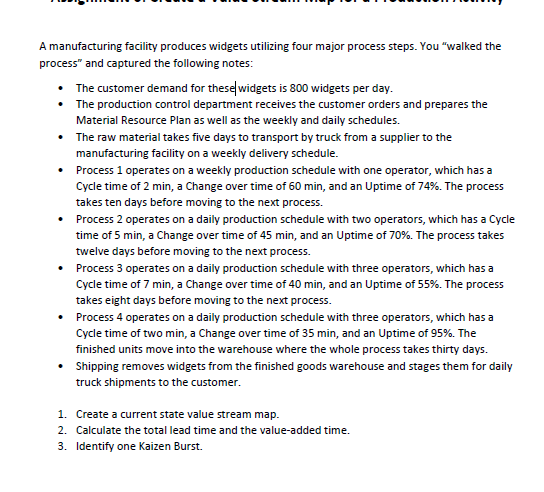
A manufacturing facility produces widgets utilizing four major process steps. You "walked the process" and captured the following notes: The customer demand for these widgets is 800 widgets per day. The production control department receives the customer orders and prepares the Material Resource Plan as well as the weekly and daily schedules. The raw material takes five days to transport by truck from a supplier to the manufacturing facility on a weekly delivery schedule. Process 1 operates on a weekly production schedule with one operator, which has a Cycle time of 2 min, a Change over time of 60 min, and an Uptime of 74%. The process takes ten days before moving to the next process. Process 2 operates on a daily production schedule with two operators, which has a Cycle time of 5 min, a Change over time of 45 min, and an Uptime of 70%. The process takes twelve days before moving to the next process. Process 3 operates on a daily production schedule with three operators, which has a Cycle time of 7 min, a Change over time of 40 min, and an Uptime of 55%. The process takes eight days before moving to the next process. Process 4 operates on a daily production schedule with three operators, which has a Cycle time of two min, a Change over time of 35 min, and an Uptime of 95%. The finished units move into the warehouse where the whole process takes thirty days. Shipping removes widgets from the finished goods warehouse and stages them for daily truck shipments to the customer. 1. Create a current state value stream map. 2. Calculate the total lead time and the value-added time. 3. Identify one Kaizen Burst. A manufacturing facility produces widgets utilizing four major process steps. You "walked the process" and captured the following notes: The customer demand for these widgets is 800 widgets per day. The production control department receives the customer orders and prepares the Material Resource Plan as well as the weekly and daily schedules. The raw material takes five days to transport by truck from a supplier to the manufacturing facility on a weekly delivery schedule. Process 1 operates on a weekly production schedule with one operator, which has a Cycle time of 2 min, a Change over time of 60 min, and an Uptime of 74%. The process takes ten days before moving to the next process. Process 2 operates on a daily production schedule with two operators, which has a Cycle time of 5 min, a Change over time of 45 min, and an Uptime of 70%. The process takes twelve days before moving to the next process. Process 3 operates on a daily production schedule with three operators, which has a Cycle time of 7 min, a Change over time of 40 min, and an Uptime of 55%. The process takes eight days before moving to the next process. Process 4 operates on a daily production schedule with three operators, which has a Cycle time of two min, a Change over time of 35 min, and an Uptime of 95%. The finished units move into the warehouse where the whole process takes thirty days. Shipping removes widgets from the finished goods warehouse and stages them for daily truck shipments to the customer. 1. Create a current state value stream map. 2. Calculate the total lead time and the value-added time. 3. Identify one Kaizen Burst









 Study Help