







Question: A mass is attached to a spring, both resting on a trictionless table as shown below. Let the equilibrium position be x=0. Let m
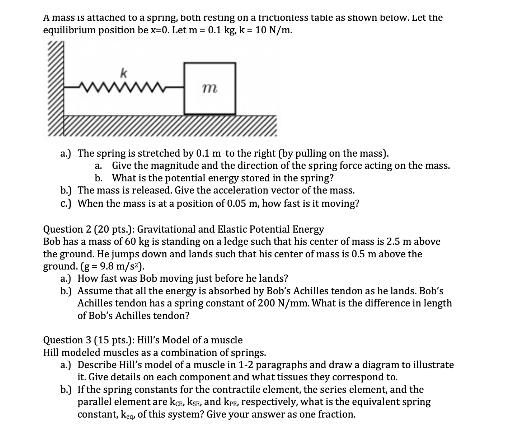
A mass is attached to a spring, both resting on a trictionless table as shown below. Let the equilibrium position be x=0. Let m = 0.1 kg, k = 10 N/m. J m a.) The spring is stretched by 0.1 m to the right (by pulling on the mass). a. Give the magnitude and the direction of the spring force acting on the mass. b. What is the potential energy stored in the spring? b.) The mass is released. Give the acceleration vector of the mass. c.) When the mass is at a position of 0.05 m, how fast is it moving? Question 2 (20 pts.): Gravitational and Elastic Potential Energy Bob has a mass of 60 kg is standing on a ledge such that his center of mass is 2.5 m above the ground. He jumps down and lands such that his center of mass is 0.5 m above the ground. (g = 9.8 m/s). a.) How fast was Bob moving just before he lands? b.) Assume that all the energy is absorbed by Bob's Achilles tendon as he lands. Bob's Achilles tendon has a spring constant of 200 N/mm. What is the difference in length of Bob's Achilles tendon? Question 3 (15 pts.): Hill's Model of a muscle Hill modeled muscles as a combination of springs. a.) Describe Hill's model of a muscle in 1-2 paragraphs and draw a diagram to illustrate it. Give details on each component and what tissues they correspond to. b.) If the spring constants for the contractile element, the series element, and the parallel element are ko, ks, and kes, respectively, what is the equivalent spring constant, k:4, of this system? Give your answer as one fraction.
Step by Step Solution
There are 3 Steps involved in it
SOLUTION a The magnitude of the spring force acting on the mass can be calculated using Hookes Law which states that the force exerted by a spring is directly proportional to the displacement from its ... View full answer

Get step-by-step solutions from verified subject matter experts
 Study Help