



Question: A model describing certain entities is formed by associating with an entity a sequence of values (possibly infinite), each term in the sequence being associated
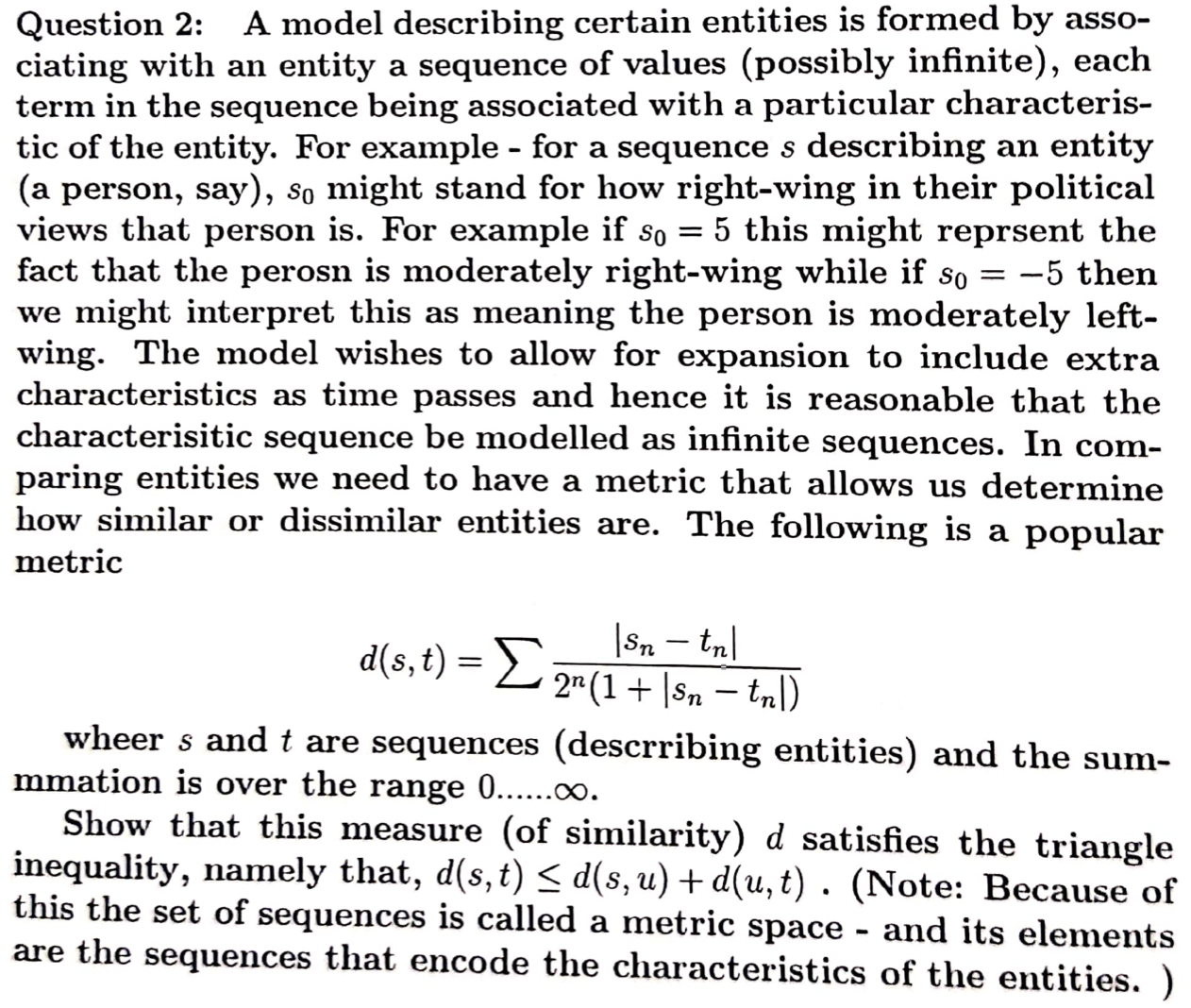
A model describing certain entities is formed by associating with an entity a sequence of values (possibly infinite), each term in the sequence being associated with a particular characteristic of the entity. For example - for a sequence s describing an entity (a person, say), s0 might stand for how right-wing in their political views that person is. For example if s0 = 5 this might represent the fact that the person is moderately right-wing while if s0 = -5 then we might interpret this as meaning the person is moderately lest-wing. The model wishes to allow for expansion to include extra characteristics as time passed and hence it is reasonable that the characteristic sequence be modelled as infinite sequences. In comparing entities we need to have a metric that allows us determine how similar or dissimilar entities are. The following is a popular metric d(s, t) = ?|sn-tn|/sn(1+|sn-tn|) where s and t are sequences (describing entities) and the summation is over the range 0........?.
Show that this measure (of similarity) d satisfies the triangle inequality, namely that, d(s, t)
Step by Step Solution
There are 3 Steps involved in it

Get step-by-step solutions from verified subject matter experts