



Question: A. Muara Logistics Berhad (MLB) has recently expanded by acquiring two smaller companies in the transportation industry. MLB had been implementing a centralized style of
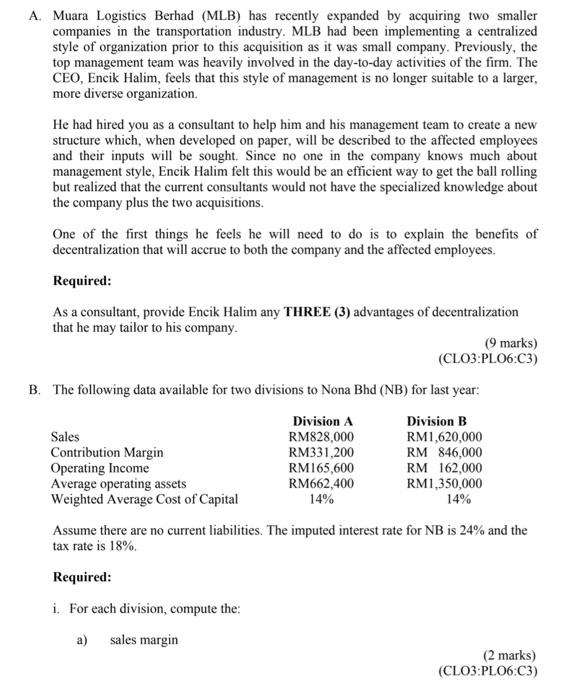
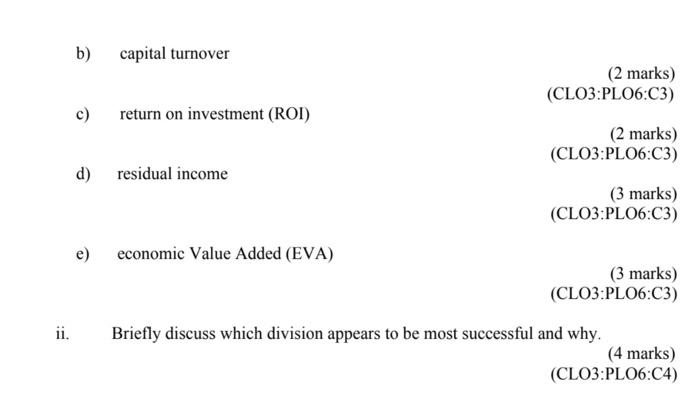
A. Muara Logistics Berhad (MLB) has recently expanded by acquiring two smaller companies in the transportation industry. MLB had been implementing a centralized style of organization prior to this acquisition as it was small company. Previously, the top management team was heavily involved in the day-to-day activities of the firm. The CEO, Encik Halim, feels that this style of management is no longer suitable to a larger, more diverse organization. He had hired you as a consultant to help him and his management team to create a new structure which, when developed on paper, will be described to the affected employees and their inputs will be sought. Since no one in the company knows much about management style, Encik Halim felt this would be an efficient way to get the ball rolling but realized that the current consultants would not have the specialized knowledge about the company plus the two acquisitions. One of the first things he feels he will need to do is to explain the benefits of decentralization that will accrue to both the company and the affected employees. Required: As a consultant, provide Encik Halim any THREE (3) advantages of decentralization that he may tailor to his company. (9 marks) (CLO3:PL06:03) B. The following data available for two divisions to Nona Bhd (NB) for last year: Division A Division B Sales RM828,000 RM1,620,000 Contribution Margin RM331,200 RM 846,000 Operating Income RM165,600 RM 162,000 Average operating assets RM662,400 RM1,350,000 Weighted Average Cost of Capital 14% 14% Assume there are no current liabilities. The imputed interest rate for NB is 24% and the tax rate is 18% Required: i. For each division, compute the: a) sales margin (2 marks) (CLO3:PLO6.C3) b) capital turnover (2 marks) (CLO3:PLO6:03) c) return on investment (ROI) (2 marks) (CLO3:PL06:03) d) residual income (3 marks) (CLO3:PL06:C3) e) economic Value Added (EVA) (3 marks) (CLO3:PL06:03) Briefly discuss which division appears to be most successful and why. (4 marks) (CLO3:PL06:04)
Step by Step Solution
There are 3 Steps involved in it

Get step-by-step solutions from verified subject matter experts