







Question: A multiple-choice question with one possible answer. Regarding community indifference curves, which is true among the followings? They can't represent an averageindividual's indifference curves. They
A multiple-choice question with one possible answer.
Regarding community indifference curves, which is true among the followings?
- They can't represent an averageindividual's indifference curves.
- They cross, so they cannot be used in the analysis.
- They denote a representative individual's tastes.
- They are entirely unrelated to individual's community indifference curves.
- They are concave to the origin.
A multiple-choice question with one possible answer.
Which of the following statements is false?
- Gains from specializationresult even without exchange
- None of the others
- Gains from trade result even without specialization
- Gains from trade can be broken down into gains from exchange and gains from specialization
- Gains from trade occurs only when scale economies exist at the firm level.
A multiple-choice question with one possible answer.
Mutually beneficial trade cannot occur when production possibility frontiers are:
- different but tastes are equal
- equal and tastes are also equal
- different and tastes are alsodifferent
- the same but tastes are not
A multiple-choice question with one possible answer.
When there is an increase in a nation's terms of trade in a two-nation world, what happens to the terms of trade of its trade partner.
- can't be determined
- improves
- remains the same
- deteriorates
A multiple-choice question with one possible answer.
If national tastes for its import commodity decreases:
- the partner's terms of tradeimproves.
- the partner's terms of trade deteriorates.
- the nation's terms of trade remain unchanged.
- the nation's terms of trade deteriorates.
A multiple-choice question with one possible answer.
A greater deal of international trade is not:
- intra-industry trade
- between north-south trade
- involves differentiated products
- among developed countries
- based on monopolistic competition
A multiple-choice question with one possible answer.
What is a bench mark share for foreign investmentto be called foreign direct investment?
- 0.5
- 1.0
- 0.75
- 0.25
- 0.6
A multiple-choice question with one possible answer.
What is true about gains from integrated market?
- The integrated market only lowers the price of imports goods.
- The integrated market enables firms to produce at a larger scale.
- The integrated market only benefits smaller country.
- The integrated market increases the total number of products more than the total sumof two countries' products before integration.
- The integrated market only benefits larger country.
A multiple-choice question with one possible answer.
Technical progress in the nation's export commodity:
- will increase the nation's welfare
- may reduce the nation's welfare
- leaves the nation's welfare unchanged
- won't change the nation's welfare
A multiple-choice question with one possible answer.
Choose the industry that is engaged in intra-industry trade most among the following U.S. industries.
- Inorganic chemicals
- Office machines
- Scientific equipment
- Telecommunication equipment
- Road vehicles
A multiple-choice question with one possible answer.
How do firms respond to trade?
- Best-performing firms can expand.
- Worst-performing firms can export.
- Best-performing firms can survive.
- Worst-performing firms can sustain.
- Best-performing firms can sustain.
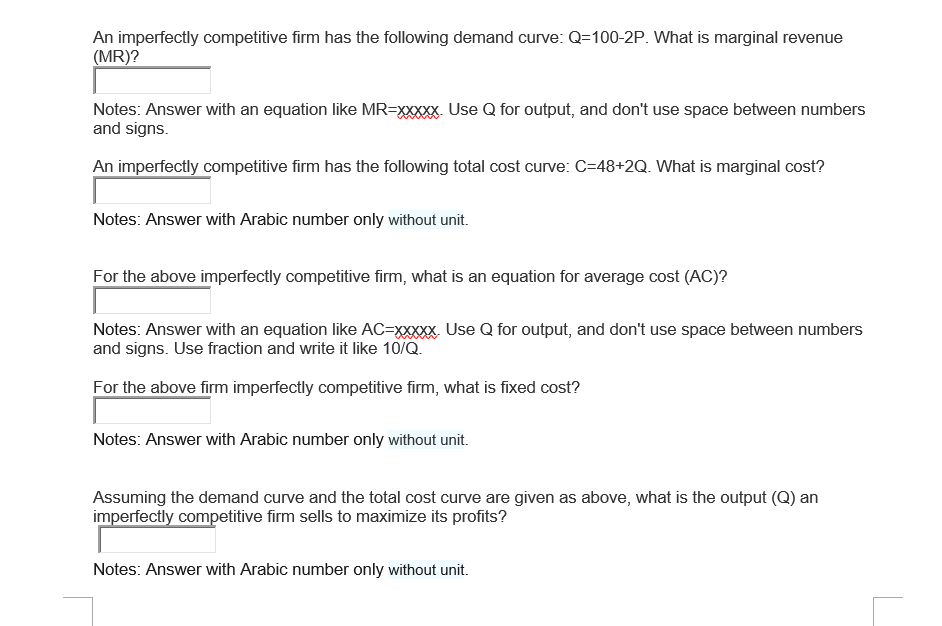
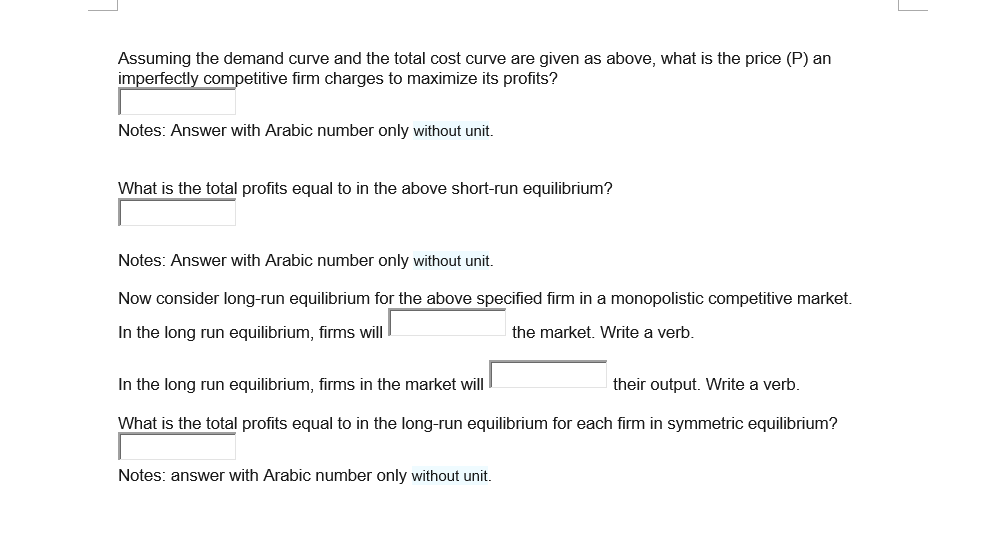
An imperfectly competitive firm has the following demand curve: Q=100-2P. What is marginal revenue (MR)? Notes: Answer with an equation like MR=xxxxx. Use Q for output, and don't use space between numbers and signs. An imperfectly competitive firm has the following total cost curve: C=48+2Q. What is marginal cost? Notes: Answer with Arabic number only without unit. For the above imperfectly competitive firm, what is an equation for average cost (AC)? Notes: Answer with an equation like AC=xxxxx. Use Q for output, and don't use space between numbers and signs. Use fraction and write it like 10/Q. For the above firm imperfectly competitive firm, what is fixed cost? Notes: Answer with Arabic number only without unit. Assuming the demand curve and the total cost curve are given as above, what is the output (Q) an imperfectly competitive firm sells to maximize its profits? Notes: Answer with Arabic number only without unit.Assuming the demand curve and the total cost curve are given as above, what is the price (P) an imperfectly competitive firm charges to maximize its profits? Notes: Answer with Arabic number only without unit. What is the total profits equal to in the above short-run equilibrium? Notes: Answer with Arabic number only without unit. Now consider long-run equilibrium for the above specified firm in a monopolistic competitive market. In the long run equilibrium, firms will the market. Write a verb. In the long run equilibrium, firms in the market will their output. Write a verb. What is the total profits equal to in the long-run equilibrium for each firm in symmetric equilibrium? Notes: answer with Arabic number only without unit
Step by Step Solution
There are 3 Steps involved in it

Get step-by-step solutions from verified subject matter experts
 Study Help