Question: The article below explains how corrupt practices in international trade are legally managed. 1. According to the article International Ethics and International Law
The article below explains how corrupt practices in international trade are legally managed. 1. According to the article "International Ethics and International Law" by Terry Nardin (provided below): a. Provide a brief review and summary of the article. b. Provide a discussion outlining your own views and conclude with your views on what Terry Nardin had to say. Note: The answers to the above questions must be in detail and related to professional ethics. The questions are clear to be answered if you read the provided article.
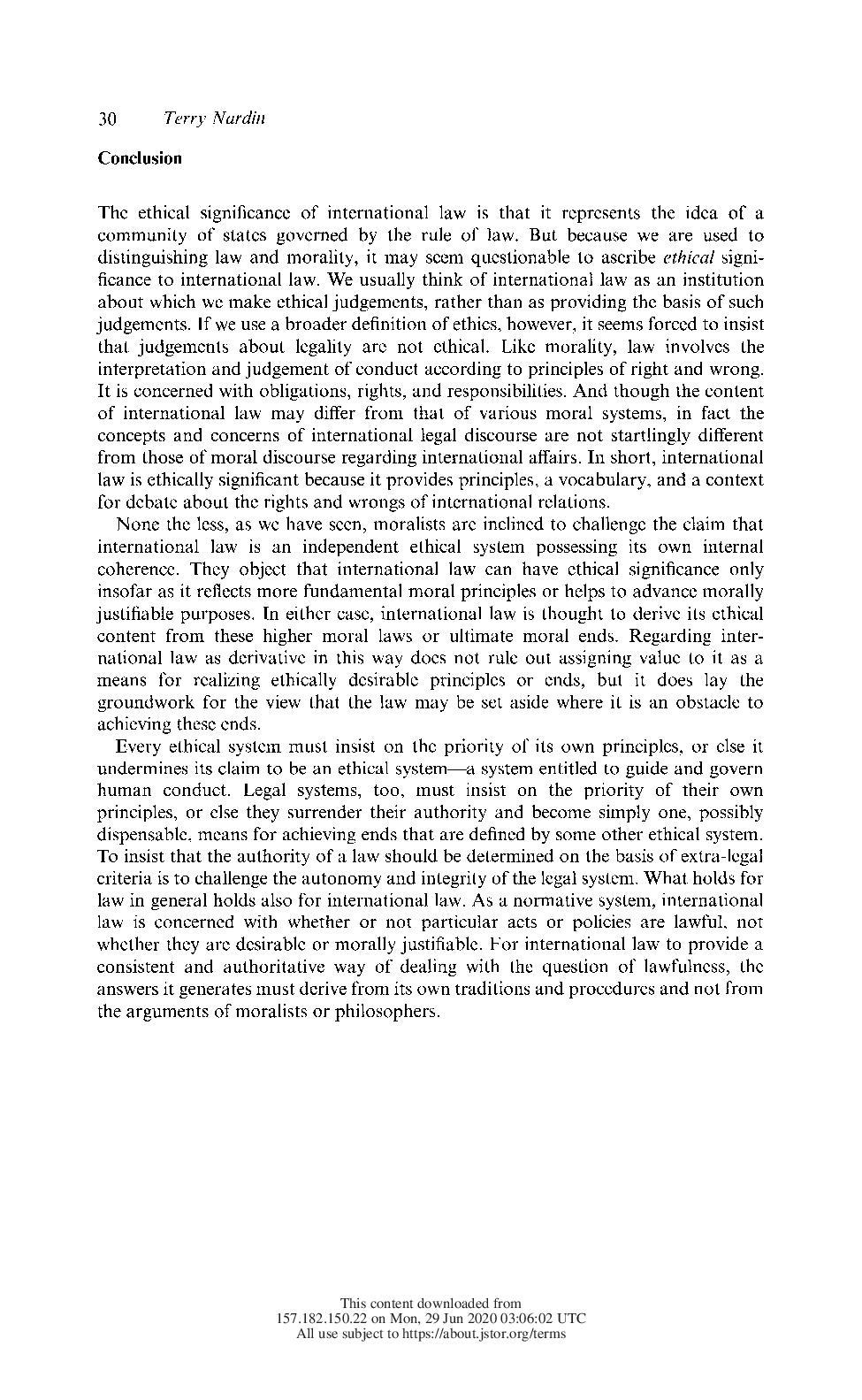
CAMBRIDGE UNIVERSITY PRESS International Ethics and International Law Author(s): Terry Nardin Source: Review of International Studies, Jan., 1992. Vol. 18, No. 1 (Jan., 1992). pp. 19- 30 Published by: Cambridge University Press Stable URL: http://www.jstor.com/stable/20097279 JSTOR is a not-for-profit service that helps scholars, researchers, and students discover, use, and build upon a wide range of content in a trusted digital archive. We use information technology and tools to increase productivity and facilitate new forms of scholarship, For more information about JSTOR, please contact support@jstor.org Your use of the JSTOR archive indicates your acceptance of the Terms & Conditions of Use, available at https://about jstor.org/terms SS Cambridge University Press is collaborating with JSTOR to digitize, preserve and extend access to Review of International Studies JSTOR This content downloaded from 157.182.150.22 on Mon, 29 Jun 2020 03:06:02 UTC All use subject to http://about.jstor.orgtens Reriet of niernational Studies ( 1992;, 18, 19 30 Printed i Great Britai International ethics and international law* TERRY NARDIN In this paper I am going to argue a familiar but still controversial thesis about the relation between international cthics and international law, which I would sum up in the following list of propositions: First, international law is a source as well as an object of ethical judgements. The idea of legality or the rule of law is an ethical one, and international law has ethical significance because it gives institutional expression to the rule of law in international relations. Secondly, international lawor, more precisely, the idea of the rule of law in international relations reflects a rule-oriented rather than outcome-oriented ethic of international affairs. By insisting on the priority of rules over outcomes, this ethic rejects conscquentialism in all its forms. Thirdly, though the content of international law reflects the influence of other ethical systems, the rule of law requires that principles drawn from thesc systems be incorporated into international law by recognized procedures of law-creation. The authority of international law is determined by criteria internal to the institution of international law, not by exogenous tests of moral validity. Fourthly, and as a consequence of this, international legal obligation is in- dependent of moral obligation. It cannot depend on whether the principles of international law correspond to those of some other ethical system, or on whether conforming to these principles produces outcomes that other ethical systems identify as desirable. One can, of course, criticize international law from the point of view of other ethical systems, but were legal authority and obligation to depend on external judgements, the boundaries of international law would disappear. International law can have ethical significance only insofar as it remains an independent institution. The following discussion is an allempt to explain these propositions and the basic distinction on which they rest, and to answer the main objectionsboth conceptual and normative--that have been made to this account of the ethical significance of international law.! Purposive and practical association The international system displays two distinct types of relationship or association. The first involves cooperation among states to promote shared purposes such as trade This paper has benefited from discussions at the American Society of International Law, the Yale Law School, and the PIPES Program at the University of Chicago. For helpful criticisni l particularly wish to thank Chris Brown, Mervyn Frost, Friedrich Kratochwil, David Mapel, and Thomas Pogge. The paper may he read as an effort to restate and defend sonic of the arguments of Terry Nardin, Low, Morality, and the Relations of States (Princeton, 1983). 19 This content downloaded from 157.182.150.22 on Mon, 29 Jun 2020 03:06:02 UTC All use subject to https://about.jstor.org/terms 20 Terry Nardin or mutual defence: purposive association'. The other is a relationship constituted by common rules such as those of diplomatic practice or international law: 'practical association'. The participants in a practical association may have shared purposes, but it is common rules, not shared purposes, that define their relationship. I have borrowed this distinction from the late Michael Oakeshott, who in On Human Conduct distinguishes two forms of association that permeate social inter- action generally.? Oakeshott argues that all human association can be understood in terms of the categories of purpose and practice. Human beings characteristically join with one another in purposive transactions and joint enterprises, and these trans- actions and enterprises are themselves regulated by customs, traditions, inores, laws, and other practices. According to Oakeshott, morality itself is such a practicc. Purposive association is outcomc-oriented. It views actions, policies, and insti- tutions instrumentally in terms of the causal contribution they make to producing a particular state of affairs. Ethical theories based on the assumption that all human association is purposive focus attention on the consequences of the action, policy, or institution in question rather than on its intrinsic character. Such theories are today labelled 'consequentialist'. Political realism and utilitarianism represent a purposive or consequentialist approach to ethics because they evaluate conduct according to the outcomes it produces, and this is an essentially purposive concern. In practical association, in contrast, moral judgement determines whether actions, policies, or institutions conform to the traditions or rules that constitute the association. To judge an activity from the perspective of practical association is therefore to consider it in relation to the standards of a particular practice standards that operate as constraints on the pursuit of various goals. Whereas purposive theories hold that activities should be judged in relation to the contribution they make to producing the greatest happiness or some other end, the practical perspective postulates no such ends. On the contrary, il assumes the existence of individuals or groups pursuing ends of their own, and judges their actions according to rules of conduct that constitute the normative order within which they are related. These rules prescribe forms and limits but leave those to whom they apply free to pursue their self-chosen purposes within these constraints. A familiar example is provided by parliamentary procedure, which is independent of the substantive concerns of parliaments or their members. In short, to judge purposively is to refer to outcomes or ends, while io judge practically is to invoke recognised principles or rules. . Michael Oakesholl, On Humun Conduct (Oxford, 1975). Oakeshott is especially concerned with two forms of association implicit in the nodern state which he labels 'enterprise' and 'civil' association. But applying these terms to international relations encounters the difficulty that international relations on the basis of international law is not. strictly speaking, 'civil association because the word implies an institution to make and apply rules (a state) and such an institution is, by definition, lacking in the international system. So I have chosen instead 10 speak of practical association (association on the basis of common practices or rules, whether or not those rules are really laws), and purposive association (association in order to proniole shared purposes). All these expressions reler to ideal types, which means that actual, historic states or international systems may not fit entirely into a single category Consequentialism includes the kind of thinking, common today, that judges policies and institutions according to their contribution to producing a state of affairs identified as just. For exaniples of this kind of consequentialisin in the international ethics literature, see Charles R. Beitz, Political Theory and International Relations (Princeton, 1977); Ilaskell Fain. Normative Politics and the Community of Nations (Philadelphia, 1987); Robert , Keohane, 'Closing the Fairness-Practice Gap: Ethics and International Affairs, 3 (1989), pp. 101-16; and Thomas W. Poggc, Realizing Rawls (Ithaca, 1989), chs. S and 6. ! This content downloaded from 157.182.150.22 on Mon, 29 Jun 2020 03:06:02 UTC All use subject to https://about.jstor.org/terms Internaional ethics and international law: 21 The distinction between purposive and practical association can be sharpened by considering the allitude toward the authority of rules implicit in each perspective. In practical association the authority of rules governing conduct is presupposed. When I judge the propriety or justice of an act, I presuppose the authority of the standard on which that judgement is based. In purposive association, however, the authority of rules governing an enterprise depends on their cllicacy in producing a desired result. The attitude of the associates toward these rules is conditional. They accept the rules because of the advantages of doing so. There are, however, two reasons why this conditional attitude toward the authority of rules cannot provide a basis for moral obligation. First, human interaction, whether it takes the form of a simple transaction of exchange or more sustained cooperation to promote a shared purpose, presupposes rules that are valid apart from the immediate transaction or cooperative agreement. To set up a cooperative, rule-governed enterprise itself rcquires rules and procedures, and these cannot be the outcome of the same enterprise. They mighi, of course, be the outcome of prior agreement, but that agreement in turn presupposes some still earlier agreement. We must therefore postulate the existence and antecedent authority of rules that are not themselves the outcome of any agreement, to avoid an infinite regress. Additional rules may, of course, be required in order to realize common interests through cooperative agreements. And the authority of these (instrumental) rules may be thought, not unreasonably, to depend on the contribution they make to achieving that end. But the authority of the very rules relied upon in making cooperative agreements cannot be instrumental, Secondly, if the authority of a rule is not distinguished from judgements about the desirability of the conscquences of observing it, it has no real authority. From the purposive perspective, since the obligation to observe a rule depends on the contri- bution it makes to rcalizing a desired outcome, the rule has no authority apart from ils utility in producing that outcome. Its authority is tied to its desirability, and the distinction between recognition and approval disappears. Those who are related on the basis of rules the authority of which is conditional in this way are not really related on the basis of common rules. Their relationship depends on shared interests, values, or beliefs. It is their joint desire for a certain outcome rather than their joint recognition of a common body of rules that binds them together. Laws may be consequentially desirable in the sense that they are inade to, or do in fact, produce peace or other desirable states of affairs, but they have authority not because they further those consequences but because they are law. To make peace and the other benefits of legal order the ground of legal authority would be to regard that authority as an instrument for the production of those benefits, and to view legal obligation as conditional on their successful production. A legal order would then be indistinguishable from a voluntary association that might be disbanded at the discretion of its members. Since those members would, in effect, retain the right to judge how well the association served the ends for which it was established, the distinction between a legal order and a state of nature would disappear. The only way to distinguish laws from rules of convenience is to distinguish the source of legal * It may be objected that we must also postulate the existence of purposes, for cooperation in fact presupposes a rich background of both rules and purposes--we never begin from a state of nature or original contract. Of course it is true that people enter cooperative agreements hecause they bave purposes which they think cooperation will serve, but one could never say of these purposes, as one might of the rules of contract, ihat cooperation postulates their antecedent authority. This content downloaded from 157.182.150.22 on Mon, 29 Jun 2020 03:06:02 UTC All use subject to https://about.jstor.org/terms 22 Terry Nardin authority from its benefits. Authority cannot be attributed to law on the basis of what can be enjoyed only through the prior recognition of authority. In short, though the consequences of observing a rule may be important in evaluating its desirability, they cannot determine its validity. No normative system can have an independent existence if the authority of its rules depends on the approval of their consequences by the persons to whom they apply. In order for cooperation to take place on the basis of common rules, those who wish to cooperate must acknowledge the authority of these rules. The rules cannot be unilaterally rejected as perceptions of advantage dictate. This is quite obvious in practices of fundamental importance to cooperation such as promising, contracting, and treaty- making Practical association displays a two-level structure which judges acts according to the standards of justice and propriety that compose a particular normative system. According to some theories, moral and legal rules are themselves rationalized in terms of the outcomes they promote. But in any system of rules having this two-level structure, judgements of right and wrong are made by applying the rules, not by appealing directly to the ultimate values on which the system itself is founded. To invoke those values directly would be to override the principles through which they are supposed to be realized and thereby collapse the two-level structure of morality and law into a single, unmediated, sel of ultimate values. Some purposive ethical theoriesthose of moral consequentialism and legal instrumentalismwould have us determine the rightness of an act in relation to its expected consequences, without relying on any mediating rules. While it is true that the entire system might be evaluated in purposive terms, one cannot make this evaluation the basis of decisions about complying with particular rules in particular situations, for to do that would be to dissolve the institution. If a systein is to be defended because it has good consequences as a system, then it follows that the system must be allowed to operate, its integrity preserved, its rules and procedures respected otherwise it cannot achieve these good results. The authority of the rules of practical association cannot, then, depend on consequentialist considerations. The authority of the fundamental rules that consti- tute a legal order is independent of the desirability of the outcomes that may be achieved by observing them. Legal authority is formal or non-instrumental. Law may provide benefits to the inembers of the community it constitutes, and it may help lo advance the claims of morality and justice within that community. But law can provide these benefits only because its authority, and therefore its very existence, rests on independent grounds. The implications of this analysis for international law are easily drawn, despite the obvious differences between domestic and international society. If there is to be an international society regulated by a common law, those who make and administer foreign policy must respect the limits laid down by this law. International law must be respected by those whose conduct it regulates: most importantly, by the public officials whose responsibilities include executing or applying this law. These officials must obey the law even in situations in which it cannot be reconciled with their own opinions regarding what is desirable or just. To the extent that international law is regarded purely in instrumental terms, the international system becomes an order based on the existence of shared valucs, not a truly rule-governed order. International law exists as an independent institution only to the extent that its authority is This content downloaded from 157.182.150.22 on Mon, 29 Jun 2020 03:06:02 UTC All use subject to https://about.jstor.org/terms Internasional ethics and international lumi 23 acknowledged in the practice of international relations. And this means that its authority must have some other ground than its usefulness in promoting a desired international order. The authority of law, which is a matter of its validity or authenticity as law, must not be confused with its rightness in relation to moral considerations or judgements regarding the desirability of the purposes it serves. Such concerns often and quite properly motivate efforts to change existing laws, but these efforts take place within an ongoing legal order and presuppose the authority of its constitutional procedures and of the laws created in accordance with these procedures. Purposive theories cannot account for the ultimately non-instrumental character of international law. According to those who understand it as a kind of purposive association, international society is created and sustained by cooperation. From the purposive perspective, international law is a means of achieving goals and is therefore no more than an instrument of cooperation. The purposive view gets things backwards, however, for though international law does indeed provide substantive benefits, it cannot be regarded as authoritative for this reason. On the contrary, if the law provides these benefits it can do so only because it is already authoritative. Any description of the international system as an association of states that share certain ends is necessarily incomplete. Such an association would not constitute a rule-governed moral or legal order. What transforms a number of powers, con- tingently related in terms of shared interests, into a society proper is not their agreement to participate in a common enterprise for as long as they desire to participate, but their participation in and implicit recognition of the practices, procedures, and other rules of international law that compose international society. The rules of international law, in other words, are not merely regulatory but constitutive: they not only create a normative order among separate political communities but define the status, rights, and duties of these communities within this normative order. In international society "states' arc constituted as such within the practice of international law; 'statehood' is a position or role that is defined by international law, not independent of it. International law includes rules that are the outcome of cooperation to further shared goals as well as rules that make such cooperation possible and that exist even where shared goals are lacking. But it is rules of the latter sort that are fundamental. First, the particular arrangements through which states cooperate to promote shared goals themselves depend on having available authoritative procedures for negotiating such arrangements. These procedures, embodied in customary international law, are prior to the treaties, alliances, and international organizations through which states cooperate. Customary international law is thus the foundation of all international association. Secondly, it is the rules of customary international law that delimit the jurisdiction of states, prohibit aggression and unlawful intervention, and regulate the activities of treaty-making, diplomacy, and war. Because they govern the relations of enernies as well as of friends, these rules provide a basis for international order even in the absence of shared beliefs, values, or ends. By requiring restraint in the pursuit of national aims and toleration of national diversity, customary international law Michael Oakeshott offers a theoretical investigation of the idea of the rule of law in terms of the concept of authenticity' in "The Rule of Law', in On History and Other Essays (Oxford, 1983). This content downloaded from 157.182.150.22 on Mon, 29 Jun 2020 03:06:02 UTC All use subject to https://about.jstor.org/terms 24 Terry: Nardin reflects the inevitably plural character of international society and may be said to constitute a morality of states, one that is a morality of coexistence. Objections to the practice-purpose distinction What grounds are there for concluding that 'practical association is categorically different from `purposive association"?? Can the relationship of states on the basis of common rules really be distinguished from cooperative relationships to promote shared purposes? If no such differencc exists, then international law is a cooperative enterprise like any other, one whose rules owe what authority they possess to their usefulness in advancing its purposes. If the practice purpose distinction is untenable, then all association is really purposive. This objection rests on the premise that all rules and procedures are means for realizing some purpose. Individual rules produce particular outcomes, and so docs the institution of international law as a whole. All human activity aims at some purpose or good, and legal rules are no more than instruments for securing the kind of good summed up in the idea of the rule of law. What justifies any set of rules, on this account, is its utility in promoting worthwhile goals. The rules of customary international law have as their purpose the establishment of a kind of minimal association among states. Although an international society might aim to achieve some more ample conception of justice, the international society we have aims at mere coexistence. The argument that the purpose-practice distinction is spurious, which underlies this moral critique of international law, takes dierent forms. One can argue that the supposedly non-instrumental constraints of practical association are in fact instru- mental to the particular ends of practical association. Mervyn Frost puts the objection this way: The distinction here is between rules that constrain the behavior of people with diverse goals and rules that are aimed at advancing an agreed-upou goal. It is a distinction between constraining rules and instrumental rules. This way of making the distinction between practical association and purposive association will not do, however, because it is always possible to construc constraining rules as instrumental rules. The rules of ... practical associations may always be portrayed as advancing some set of goals. * Sec Chris Brown, "Tithics of Coexistence: The International Theory of Terry Nardin', Review of International Studies, 14 (1988), pp. 213-22. While the fact that it constitutes an international order hased on coexistence could be used to construct a purposive rationale for international law as an institution, it is not my intention in making this point to offer such a rationale. ? Most of the criticisms that have been made of my own effort to analyze international law using Oakesholl's categories have also been made against the original. For discussion of these objections and some possible responses, see Paul Franco, The Political Philosophy of Michael Oakeshori (New Haven, 1990), pp. 222-9. * The Critical Legal Studies movement has revived the challenges of the American legal realisis to a 'rule conception' of society and to the idea of the rule of law. I have discussed these challenges, under the labels 'rule skepticism' and 'instrumentalism', at some length in Lam, Morality', und the Relations of States, ch. 8. For discussion of criticism within Critical Legal Studies of the idea of the rule of law, see Andrew Allman, Critical Legal Studies: A Liberal Critique (Princeton, 1990). Mervyn L. Frost, 'International Society: Purposive Association or Authoritative Practice?, unpublished paper, Deparlment of Political Science, University of Natal, South Africa, p. 4. Frost does not object to the purpose-practice distinction itsell, but only to basing it on a distinction between two types of rules. . This content downloaded from 157.182.150.22 on Mon, 29 Jun 2020 03:06:02 UTC All use subject to https://about.jstor.org/terms 26 Terry Nardin that Frost refers to is really an external good, one that is not intrinsically linked to the game of chess; the internal good that is an intrinsic part of chess is not, as he suggests, the pleasure of playing an intellectually stimulating game but rather mastery of chess. Moral values such as justice, charity, and respect for human dignity are internal goods, for they can be enjoyed only in relation to the principles of a moral practice. Legality, too, is an internal good because it can only be achieved through respect for law; it is the good of a community governed according to the rule of law. And coexistence is not a substantive good produced by respect for international law, but rather the premise of the institution of international law. The objection that coexistence and the rule of law are products of international law in the same way that wealth or security are products of cooperative activity is therefore mistaken. Legality in international relations is a constraint, not an outcome. Legality and coexistence are immanent in the very idea of international relations on the basis of the rule of law. Others, while conceding that coexistence and legality are not substantive purposes, might suggest that there remain still other values that are the purpose of practical association, and that show that the practice purpose distinction cannot be funda- mental. According to Andrew Altman, liberal thinkers judge the rule of law to be an indispensable institutional mechanism for securing the dominant valuc cherished by their tradition-individual liberty ... The rule of law is ... a necessary condition for securing a sufficiently wide zone of individual liberty'.!? In other words, practical association might be said to exist to protect individuality, freedom, or even agency'. Because persons can remain free individuals or "agents' only in a community governed by the rule of law, freedom must be the underlying purpose of practical association. By analogy, then, the purpose of international law must be to maintain the equivalent of agency at the international level, that is, the independence or sovereignty of states. But 'freedom' or 'agency' is a formal presupposition of conduct, not a substantive purpose. ! It is a premise, not a consequence, of practical association. And sovereignty is a premisc of international law, not ils product. The purposes of practical association at the international level, then, are realized by action that respects international law. To fail to respect this law is to deny its authority and thus to challenge the very idea of the rule of law in international society. Frost is therefore right to argue that the idea of authority is crucial to the practico-purpose distinction. For, as he suggests, the rules of practical association are constitutive not only of the states system but of states. Statehood is itself a status constituted by international law. And international society is not an aggregate of separate communities but itself a community: a community of communities tied together by its constitutive practices, including those defining the attributes of statehood. States that deny the authority of international law are not simply opting out of an instrumental association which no longer suits their purposes. Rather they are undercutting their claim to be a state properly so called at all.!4 To put the point . Aliman, Critical Legal Studies, pp. 12 13. 13 As Oakeshott puts it in "The Rule of Law. p. 161, this freedoin does not follow as a consequence of the rule of law but is inherent in its character'. Oakeshott's analysis is therefore quite different from that of liberal theorists who conceive the relation between liberty and the rule of law to be a contingent rather than a conceptual one. The quotation from Andrew Altman's liberal critique of the Critical Legal Studies movement suggests how easy it is to slide into instrumentalism even while criticizing it. 14 Frost, 'International Society', p. 10. For the constitutive theory' on which this point is based, see Mervyn Frost, Towards a Normative Theory of International Relations (Cambridge, 1986). Frost would stress even more than I do here that whereas in purposive association the identities of the participants are independent of the transactions in which they engage with one another, in practical association these identities are constituted by the practice itself. This content downloaded from 157.182.150.22 on Mon, 29 Jun 2020 03:06:02 UTC All use subject to https://about.jstor.org/terms 28 Terry Nardin coexistence does not commit one to the dubious proposition that the rules of international law 'have no impact on the endeavours of states. Such a clain would be mistaken, for it is obviously the point of international law to permit some endeavours and prohibit others. The idea of impartiality in morality and law, which is sometimes called 'neutrality, is that persons are entitled to equal respect, that their claims should be heard without prejudice. It does not have to do with the distribution of substantive benefits. To object to inicrnational law as an institution because its rules are not neutral in the sense that they distribute rewards and burdens unequally is to challenge the very idea of an international legal order. From this sort of criticism there is no escape, however the rules of the moment are reformed. The principles of international society embodied in customary international lawthe principles of political independence and territorial integrity, legal equality, diplomatic immunity, respect for treaty obligations, self-defence, non-intervention together with its recognized cxceptions, and restraint in the conduct of war can never aspire to this kind of neutrality. Because these rules affect different states differently, they cannot be neutral in their consequences. But no rule could conceivably be neutral in this sense. Any rule is likely to advance some interests while frustrating others. The rule that treaty obligations must be respected favours states that at any moment are advantaged by a particular treaty, just as the rule that only wars of self-defence are just discriminates against those who stand to gain by aggression. The impartiality that is essential to the rule of law does not require that all who are governed by a rule must be equally advantaged or disadvantaged by it. If the authority of a rule depended on the neutrality of its distributive consequences, it is hard to imagine how there could be any rules at all. Another normative objection to the legalist argument is that there is no reason why the ethic of coexistence cmbodicd in international law should have priority over other ethical perspectives. The objection here is that to assert the autonomous character of legal authority is in effect to subordinate the claims of morality to those of law. And because international law reflects and reinforces an unjust global order, insisting on its supremacy leads to morally unacceptable conclusions. In addition, the objection is made that the legalist argument is really a normative argument masquerading as non-normative theory. Because the argument provides no explicit grounds for its normative conclusions, it cannot support the conclusion that the rule of law should have priority over the claims of morality! To reach this conclusion one would have to provide external grounds for the authority of international law, that is, a moral justiication for international law as an institution. And this moral justification would have to appeal either to a higher law, in the manner of natural law, or to some consequentialist conception of justice. 1* According to Charles Beitz, 10 assert the priority of intemational law is to recommend 'resistance to reformist proposals aimed at increasing respect for a wide range of human rights and at redressing the extremely unequal international distribution of wealth'. Review of Lah', Morality, and the Relations of States, Political Theory, 12 (1984), p. 454. For Thomas Pogge, the argument displays 'systematic indifference to ... hunan rights, to roughly equal chances for political participation, to a greater diffusion of educational opportunities and material resources, and to the cffective and uniform rule of law", Thomas W. Pogge, "Liberalism and Global Justice: Hoffman and Nardin on Morality in International Affairs, Philosophy and Public Affairs, 15 (1986), p. 80. 19 Beitz, Review, p. 456. A similar criticism is made by Pogge: 'If we are not to recognize any ulterior values or principles in terms of which to assess alternative sets of practices, then we are left with no grounds at all for preferring any one set of practices over any other ... We must pledge allegiance to a set of procedural practices for the adoption of which we do not have any substantive rcasons, Pagge. Liberalism and Global Justice'. p. 77. This content downloaded from 157.182.150.22 on Mon, 29 Jun 2020 03:06:02 UTC All use subject to https://about.jstor.org/terms International ethics and international law 29 Here, too, the objection rests at least in part on a misunderstanding. To say that international law exists in the international community only insofar as the authority of its rules is ackuowledged within that community is not to assert its moral supremacy. It is to say only that i the relations of states are to be based on the rule of law, then international law must be respected, even if doing so would be undesirable or wrong according to some other ethical system. Similarly, to suggest that the constitutive rules of customary international law are prior to cooperative agreements among states is simply to identify in the international legal system a characteristic feature of legal systems generally, not to offer a moral justification for these rules. Whether the rules of international law are morally valid or con- sequentially desirable, according to the standards of common morality, political realisin, global consequentialism, or some other ethical perspective, is a different question. We need not answer it in order to understand the rule of law in international relations. To insist that the authority of international law must rest on moral foundations, or that the legal obligations created by international law need not to be taken seriously if they have what some other ethical system deems immoral or undesirable con- sequences, is to assert the supremacy of another set of ethical considerations over those of international law. It is also to deny the importance of law as a separate institution. The vicw that laws are binding only if they are morally valid or conscquentially desirable gives no independent weight to the fact that they are laws. Thcoretically speaking, it amounts to an assertion that a satisfactory explanation of the authority of international law must rest on principles external to the rule of law. On such a view, questions about legal authority cannot be divorced from questions about the morality and proper aims law. But this is to confuse analysis of the concepts of authority and obligation with the attempt to find morally acceptable grounds for legal obcdience. It confuses the explanation of legal authority, which is a property of any legal order, with its moral justification. And it implies the priority of the moral over the legal, for if one argues that legal rules are binding only if they are just according to external moral criteria, then one necessarily makes 'justice' rather than law the actual basis of association. Finally, I want briefly to mention a third normative objection, which is that the legalist argument, by rejecting consequences, commits itself to the view that con- sequences lave no place at all in ethics and that such a view is absurd.20 The problem here concerns the meaning of 'consequentialism, the view that the righlness or wrongness of an act depends not on the kind of act it is but on its consequences, Moral systems that are concerned with the intrinsic qualities of action, like the Christian tradition, are sometimes deseribed as 'non-consequentialist' because they reject this view. Yet such systems do not ignore the consequences of action. Christian morality, for example, includes the principle that one should act, insofar as reason- ably possible, in ways that have good conscquences both for oneself and others. One is not, however, permitted to pursuc good ends by morally impermissible means. This morality therefore remains non-consequentialist because the production of desirable conscquences is constrained by certain prohibitions. A non-consequentialist morality is not one that ignores consequences, but one in which the pursuit of substantive ends is constrained by moral principles forbidding certain kinds of conduci, regardless of consequences. Pogge, 'Liberalism and Global Justice'. p. 78. note !2. This content downloaded from 157.182.150.22 on Mon, 29 Jun 2020 03:06:02 UTC All use subject to https://about.jstor.org/terms CAMBRIDGE UNIVERSITY PRESS International Ethics and International Law Author(s): Terry Nardin Source: Review of International Studies, Jan., 1992. Vol. 18, No. 1 (Jan., 1992). pp. 19- 30 Published by: Cambridge University Press Stable URL: http://www.jstor.com/stable/20097279 JSTOR is a not-for-profit service that helps scholars, researchers, and students discover, use, and build upon a wide range of content in a trusted digital archive. We use information technology and tools to increase productivity and facilitate new forms of scholarship, For more information about JSTOR, please contact support@jstor.org Your use of the JSTOR archive indicates your acceptance of the Terms & Conditions of Use, available at https://about jstor.org/terms SS Cambridge University Press is collaborating with JSTOR to digitize, preserve and extend access to Review of International Studies JSTOR This content downloaded from 157.182.150.22 on Mon, 29 Jun 2020 03:06:02 UTC All use subject to http://about.jstor.orgtens Reriet of niernational Studies ( 1992;, 18, 19 30 Printed i Great Britai International ethics and international law* TERRY NARDIN In this paper I am going to argue a familiar but still controversial thesis about the relation between international cthics and international law, which I would sum up in the following list of propositions: First, international law is a source as well as an object of ethical judgements. The idea of legality or the rule of law is an ethical one, and international law has ethical significance because it gives institutional expression to the rule of law in international relations. Secondly, international lawor, more precisely, the idea of the rule of law in international relations reflects a rule-oriented rather than outcome-oriented ethic of international affairs. By insisting on the priority of rules over outcomes, this ethic rejects conscquentialism in all its forms. Thirdly, though the content of international law reflects the influence of other ethical systems, the rule of law requires that principles drawn from thesc systems be incorporated into international law by recognized procedures of law-creation. The authority of international law is determined by criteria internal to the institution of international law, not by exogenous tests of moral validity. Fourthly, and as a consequence of this, international legal obligation is in- dependent of moral obligation. It cannot depend on whether the principles of international law correspond to those of some other ethical system, or on whether conforming to these principles produces outcomes that other ethical systems identify as desirable. One can, of course, criticize international law from the point of view of other ethical systems, but were legal authority and obligation to depend on external judgements, the boundaries of international law would disappear. International law can have ethical significance only insofar as it remains an independent institution. The following discussion is an allempt to explain these propositions and the basic distinction on which they rest, and to answer the main objectionsboth conceptual and normative--that have been made to this account of the ethical significance of international law.! Purposive and practical association The international system displays two distinct types of relationship or association. The first involves cooperation among states to promote shared purposes such as trade This paper has benefited from discussions at the American Society of International Law, the Yale Law School, and the PIPES Program at the University of Chicago. For helpful criticisni l particularly wish to thank Chris Brown, Mervyn Frost, Friedrich Kratochwil, David Mapel, and Thomas Pogge. The paper may he read as an effort to restate and defend sonic of the arguments of Terry Nardin, Low, Morality, and the Relations of States (Princeton, 1983). 19 This content downloaded from 157.182.150.22 on Mon, 29 Jun 2020 03:06:02 UTC All use subject to https://about.jstor.org/terms 20 Terry Nardin or mutual defence: purposive association'. The other is a relationship constituted by common rules such as those of diplomatic practice or international law: 'practical association'. The participants in a practical association may have shared purposes, but it is common rules, not shared purposes, that define their relationship. I have borrowed this distinction from the late Michael Oakeshott, who in On Human Conduct distinguishes two forms of association that permeate social inter- action generally.? Oakeshott argues that all human association can be understood in terms of the categories of purpose and practice. Human beings characteristically join with one another in purposive transactions and joint enterprises, and these trans- actions and enterprises are themselves regulated by customs, traditions, inores, laws, and other practices. According to Oakeshott, morality itself is such a practicc. Purposive association is outcomc-oriented. It views actions, policies, and insti- tutions instrumentally in terms of the causal contribution they make to producing a particular state of affairs. Ethical theories based on the assumption that all human association is purposive focus attention on the consequences of the action, policy, or institution in question rather than on its intrinsic character. Such theories are today labelled 'consequentialist'. Political realism and utilitarianism represent a purposive or consequentialist approach to ethics because they evaluate conduct according to the outcomes it produces, and this is an essentially purposive concern. In practical association, in contrast, moral judgement determines whether actions, policies, or institutions conform to the traditions or rules that constitute the association. To judge an activity from the perspective of practical association is therefore to consider it in relation to the standards of a particular practice standards that operate as constraints on the pursuit of various goals. Whereas purposive theories hold that activities should be judged in relation to the contribution they make to producing the greatest happiness or some other end, the practical perspective postulates no such ends. On the contrary, il assumes the existence of individuals or groups pursuing ends of their own, and judges their actions according to rules of conduct that constitute the normative order within which they are related. These rules prescribe forms and limits but leave those to whom they apply free to pursue their self-chosen purposes within these constraints. A familiar example is provided by parliamentary procedure, which is independent of the substantive concerns of parliaments or their members. In short, to judge purposively is to refer to outcomes or ends, while io judge practically is to invoke recognised principles or rules. . Michael Oakesholl, On Humun Conduct (Oxford, 1975). Oakeshott is especially concerned with two forms of association implicit in the nodern state which he labels 'enterprise' and 'civil' association. But applying these terms to international relations encounters the difficulty that international relations on the basis of international law is not. strictly speaking, 'civil association because the word implies an institution to make and apply rules (a state) and such an institution is, by definition, lacking in the international system. So I have chosen instead 10 speak of practical association (association on the basis of common practices or rules, whether or not those rules are really laws), and purposive association (association in order to proniole shared purposes). All these expressions reler to ideal types, which means that actual, historic states or international systems may not fit entirely into a single category Consequentialism includes the kind of thinking, common today, that judges policies and institutions according to their contribution to producing a state of affairs identified as just. For exaniples of this kind of consequentialisin in the international ethics literature, see Charles R. Beitz, Political Theory and International Relations (Princeton, 1977); Ilaskell Fain. Normative Politics and the Community of Nations (Philadelphia, 1987); Robert , Keohane, 'Closing the Fairness-Practice Gap: Ethics and International Affairs, 3 (1989), pp. 101-16; and Thomas W. Poggc, Realizing Rawls (Ithaca, 1989), chs. S and 6. ! This content downloaded from 157.182.150.22 on Mon, 29 Jun 2020 03:06:02 UTC All use subject to https://about.jstor.org/terms Internaional ethics and international law: 21 The distinction between purposive and practical association can be sharpened by considering the allitude toward the authority of rules implicit in each perspective. In practical association the authority of rules governing conduct is presupposed. When I judge the propriety or justice of an act, I presuppose the authority of the standard on which that judgement is based. In purposive association, however, the authority of rules governing an enterprise depends on their cllicacy in producing a desired result. The attitude of the associates toward these rules is conditional. They accept the rules because of the advantages of doing so. There are, however, two reasons why this conditional attitude toward the authority of rules cannot provide a basis for moral obligation. First, human interaction, whether it takes the form of a simple transaction of exchange or more sustained cooperation to promote a shared purpose, presupposes rules that are valid apart from the immediate transaction or cooperative agreement. To set up a cooperative, rule-governed enterprise itself rcquires rules and procedures, and these cannot be the outcome of the same enterprise. They mighi, of course, be the outcome of prior agreement, but that agreement in turn presupposes some still earlier agreement. We must therefore postulate the existence and antecedent authority of rules that are not themselves the outcome of any agreement, to avoid an infinite regress. Additional rules may, of course, be required in order to realize common interests through cooperative agreements. And the authority of these (instrumental) rules may be thought, not unreasonably, to depend on the contribution they make to achieving that end. But the authority of the very rules relied upon in making cooperative agreements cannot be instrumental, Secondly, if the authority of a rule is not distinguished from judgements about the desirability of the conscquences of observing it, it has no real authority. From the purposive perspective, since the obligation to observe a rule depends on the contri- bution it makes to rcalizing a desired outcome, the rule has no authority apart from ils utility in producing that outcome. Its authority is tied to its desirability, and the distinction between recognition and approval disappears. Those who are related on the basis of rules the authority of which is conditional in this way are not really related on the basis of common rules. Their relationship depends on shared interests, values, or beliefs. It is their joint desire for a certain outcome rather than their joint recognition of a common body of rules that binds them together. Laws may be consequentially desirable in the sense that they are inade to, or do in fact, produce peace or other desirable states of affairs, but they have authority not because they further those consequences but because they are law. To make peace and the other benefits of legal order the ground of legal authority would be to regard that authority as an instrument for the production of those benefits, and to view legal obligation as conditional on their successful production. A legal order would then be indistinguishable from a voluntary association that might be disbanded at the discretion of its members. Since those members would, in effect, retain the right to judge how well the association served the ends for which it was established, the distinction between a legal order and a state of nature would disappear. The only way to distinguish laws from rules of convenience is to distinguish the source of legal * It may be objected that we must also postulate the existence of purposes, for cooperation in fact presupposes a rich background of both rules and purposes--we never begin from a state of nature or original contract. Of course it is true that people enter cooperative agreements hecause they bave purposes which they think cooperation will serve, but one could never say of these purposes, as one might of the rules of contract, ihat cooperation postulates their antecedent authority. This content downloaded from 157.182.150.22 on Mon, 29 Jun 2020 03:06:02 UTC All use subject to https://about.jstor.org/terms 22 Terry Nardin authority from its benefits. Authority cannot be attributed to law on the basis of what can be enjoyed only through the prior recognition of authority. In short, though the consequences of observing a rule may be important in evaluating its desirability, they cannot determine its validity. No normative system can have an independent existence if the authority of its rules depends on the approval of their consequences by the persons to whom they apply. In order for cooperation to take place on the basis of common rules, those who wish to cooperate must acknowledge the authority of these rules. The rules cannot be unilaterally rejected as perceptions of advantage dictate. This is quite obvious in practices of fundamental importance to cooperation such as promising, contracting, and treaty- making Practical association displays a two-level structure which judges acts according to the standards of justice and propriety that compose a particular normative system. According to some theories, moral and legal rules are themselves rationalized in terms of the outcomes they promote. But in any system of rules having this two-level structure, judgements of right and wrong are made by applying the rules, not by appealing directly to the ultimate values on which the system itself is founded. To invoke those values directly would be to override the principles through which they are supposed to be realized and thereby collapse the two-level structure of morality and law into a single, unmediated, sel of ultimate values. Some purposive ethical theoriesthose of moral consequentialism and legal instrumentalismwould have us determine the rightness of an act in relation to its expected consequences, without relying on any mediating rules. While it is true that the entire system might be evaluated in purposive terms, one cannot make this evaluation the basis of decisions about complying with particular rules in particular situations, for to do that would be to dissolve the institution. If a systein is to be defended because it has good consequences as a system, then it follows that the system must be allowed to operate, its integrity preserved, its rules and procedures respected otherwise it cannot achieve these good results. The authority of the rules of practical association cannot, then, depend on consequentialist considerations. The authority of the fundamental rules that consti- tute a legal order is independent of the desirability of the outcomes that may be achieved by observing them. Legal authority is formal or non-instrumental. Law may provide benefits to the inembers of the community it constitutes, and it may help lo advance the claims of morality and justice within that community. But law can provide these benefits only because its authority, and therefore its very existence, rests on independent grounds. The implications of this analysis for international law are easily drawn, despite the obvious differences between domestic and international society. If there is to be an international society regulated by a common law, those who make and administer foreign policy must respect the limits laid down by this law. International law must be respected by those whose conduct it regulates: most importantly, by the public officials whose responsibilities include executing or applying this law. These officials must obey the law even in situations in which it cannot be reconciled with their own opinions regarding what is desirable or just. To the extent that international law is regarded purely in instrumental terms, the international system becomes an order based on the existence of shared valucs, not a truly rule-governed order. International law exists as an independent institution only to the extent that its authority is This content downloaded from 157.182.150.22 on Mon, 29 Jun 2020 03:06:02 UTC All use subject to https://about.jstor.org/terms Internasional ethics and international lumi 23 acknowledged in the practice of international relations. And this means that its authority must have some other ground than its usefulness in promoting a desired international order. The authority of law, which is a matter of its validity or authenticity as law, must not be confused with its rightness in relation to moral considerations or judgements regarding the desirability of the purposes it serves. Such concerns often and quite properly motivate efforts to change existing laws, but these efforts take place within an ongoing legal order and presuppose the authority of its constitutional procedures and of the laws created in accordance with these procedures. Purposive theories cannot account for the ultimately non-instrumental character of international law. According to those who understand it as a kind of purposive association, international society is created and sustained by cooperation. From the purposive perspective, international law is a means of achieving goals and is therefore no more than an instrument of cooperation. The purposive view gets things backwards, however, for though international law does indeed provide substantive benefits, it cannot be regarded as authoritative for this reason. On the contrary, if the law provides these benefits it can do so only because it is already authoritative. Any description of the international system as an association of states that share certain ends is necessarily incomplete. Such an association would not constitute a rule-governed moral or legal order. What transforms a number of powers, con- tingently related in terms of shared interests, into a society proper is not their agreement to participate in a common enterprise for as long as they desire to participate, but their participation in and implicit recognition of the practices, procedures, and other rules of international law that compose international society. The rules of international law, in other words, are not merely regulatory but constitutive: they not only create a normative order among separate political communities but define the status, rights, and duties of these communities within this normative order. In international society "states' arc constituted as such within the practice of international law; 'statehood' is a position or role that is defined by international law, not independent of it. International law includes rules that are the outcome of cooperation to further shared goals as well as rules that make such cooperation possible and that exist even where shared goals are lacking. But it is rules of the latter sort that are fundamental. First, the particular arrangements through which states cooperate to promote shared goals themselves depend on having available authoritative procedures for negotiating such arrangements. These procedures, embodied in customary international law, are prior to the treaties, alliances, and international organizations through which states cooperate. Customary international law is thus the foundation of all international association. Secondly, it is the rules of customary international law that delimit the jurisdiction of states, prohibit aggression and unlawful intervention, and regulate the activities of treaty-making, diplomacy, and war. Because they govern the relations of enernies as well as of friends, these rules provide a basis for international order even in the absence of shared beliefs, values, or ends. By requiring restraint in the pursuit of national aims and toleration of national diversity, customary international law Michael Oakeshott offers a theoretical investigation of the idea of the rule of law in terms of the concept of authenticity' in "The Rule of Law', in On History and Other Essays (Oxford, 1983). This content downloaded from 157.182.150.22 on Mon, 29 Jun 2020 03:06:02 UTC All use subject to https://about.jstor.org/terms 24 Terry: Nardin reflects the inevitably plural character of international society and may be said to constitute a morality of states, one that is a morality of coexistence. Objections to the practice-purpose distinction What grounds are there for concluding that 'practical association is categorically different from `purposive association"?? Can the relationship of states on the basis of common rules really be distinguished from cooperative relationships to promote shared purposes? If no such differencc exists, then international law is a cooperative enterprise like any other, one whose rules owe what authority they possess to their usefulness in advancing its purposes. If the practice purpose distinction is untenable, then all association is really purposive. This objection rests on the premise that all rules and procedures are means for realizing some purpose. Individual rules produce particular outcomes, and so docs the institution of international law as a whole. All human activity aims at some purpose or good, and legal rules are no more than instruments for securing the kind of good summed up in the idea of the rule of law. What justifies any set of rules, on this account, is its utility in promoting worthwhile goals. The rules of customary international law have as their purpose the establishment of a kind of minimal association among states. Although an international society might aim to achieve some more ample conception of justice, the international society we have aims at mere coexistence. The argument that the purpose-practice distinction is spurious, which underlies this moral critique of international law, takes dierent forms. One can argue that the supposedly non-instrumental constraints of practical association are in fact instru- mental to the particular ends of practical association. Mervyn Frost puts the objection this way: The distinction here is between rules that constrain the behavior of people with diverse goals and rules that are aimed at advancing an agreed-upou goal. It is a distinction between constraining rules and instrumental rules. This way of making the distinction between practical association and purposive association will not do, however, because it is always possible to construc constraining rules as instrumental rules. The rules of ... practical associations may always be portrayed as advancing some set of goals. * Sec Chris Brown, "Tithics of Coexistence: The International Theory of Terry Nardin', Review of International Studies, 14 (1988), pp. 213-22. While the fact that it constitutes an international order hased on coexistence could be used to construct a purposive rationale for international law as an institution, it is not my intention in making this point to offer such a rationale. ? Most of the criticisms that have been made of my own effort to analyze international law using Oakesholl's categories have also been made against the original. For discussion of these objections and some possible responses, see Paul Franco, The Political Philosophy of Michael Oakeshori (New Haven, 1990), pp. 222-9. * The Critical Legal Studies movement has revived the challenges of the American legal realisis to a 'rule conception' of society and to the idea of the rule of law. I have discussed these challenges, under the labels 'rule skepticism' and 'instrumentalism', at some length in Lam, Morality', und the Relations of States, ch. 8. For discussion of criticism within Critical Legal Studies of the idea of the rule of law, see Andrew Allman, Critical Legal Studies: A Liberal Critique (Princeton, 1990). Mervyn L. Frost, 'International Society: Purposive Association or Authoritative Practice?, unpublished paper, Deparlment of Political Science, University of Natal, South Africa, p. 4. Frost does not object to the purpose-practice distinction itsell, but only to basing it on a distinction between two types of rules. . This content downloaded from 157.182.150.22 on Mon, 29 Jun 2020 03:06:02 UTC All use subject to https://about.jstor.org/terms 26 Terry Nardin that Frost refers to is really an external good, one that is not intrinsically linked to the game of chess; the internal good that is an intrinsic part of chess is not, as he suggests, the pleasure of playing an intellectually stimulating game but rather mastery of chess. Moral values such as justice, charity, and respect for human dignity are internal goods, for they can be enjoyed









 Study Help