



Question: A n 8.0%, 25-year bond has a par value o $1,000 and a call r ce o $1.150. The bond's first call date is n
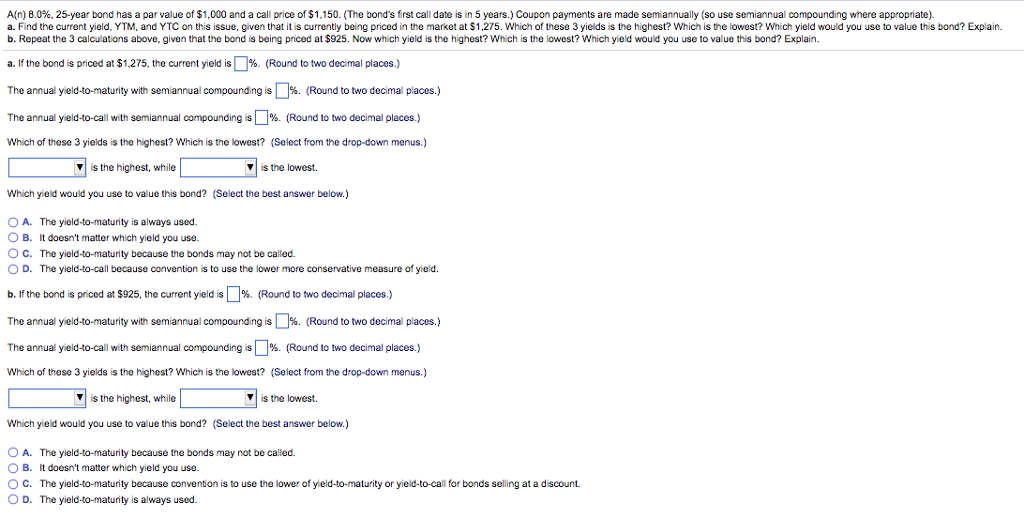
A n 8.0%, 25-year bond has a par value o $1,000 and a call r ce o $1.150. The bond's first call date is n 5 ears. Coupon payments are made sem annually so use sem annual compounding where appropriate a. Find the current yield, YTM, and YTC on this issue, given that it is currently being priced in the market at $1,275. Which of these 3 yields is the highest? Which is the lowest? Which yield would you use to value this bond? Explain. b. Repeat the 3 calculations above, given that the bond is being priced at $925. Now which yield is the highest? Which is the lowest? Which yield would you use to value this bond? Explain. a. If the bond priced at $1.275, the arrent yield is D%. (Round to two decimal places.) The annual y eld-to-maturity with semiannual compounding is The annual yield to call with semiannual compounding is L %. Round to two decimal places. Which of these 3 yields is the highest? Which is the lowest? (Select from the drop-down menus.) .%, (Round to two decima places.) is the highest, while is the lowest Which yield would you use to value this bond? (Select the best answer below.) O A. The yield-to-maturity is always used. O B. It doesn't matter which yield you use O C. The yield-to-maturity because the bonds may not be called. O D. The yield-to-call because convention is to use the lower more conservative measure of yield. b. ?f the bond is pnced at $925, the current yield is ?96. (Round to two decimal places.) The annual y eld-to-maturity with semiannual compounding is The annual yield-to-call with semiannual compounding is | |96. (Round to two decimal places.) Which of these 3 yields is the highest? Which is the lowest? (Select from the drop-down menus.) %. (Round to two decimal places.) is the highest, while is the lowest. Which yield would you use to value this bond? (Select the best answer below.) O A. O B. ? c. O D. The yield-to-maturity because the bonds may not be called. It doesn't matter which yield you use The yield-to-maturity because convention is to use the lower of yield-to-maturity or yield-to-call for bonds selling at a discounL The yield-to-maturity is always used
Step by Step Solution
There are 3 Steps involved in it

Get step-by-step solutions from verified subject matter experts