







Question: A . n engineering design firm is considering the use of solar power for its stand - alone office. Two options are being considered: (
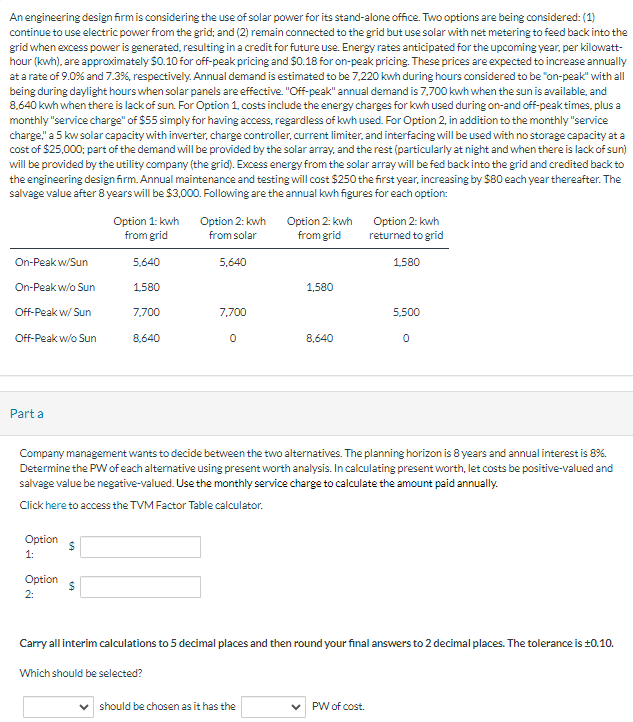
An engineering design firm is considering the use of solar power for its standalone office. Two options are being considered:
continue to use electric power from the grid; and remain connected to the grid but use solar with net metering to feed back into the
grid when excess power is generated, resulting in a credit for future use. Energy rates anticipated for the upcoming year, per kilowatt
hour kwh are approximately $ for offpeak pricing and $ for onpeak pricing. These prices are expected to increase annually
at a rate of and respectively. Annual demand is estimated to be during hours considered to be onpeak" with all
being during daylight hours when solar panels are effective. "Offpeak" annual demand is kwh when the sun is available, and
when there is lack of sun. For Option costs include the energy charges for kwh used during onand offpeak times, plus a
monthly "service charge" of $ simply for having access, regardless of kwh used. For Option in addition to the monthly "service
charge," a kw solar capacity with inverter, charge controller, current limiter and interfacing will be used with no storage capacity at a
cost of $; part of the demand will be provided by the solar array, and the rest particularly at night and when there is lack of sun
will be provided by the utility company the grid Excess energy from the solar array will be fed back into the grid and credited back to
the engineering design firm. Annual maintenance and testing will cost $ the first year, increasing by $ each year thereafter. The
salvage value after years will be $ Following are the annual kwh figures for each option:
Part a
Company management wants to decide between the two alternatives. The planning horizon is years and annual interest is
Determine the PW of each alternative using present worth analysis. In calculating present worth, let costs be positivevalued and
salvage value be negativevalued. Use the monthly service charge to calculate the amount paid annually.
Click here to access the TVM Factor Table calculator.
Option $ :
Option
:
Carry all interim calculations to decimal places and then round your final answers to decimal places. The tolerance is
Which should be selected?
Step by Step Solution
There are 3 Steps involved in it
1 Expert Approved Answer
Step: 1 Unlock

Question Has Been Solved by an Expert!
Get step-by-step solutions from verified subject matter experts
Step: 2 Unlock
Step: 3 Unlock
 Study Help