







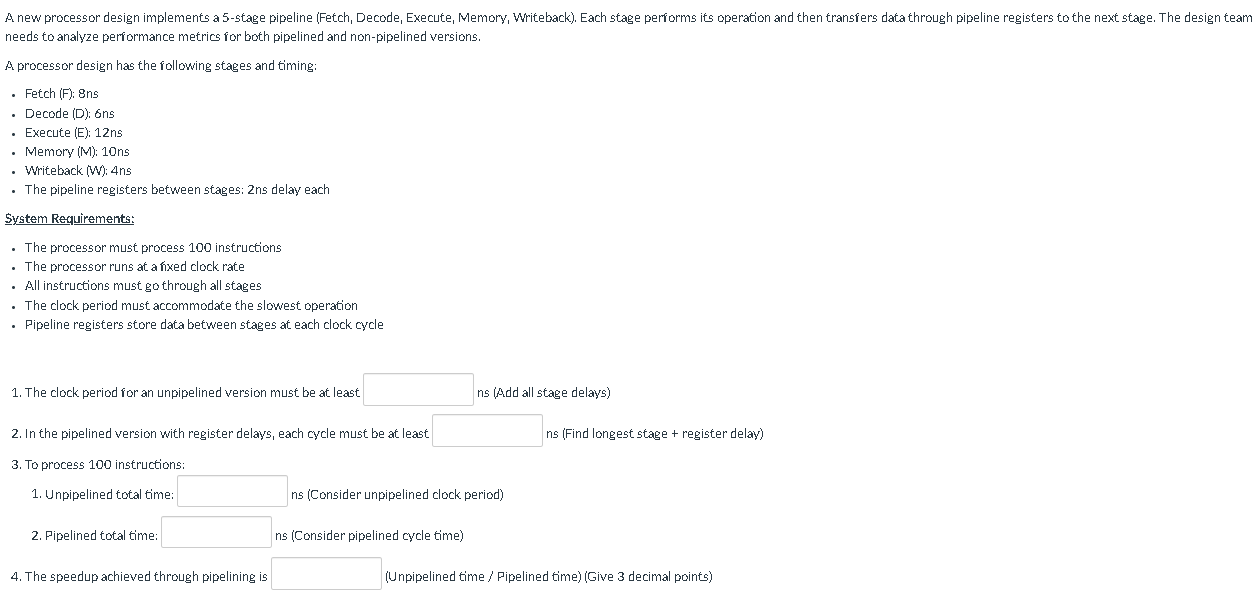
Question: A new processor design implements a 5 - stage pipeline ( Fetch , Decode, Execute, Memory, Writeback ) . Each stage performs its operation and
A new processor design implements a stage pipeline Fetch Decode, Execute, Memory, Writeback Each stage performs its operation and then transfers data through pipeline registers to the next stage. The design team needs to analyze performance metrics for both pipelined and nonpipelined versions.
A processor design has the following stages and timing:
Fetch F: Bns
Decode D: ns
Execute E: ns
Memory M; ns
Writeback W: ns
The pipeline registers between stages: ns delay each
system Requirements:
The processor must process instructions
The processor runs at a fixed clock rate
All instructions must go through all stages
The clock period must accommodate the slowest operation
Pipeline registers store data between stages at each clock cycle
The clock period for an unpipelined version must be at least ns Add all stage delays
In the pipelined version with register delays, each cycle must be at least
ns Find longest stage register delay
To process instructions:
Unpipelined total time: ns Consider unpipelined clock period
Pipelined total time: ns Consider pipelined cycle time
The speedup achieved through pipelining is
Unpipelined time Pipelined timeGive decimal points
Step by Step Solution
There are 3 Steps involved in it
1 Expert Approved Answer
Step: 1 Unlock

Question Has Been Solved by an Expert!
Get step-by-step solutions from verified subject matter experts
Step: 2 Unlock
Step: 3 Unlock
 Study Help