







Question: A new SAT study course is tested on 12 individuals. Pre-course and post-course scores are recorded. Of interest is the average increase in SAT scores.
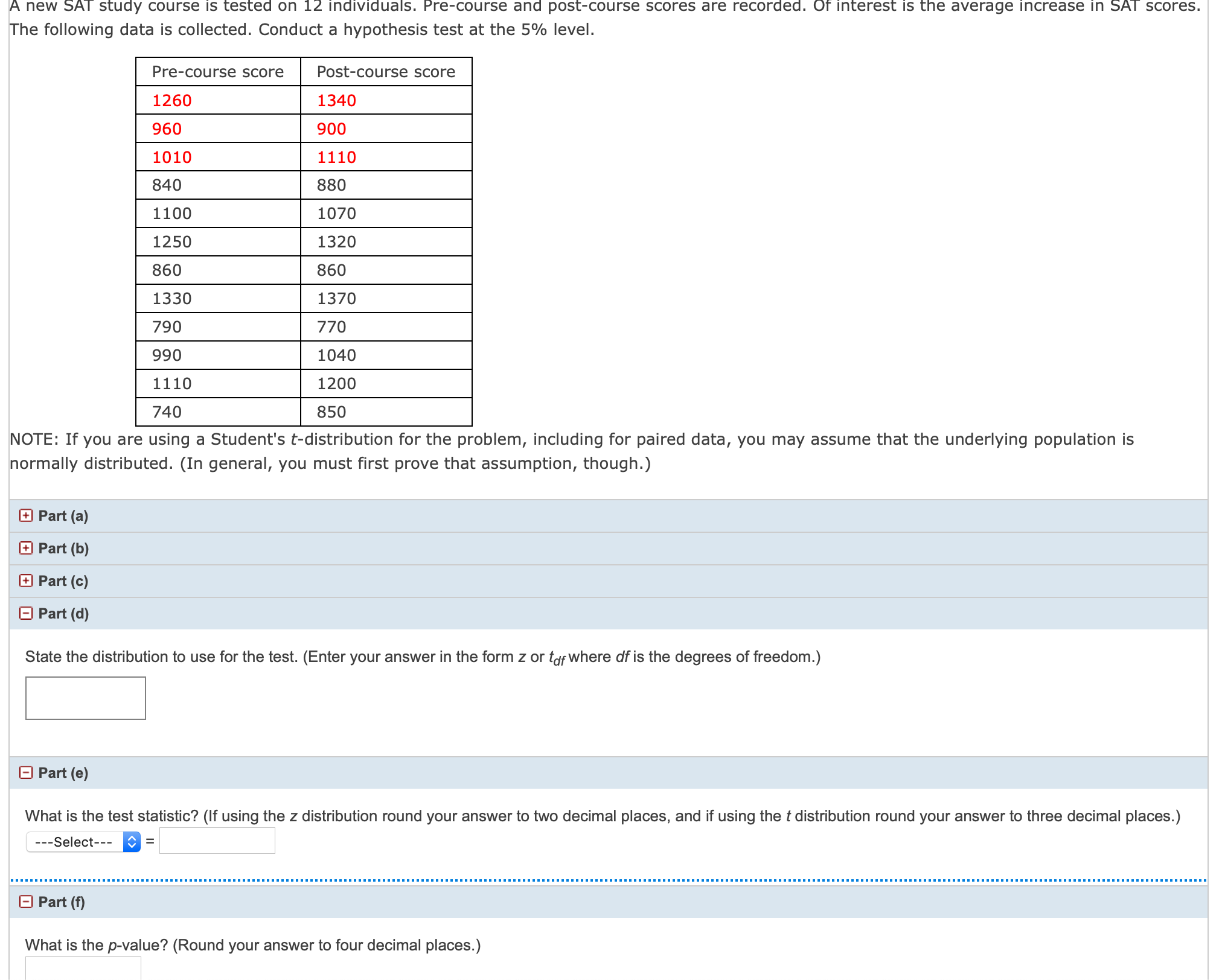
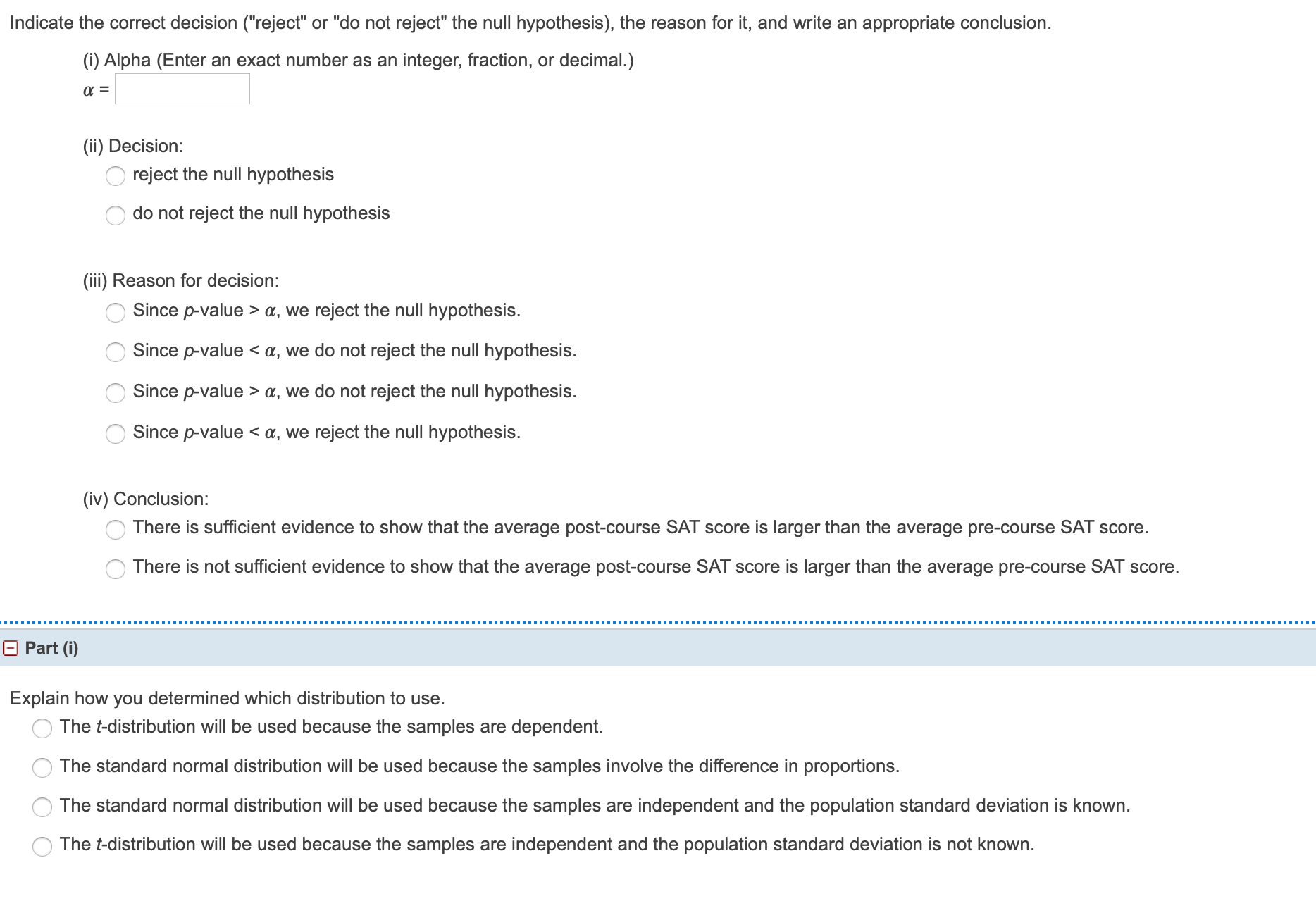
A new SAT study course is tested on 12 individuals. Pre-course and post-course scores are recorded. Of interest is the average increase in SAT scores. The following data is collected. Conduct a hypothesis test at the 5% level. Pre-course score Post-course score 1260 1340 960 900 1010 1110 840 880 1100 1070 1250 1320 860 360 1330 1370 790 770 990 1040 1110 1200 740 850 NOTE: If you are using a Student's t-distribution for the problem, including for paired data, you may assume that the underlying population is normally distributed. (In general, you must first prove that assumption, though.) + Part (a) [+ Part (b) + Part (c) Part (d) State the distribution to use for the test. (Enter your answer in the form z or to where df is the degrees of freedom.) Part (e) What is the test statistic? (If using the z distribution round your answer to two decimal places, and if using the t distribution round your answer to three decimal places.) ---Select--- = Part (f) What is the p-value? (Round your answer to four decimal places.)Indicate the correct decision ("reject" or "do not reject" the null hypothesis), the reason for it, and write an appropriate conclusion. (i) Alpha (Enter an exact number as an integer, fraction, or decimal.) a: (ii) Decision: A reject the null hypothesis A do not reject the null hypothesis (iii) Reason for decision: A Since p-value > a, we reject the null hypothesis. A Since pvalue a, we do not reject the null hypothesis. A Since p-value
Step by Step Solution
There are 3 Steps involved in it

Get step-by-step solutions from verified subject matter experts
 Study Help