







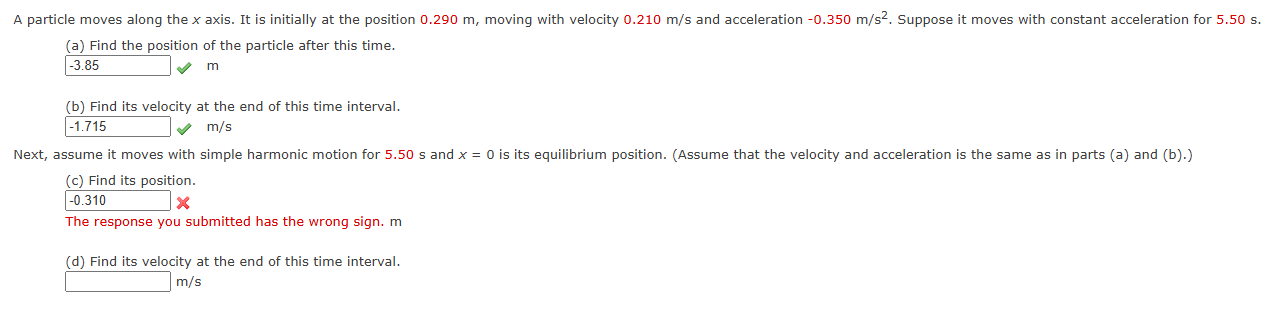
Question: A particle moves along the ( x ) axis. It is initially at the position 0 . 2 9 0 m , moving
A particle moves along the x axis. It is initially at the position m moving with velocity mathrm~mmathrms and acceleration mathrm~mmathrms Suppose it moves with constant acceleration for s
a Find the position of the particle after this time.
m
b Find its velocity at the end of this time interval.
checkmark mathrmmmathrms
Next, assume it moves with simple harmonic motion for s and x is its equilibrium position. Assume that the velocity and acceleration is the same as in parts a and b
c Find its position.
The response you submitted has the wrong sign. m
d Find its velocity at the end of this time interval.
mathrmmmathrms
Step by Step Solution
There are 3 Steps involved in it
1 Expert Approved Answer
Step: 1 Unlock

Question Has Been Solved by an Expert!
Get step-by-step solutions from verified subject matter experts
Step: 2 Unlock
Step: 3 Unlock
 Study Help