







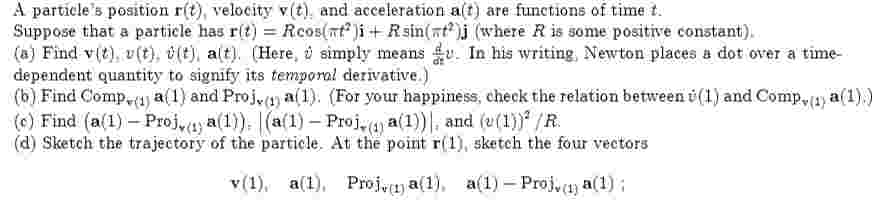
Question: A particle's position r ( t ) , velocity v ( t ) , and acceleration a ( t ) are functions of time t
A particle's position rt velocity vt and acceleration at are functions of time t
Suppose that a particle has rtRcospi tiRsinpi tjR is some positive constantvtvthatvtathatv simply means ddzv In his writing, Newton places a dot over a time
dependent quantity to signify its temponal derivative.cosa and Projvav and CompvaaProfgamma aaProjtau a and vR
d Sketch the trajectory of the particle. At the point r sketch the four vectors
vaProjvaaProfva;
Step by Step Solution
There are 3 Steps involved in it
1 Expert Approved Answer
Step: 1 Unlock

Question Has Been Solved by an Expert!
Get step-by-step solutions from verified subject matter experts
Step: 2 Unlock
Step: 3 Unlock
 Study Help