







Question: A pendulum hangs from the ceiling. As the pendulum swings, its distance, d cm, from one wall of the room depends on the number

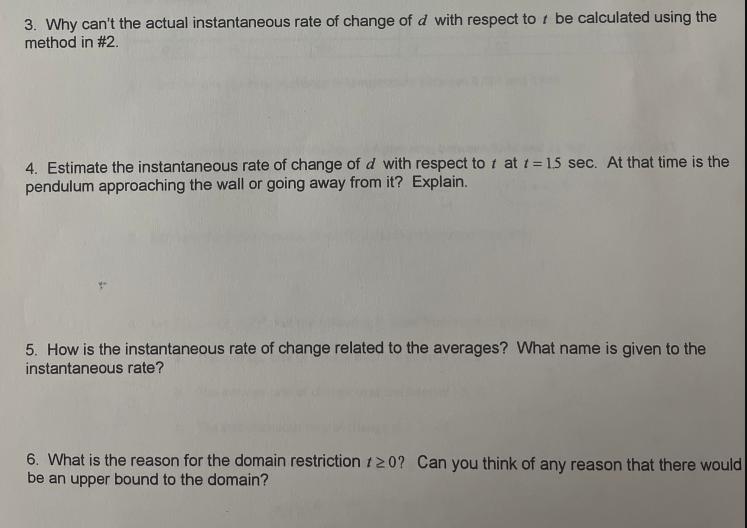
A pendulum hangs from the ceiling. As the pendulum swings, its distance, d cm, from one wall of the room depends on the number of seconds, t, since it was set in motion. Assume that the equation for d as a function of t is d=80+30 cost for t0. It is desired to find out how fast the pendulum is moving at a given instant, 1, and whether it is approaching or going away from the wall. 1. Find d when t=5. If you don't get 95 for the answer, make sure your calculator is in radian mode. d=80+30cos (5)=95 2. Estimate the instantaneous rate of change of d at t=5 sec. by finding the average rates for t=5 to 5.1 sec., t=5 to 5.01 sec., and t=5 to 5.001 sec. 3. Why can't the actual instantaneous rate of change of d with respect to be calculated using the method in #2. 4. Estimate the instantaneous rate of change of d with respect to t at t=15 sec. At that time is the pendulum approaching the wall or going away from it? Explain. 5. How is the instantaneous rate of change related to the averages? What name is given to the instantaneous rate? 6. What is the reason for the domain restriction 120? Can you think of any reason that there would be an upper bound to the domain?
Step by Step Solution
There are 3 Steps involved in it

Get step-by-step solutions from verified subject matter experts
 Study Help