







Question: A person performs a squat (deep knee bend) exercise, as shown below on the left, in order to strengthen their quadriceps muscles. The exercise
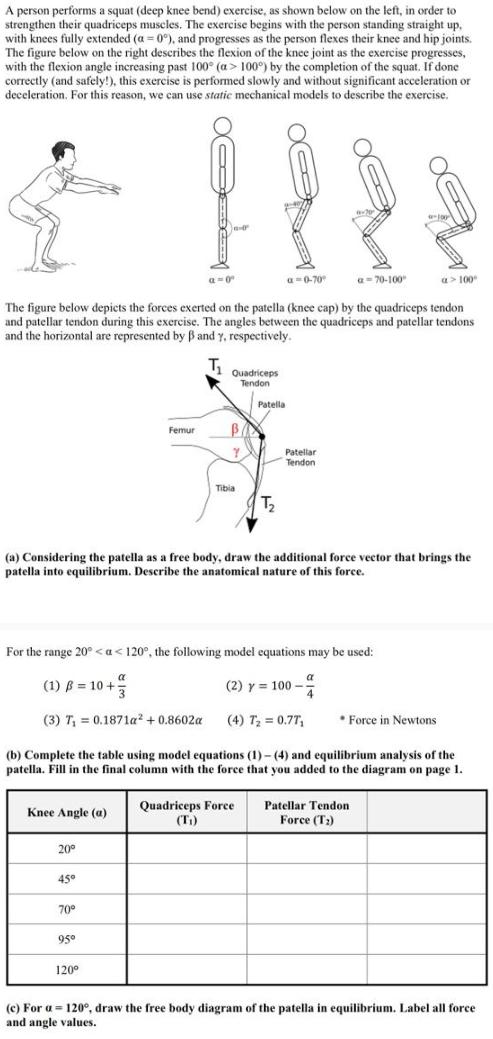
A person performs a squat (deep knee bend) exercise, as shown below on the left, in order to strengthen their quadriceps muscles. The exercise begins with the person standing straight up. with knees fully extended (a=0), and progresses as the person flexes their knee and hip joints. The figure below on the right describes the flexion of the knee joint as the exercise progresses, with the flexion angle increasing past 100 (a> 100) by the completion of the squat. If done correctly (and safely!), this exercise is performed slowly and without significant acceleration or deceleration. For this reason, we can use static mechanical models to describe the exercise. 0-70 =70-100" >100 The figure below depicts the forces exerted on the patella (knee cap) by the quadriceps tendon and patellar tendon during this exercise. The angles between the quadriceps and patellar tendons and the horizontal are represented by B and y, respectively. T Quadriceps Tendon Patella Femur BA Patellar Tendon Tibia T (a) Considering the patella as a free body, draw the additional force vector that brings the patella into equilibrium. Describe the anatomical nature of this force. For the range 20 <
Step by Step Solution
There are 3 Steps involved in it

Get step-by-step solutions from verified subject matter experts
 Study Help