







Question: Problem 4 Consider the loading on the patella lkneecapl when the knee is flexed in a squat or deep knee bend. The three major forces
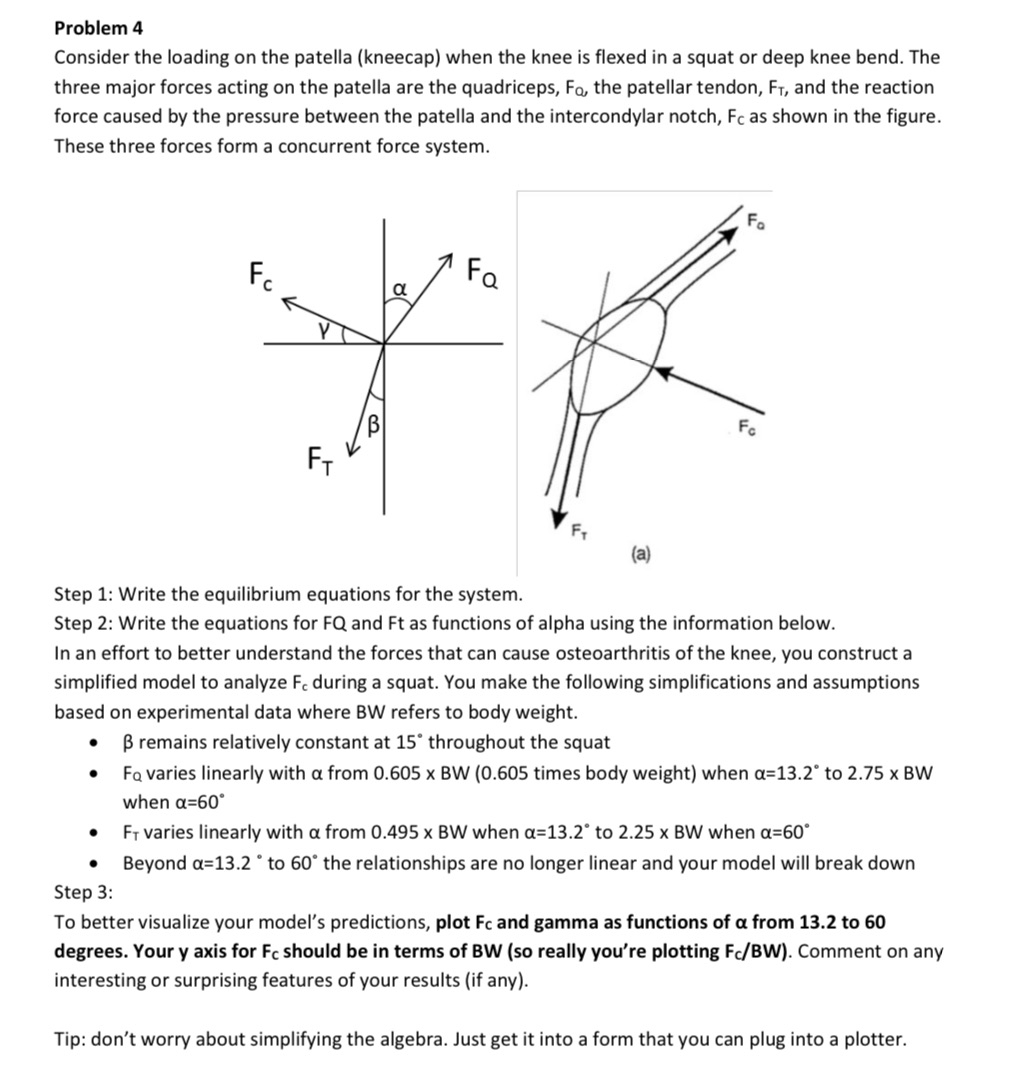
Problem 4 Consider the loading on the patella lkneecapl when the knee is flexed in a squat or deep knee bend. The three major forces acting on the patella are the quadriceps, Fa, the patellar tendon, F1, and the reaction force caused by the pressure between the patella and the intercondylar notch, F: as shown in the figure. These three forces form a concurrent force System. Fr {Ell Step 1: Write the equilibrium equations for the system. Step 2: Write the equations for F0 and Ft as functions of alpha using the information below. In an effort to better understand the forces that can cause osteoarthritis ofthe knee, you construct a simplified model to analyze Fc during a squat. You make the following simplifications and assumptions based on experimental data where aw refers to body weight. 0 [3 remains relatively constant at 15' throughout the squat I Fq varies linearly with o from 0.605 x BW (0.605 times body weight) when u=13.2' to 2.75 1: BW when a=60' - FT varies linearly with o from 0.495 1: BW when q=13.2' to 2.25 k BW when o=60' - Beyond o=13.2 to 60' the relationships are no longer linear and your model will break down Step 3: To better visualize your model's predictions, plot Fe and gamma as functions of ofrom 13.2 to 60 degrees. Your y axis for F; should be in terms of Bw (so really you're plotting FJBW). Comment on any interesting or surprising features of your results (if any). Tip: don't worry about simplifying the algebra. Just get it into a form that you can plug into a plotter
Step by Step Solution
There are 3 Steps involved in it

Get step-by-step solutions from verified subject matter experts
 Study Help