







Question: A Pew Renearch study conducted in 2017 found that approximately 75% of Americans believe that robots and computers might one day do many of the
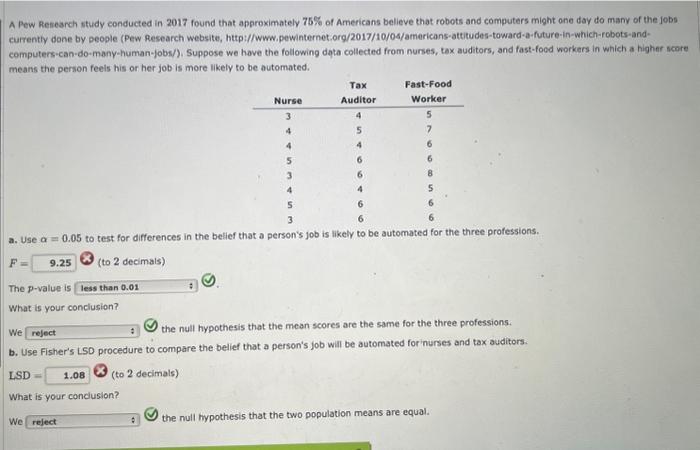
A Pew Renearch study conducted in 2017 found that approximately 75% of Americans believe that robots and computers might one day do many of the jobs currently done by people (Pew Research website, http://www,pewinternet-org/2017/10/0s/americans-attitudes-toward-a-future-in-which-robots-andcomputers-can-do-many-human-jobs/). Suppose we have the following data collected from nurses, tax auditors, and fast-focd workers in which a higher score means the person feels his or her job is more likely to be automated. a. Use =0.05 to test for differences in the belief that a person's job is likely to be automated for the three professions. F=((to2decimals) The p-value is What is your conclusion? We the null hypothesis that the mean scores are the same for the three professions. b. Use Fisher's LSD procedure to compare the belief that a person's job will be automated for inurses and tax auditors. LSD= What is your conclusion? We the null hypothesis that the two population means are equal
Step by Step Solution
There are 3 Steps involved in it

Get step-by-step solutions from verified subject matter experts
 Study Help