







Question: a) Please summarize this Case study in a simple words. b) give me some recommendations (suggestions) for it to make it successful and useful. Visitor
a) Please summarize this Case study in a simple words. b) give me some recommendations (suggestions) for it to make it successful and useful.
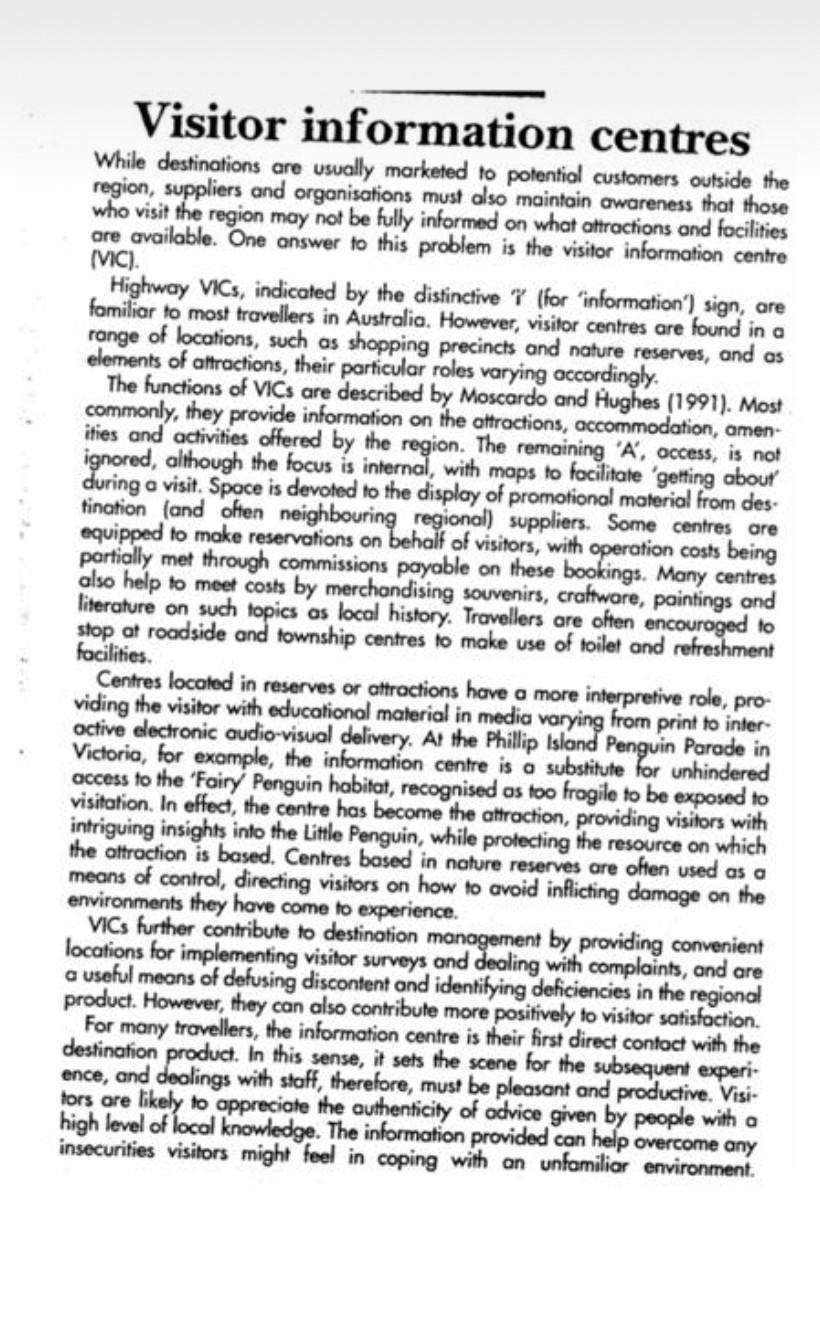
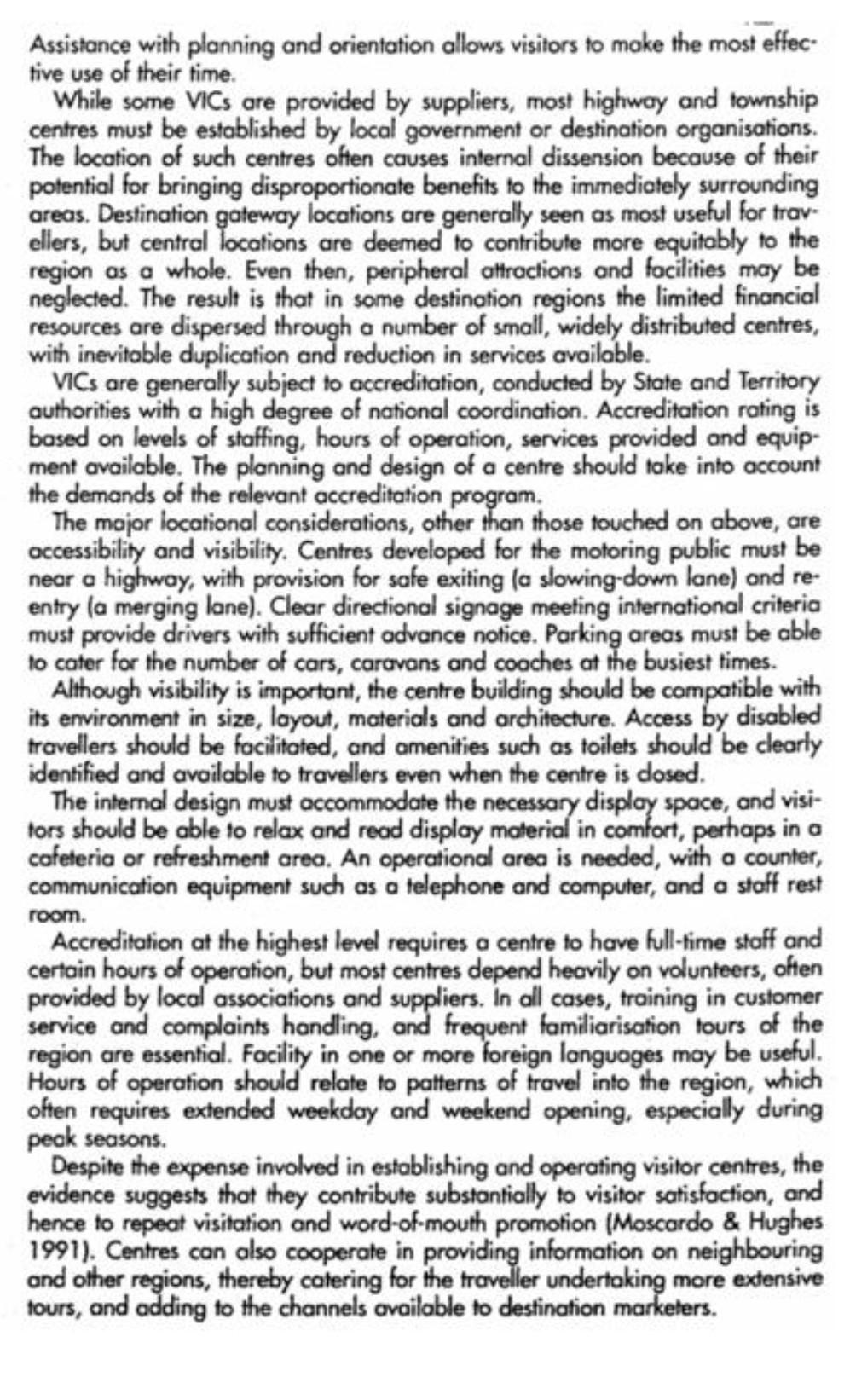
Visitor information centres While destinations are usually marketed to potential customers outside the region, suppliers and organisations must also maintain awareness that those who visit the region may not be fully informed on what attractions and facilities are available. One answer to this problem is the visitor information centre (VIC). Highway VICs, indicated by the distinctive 7 (for 'information') sign, are familiar to most travellers in Australia. However, visitor centres are found in a range of locations, such as shopping precincts and nature reserves, and as elements of attractions, their particular roles varying accordingly . The functions of VICs are described by Moscardo and Hughes (1991). Most commonly, they provide information on the attractions, accommodation, amen- ities and activities offered by the region. The remaining 'A', access, is not ignored, although the focus is internal, with maps to facilitate 'getting about during a visit. Space is devoted to the display of promotional material from des- tination (and often neighbouring regional) suppliers. Some centres are equipped to make reservations on behalf of visitors, with operation costs being partially met through commissions payable on these bookings. Many centres also help to meet costs by merchandising souvenirs, craftware, paintings and literature on such topics as local history. Travellers are often encouraged to stop at roadside and township centres to make use of toilet and refreshment facilities. Centres located in reserves or attractions have a more interpretive role, pro- viding the visitor with educational material in media varying from print to inter active electronic audio-visual delivery. At the Phillip Island Penguin Parade in Victoria, for example, the information centre is a substitute for unhindered access to the 'Fairy Penguin habitat, recognised os too fragile to be exposed to visitation. In effect, the centre has become the attraction, providing visitors with intriguing insights into the Little Penguin, while protecting the resource on which the attraction is based. Centres based in nature reserves are often used as a means of control, directing visitors on how to avoid inflicting damage on the environments they have come to experience. VICs further contribute to destination management by providing convenient locations for implementing visitor surveys and dealing with complaints, and are a useful means of defusing discontent and identifying deficiencies in the regional product. However, they can also contribute more positively to visitor satisfaction. For many travellers, the information centre is their first direct contact with the destination product. In this sense, it sets the scene for the subsequent experi- ence, and dealings with staff, therefore, must be pleasant and productive. Visi- tors are likely to appreciate the authenticity of advice given by people with a high level of local knowledge. The information provided can help overcome any insecurities visitors might feel in coping with an unfamiliar environment. Assistance with planning and orientation allows visitors to make the most effec- tive use of their time While some VICs are provided by suppliers, most highway and township centres must be established by local government or destination organisations. The location of such centres often causes internal dissension because of their potential for bringing disproportionate benefits to the immediately surrounding areas. Destination gateway locations are generally seen as most useful for trav- ellers, but central locations are deemed to contribute more equitably to the region as a whole. Even then, peripheral attractions and facilities may be neglected. The result is that in some destination regions the limited financial resources are dispersed through a number of small, widely distributed centres, with inevitable duplication and reduction in services available. VICs are generally subject to accreditation, conducted by State and Territory authorities with a high degree of national coordination. Accreditation rating is based on levels of staffing, hours of operation, services provided and equip- ment available. The planning and design of a centre should take into account the demands of the relevant accreditation program. The major locational considerations, other than those touched on above, are accessibility and visibility. Centres developed for the motoring public must be near a highway, with provision for safe exiting la slowing down lane) and re- entry la merging lane). Clear directional signage meeting international criteria must provide drivers with sufficient advance notice. Parking areas must be able to cater for the number of cars, caravans and coaches at the busiest times. Although visibility is important , the centre building should be compatible with its environment in size, layout , materials and architecture. Access by disabled travellers should be facilitated, and amenities such as toilets should be clearly identified and available to travellers even when the centre is dosed. The internal design must accommodate the necessary display space, and visi- tors should be able to relax and read display material in comfort, perhaps in a cafeteria or refreshment area. An operational area is needed, with a counter, communication equipment such as a telephone and computer, and a stoff rest room. Accreditation at the highest level requires a centre to have full-time staff and certain hours of operation, but most centres depend heavily on volunteers, often provided by local associations and suppliers. In all cases, training in customer service and complaints handling, and frequent familiarisation tours of the region are essential. Facility in one or more foreign languages may be useful. Hours of operation should relate to patterns of travel into the region, which often requires extended weekday and weekend opening, especially during peck seasons. Despite the expense involved in establishing and operating visitor centres, the evidence suggests that they contribute substantially to visitor satisfaction, and hence to repeat visitation and word-of-mouth promotion (Moscardo & Hughes 1991). Centres can also cooperate in providing information on neighbouring and other regions, thereby catering for the traveller undertaking more extensive tours, and adding to the channels available to destination marketersStep by Step Solution
There are 3 Steps involved in it
1 Expert Approved Answer
Step: 1 Unlock

Question Has Been Solved by an Expert!
Get step-by-step solutions from verified subject matter experts
Step: 2 Unlock
Step: 3 Unlock
 Study Help