







Question: a) Please write a conclusion and recommendations for this case study. b) What should visitor information centres do to be successful? Visitor information centres While
a) Please write a conclusion and recommendations for this case study.
b) What should visitor information centres do to be successful?
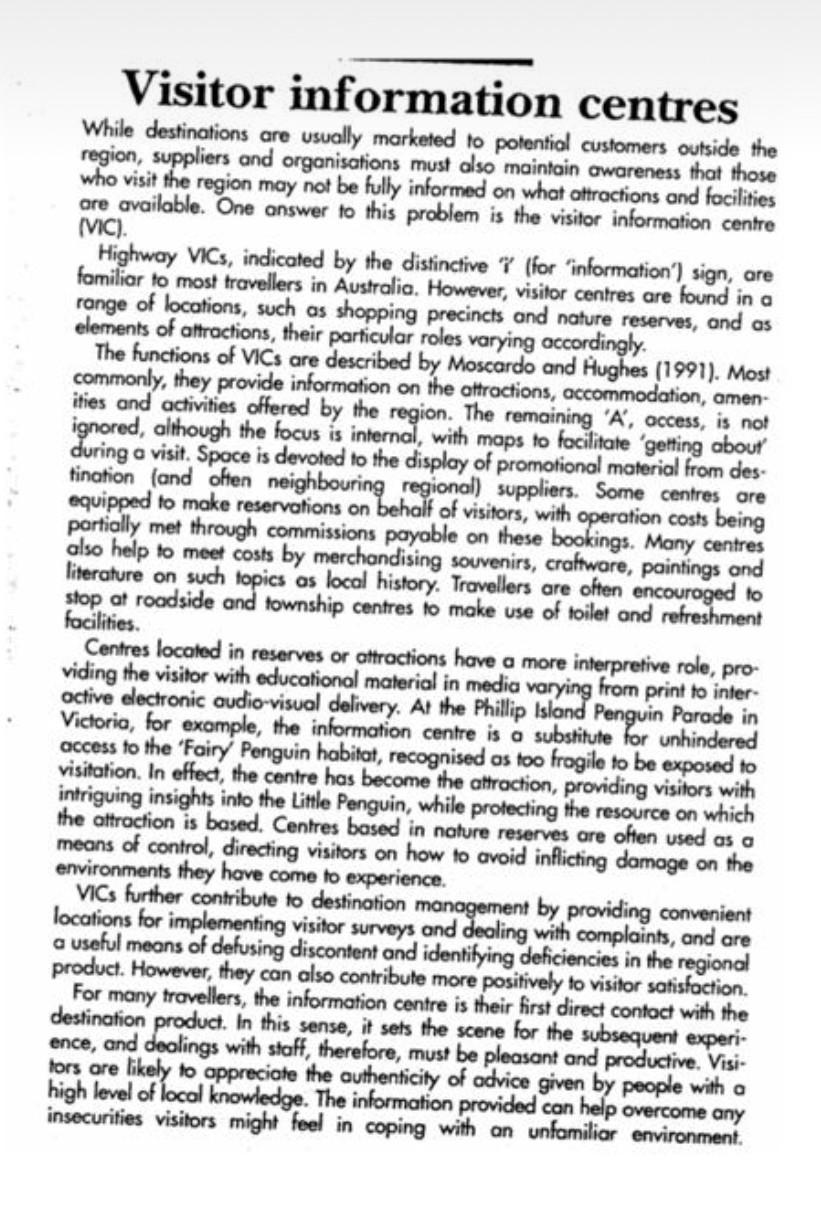
Visitor information centres While destinations are usually marketed to potential customers outside the region, suppliers and organisations must also maintain awareness that those who visit the region may not be fully informed on what attractions and facilities are available. One answer to this problem is the visitor information centre (VIC). Highway VICs, indicated by the distinctive 7 (for 'information') sign, are familiar to most travellers in Australia. However, visitor centres are found in a range of locations, such as shopping precincts and nature reserves, and as elements of attractions, their particular roles varying accordingly. The functions of VICs are described by Moscardo and Hughes (1991). Most commonly, they provide information on the attractions, accommodation, amen- ities and activities offered by the region. The remaining 'A', access, is not ignored, although the focus is internal, with maps to facilitate 'getting about during a visit. Spoce is devoted to the display of promotional material from des. tination (and often neighbouring regional) suppliers. Some centres are equipped to make reservations on behalf of visitors, with operation costs being partially met through commissions payable on these bookings. Many centres also help to meet costs by merchandising souvenirs, craftware, paintings and literature on such topics as local history. Travellers are often encouraged to stop at roadside and township centres to make use of toilet and refreshment facilities Centres located in reserves or attractions have a more interpretive role, pro viding the visitor with educational material in media varying from print to inter- active electronic audio-visual delivery. At the Phillip Island Penguin Parade in Victoria, for example, the information centre is a substitute for unhindered access to the 'Fairy Penguin habitat, recognised os too fragile to be exposed to visitation. In effect, the centre has become the attraction, providing visitors with intriguing insights into the Little Penguin, while protecting the resource on which the attraction is based. Centres based in nature reserves are often used as a means of control, directing visitors on how to avoid inflicting damage on the environments they have come to experience. VICs further contribute to destination management by providing convenient locations for implementing visitor surveys and dealing with complaints, and are a useful means of defusing discontent and identifying deficiencies in the regional product. However, they can also contribute more positively to visitor satisfaction. For many travellers, the information centre is their first direct contact with the destination product. In this sense, it sets the scene for the subsequent experi- ence, and dealings with staff, therefore, must be pleasant and productive. Visi- tors ore likely to appreciate the authenticity of advice given by people with a high level of local knowledge. The information provided can help overcome any insecurities visitors might feel in coping with an unfamiliar environmentStep by Step Solution
There are 3 Steps involved in it
1 Expert Approved Answer
Step: 1 Unlock

Question Has Been Solved by an Expert!
Get step-by-step solutions from verified subject matter experts
Step: 2 Unlock
Step: 3 Unlock
 Study Help