



Question: A post - tensioned prestressed T - beam has the following details: Span and loading: simply supported 3 2 m span dead load comprises self
A posttensioned prestressed Tbeam has the following details:
Span and loading:
simply supported span
dead load comprises selfweight concrete density plus a nominal superimposed dead load SDL of
nominal live load is and of the nominal live load is permanent
ultimate limit state load factors for dead load and SDL and for live load
single tendon with a parabolic profile and zero eccentricity at each end
all strands in the tendon are jacked simultaneously
the tendon is jacked from one end of the beam only
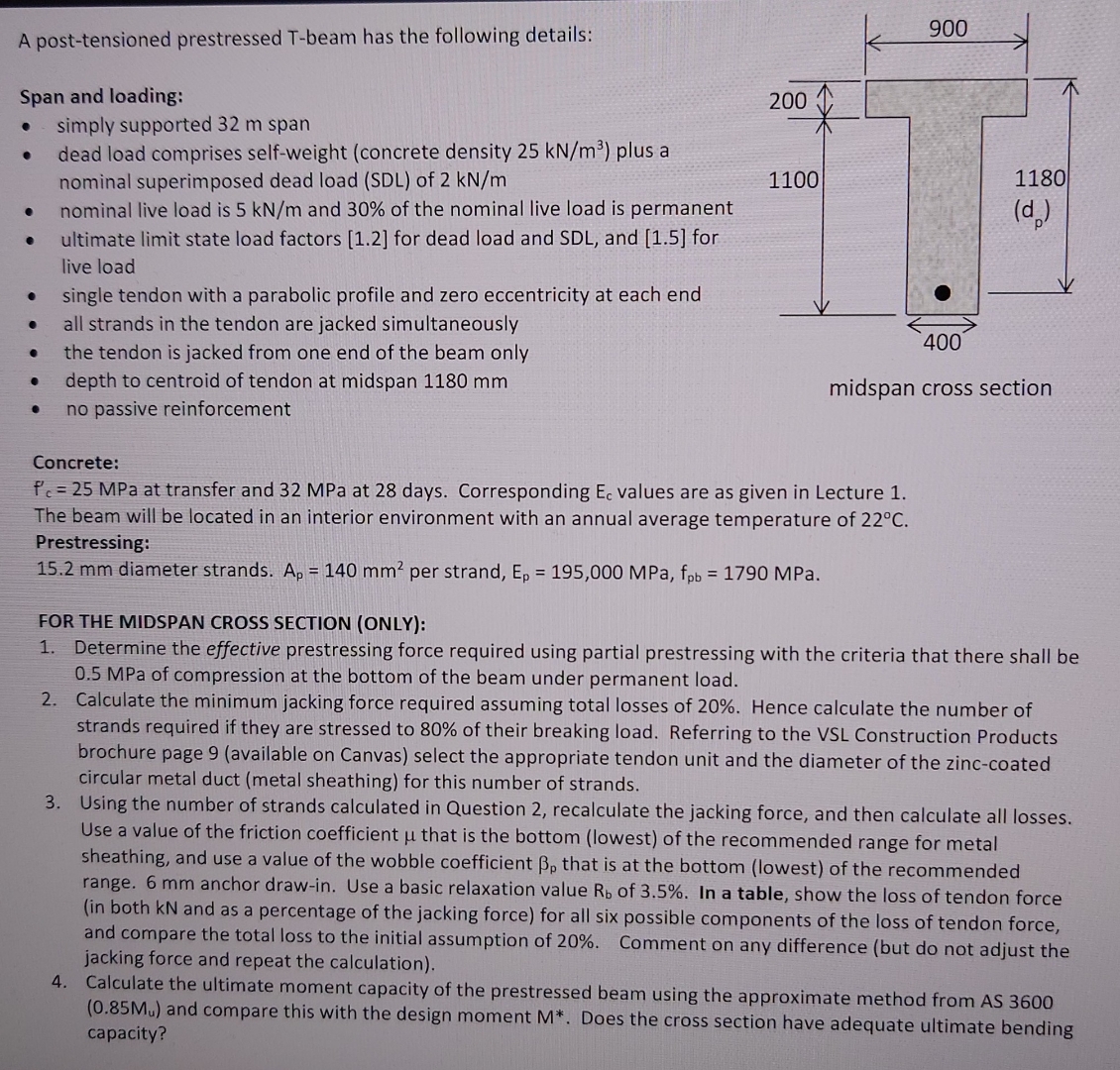
depth to centroid of tendon at midspan
midspan cross section
no passive reinforcement
Concrete:
MPa at transfer and MPa at days. Corresponding values are as given in Lecture
The beam will be located in an interior environment with an annual average temperature of
Prestressing:
diameter strands. per strand, MPa,MPa.
FOR THE MIDSPAN CROSS SECTION ONLY:
Determine the effective prestressing force required using partial prestressing with the criteria that there shall be MPa of compression at the bottom of the beam under permanent load.
Calculate the minimum jacking force required assuming total losses of Hence calculate the number of strands required if they are stressed to of their breaking load. Referring to the VSL Construction Products brochure page available on Canvas select the appropriate tendon unit and the diameter of the zinccoated circular metal duct metal sheathing for this number of strands.
Using the number of strands calculated in Question recalculate the jacking force, and then calculate all losses. Use a value of the friction coefficient that is the bottom lowest of the recommended range for metal sheathing, and use a value of the wobble coefficient that is at the bottom lowest of the recommended range. anchor drawin Use a basic relaxation value of In a table, show the loss of tendon force in both and as a percentage of the jacking force for all six possible components of the loss of tendon force, and compare the total loss to the initial assumption of Comment on any difference but do not adjust the jacking force and repeat the calculation
Calculate the ultimate moment capacity of the prestressed beam using the approximate method from AS and compare this with the design moment Does the cross section have adequate ultimate bending capacity?
Step by Step Solution
There are 3 Steps involved in it
1 Expert Approved Answer
Step: 1 Unlock

Question Has Been Solved by an Expert!
Get step-by-step solutions from verified subject matter experts
Step: 2 Unlock
Step: 3 Unlock