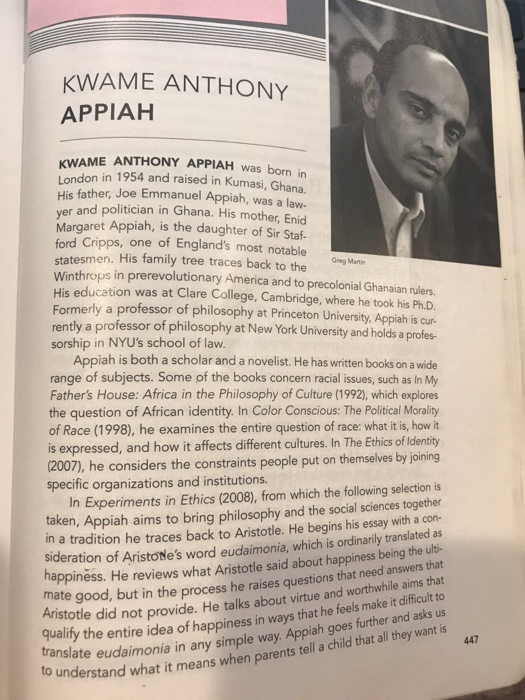
A prcis is a concise statement of the author's main point (not what you think about the topic) in a piece of writing. Each prcis is worth 10 points. Strict guidelines follow: 1. The prcis must be exactly 30 words. One point deducted for each word over or under 30. 2. Hyphenated words count as one word. 3. Be specific and direct, not general. For example, do not begin with empty filler or make a generalized statement based on the title of the essay. An example of empty filler is as follows: In the reading in our book that was assigned for our class to read today...." You have 15 words here and you have said nothing. Be direct: for example, "Elizabeth Warren claims that ..." or "Warren's main point is ...." Also, prcis that are too generalized or too far off the essay's main point will receive point reduction. 4. Your prcis must be completely free of errors. Points deducted for errors of any kind; serious errors such as sentence fragments, comma splices, run-on sentences, verb problems, and unclear expressions will count off substantial points. 5. Be sure to identify at the top of the page the essay you are writing the PQC for. Do not put the title of the essay in your prcis statement. Also, do not use a direct quote of more than two or three words, if at all. The prcis should be in your own words. KWAME ANTHONY APPIAH was born in London in 1954 and raised in Kumasi, Ghana. qualify the entire idea of happiness in ways that he feels make it difficult to translate eudaimonia in any simple way. Appiah goes further and asks us to understand what it means when parents tell a child that all they want is KWAME ANTHONY APPIAH Greg Martin His father, Joe Emmanuel Appiah, was a law- yer and politician in Ghana. His mother, Enid Margaret Appiah, is the daughter of Sir Staf- ford Cripps, one of England's most notable statesmen. His family tree traces back to the Winthrops in prerevolutionary America and to precolonial Ghanaian rulers. His education was at Clare College, Cambridge, where he took his Ph.D. Formerly a professor of philosophy at Princeton University, Appiah is cur rently a professor of philosophy at New York University and holds a profes- sorship in NYU's school of law. Appiah is both a scholar and a novelist. He has written books on a wide range of subjects. Some of the books concern racial issues, such as In My Father's House: Africa in the Philosophy of Culture (1992), which explores the question of African identity. In Color Conscious: The Political Morality of Race (1998), he examines the entire question of race: what it is, how it is expressed, and how it affects different cultures. In The Ethics of Identity (2007), he considers the constraints people put on themselves by joining specific organizations and institutions. In Experiments in Ethics (2008), from which the following selection is taken, Appiah aims to bring philosophy and the social sciences together in a tradition he traces back to Aristotle. He begins his essay with a con- sideration of Aristotle's word eudaimonia, which is ordinarily translated as happiness. He reviews what Aristotle said about happiness being the ulti- mate good, but in the process he raises questions that need answers that Aristotle did not provide. He talks about virtue and worthwhile aims that 447 448 CHAPTER SEVEN: HOW ETHICS AND MORALITY INTERACT for the child to be happy. We have all heard that expression and seem to understand it, even though upon closer examination neither the parents nor the child likely knows what is fully meant by the statement Appiah asks whether we are happy if we think we are. For some people this may be all it takes, but Appiah is looking at the entire circumstance of our awareness of happiness. Is it a feeling? Is it an experience? Is it enough for us to think that we are happy, or is there more involved? Be sure to practice prereading techniques before a careful, anno- tated reading of Appiah's essay. For a review of prereading strategies, see pages 4-9.33 If You're Happy and You Know It THICS IS, in that formulation of Aristotle's, about the ultimate aim or cal ethics has not always shared that vision; nor should philosophers be confident that history has given them a special lien upon the subject of human flourishing. There's a sense ... that the members of my profession became philosophers in the way that the Vlach,' after the union of Wallachia and Moldavia in the mid-nineteenth century, became "Romanians," claim- ing a glorious ancient pedigree through a nomenclatural coup. The slippery movements of group designations are familiar to all historians, not to men- tion any sports fan who has watched the Jets, who used to be the Titans, play the Titans, who used to be the Oilers. Still, our names can express our aspirations. In the pages that follow, then, I want to sidle up to that great end of ethics, see how we might best make sense of it, and offer a final accounting of what "naturalism" means within the realm of human values --- and within the project of eudaimonia. So what is that devoutly-to-be-hoped-for thing, anyway? If you think of eudaimonia as happiness, and believe, as many modern people claim to do, that happiness is just a matter of satisfying your felt desires, you will think that evaluations are just desires gussied up with fancy talk. The antiquity of this temptation is shown by the antiquity of the rebuttals: through more than two millennia, thinkers have vigorously demonstrated that mere sub- jective contentment isn't a worthwhile aim. One way to deepen our grasp of endaimonia is to understand why "happiness is at least for us today, a terribly misleading translation of that Greek word. How many times on TV and in the movies have we heard a parent tell a few notions you'll encounter these days. First, happiness is a feeling: you a child, "I just want you to be happy"? But what does that want Here are are happy if and only if you think you are happy. For a feeling state of mind, like a pain, that you can't have without being aware that you have it. A more sophisticated thought often follows whether you are happy or not is to be decided by standards set by you. Together, these claims amount all know whether we have it, and each of us sets the standards for our own KWAME ANTHONY APPIAH: You're Happy and You Know it Insert . 449 Ba Poup POD happiness. Call this the subjective conception of happiness, As philosophers have never tired of pointing out, this isn't really a con ception that withstands scrutiny. No loving and thoughtful parents could mean that they just wanted a child to be subjectively happy. Consider the happiness that comes from a successful relationship. If all that matters is how you feel, then if you feel it's going well, it is going well, and it's of no consequence if your partner is merely feigning affection, so long as the illo sion is maintained. But, of course, what matters in relationships requires that our feelings be apt; it requires the truth of at least some of the beliefs that partially constitute those feelings. When Dad tells his daughter he wants her to be happy, he doesn't mean it's fine if her boyfriend goes on pretending to love her. It's not just that a boyfriend who doesn't love you is, no doubt, less reliable than one who does. Daddy, especially a soap-opera daddy, could be rich enough to make it worth the boyfriend's while to keep up the act, and his daughter would still be in trouble. People who don't grasp this -- who care only whether their beloveds appear to love them -- are simply not capable of love. The philosopher Robert Nozick proposed a famous thought experi ment along these lines in Anarchy, State, and Utopia. Imagine there was an experience machine that would provide any experience you wanted. "Superduper neuropsychologists could stimulate your brain so that you would think and feel you were writing a great novel, or making a friend, or reading an interesting book," he wrote, even though you'd just be floating in a tank with electrodes plugged into your brain. Would you plug in? Films like the Wachowski brothers' The Matrix or Cameron Crowe's Vanilla Sky -- or Alejandro Amenbar's marvelous Abre los Ojos (Open Your Eyes), on which it was based --- exploit the possibility of something like an experi- ence machine to raise exactly the question Nozick asks. And his answer -- that what matters is not only how our life foels, but also whether our Robert Noziek (1938-2002) Professor of philosophy at Harvard University and author of Anarchy, State, and Utopia (1974). 2 450 CHAPTER SEVEN: HOW ETHICS AND MORALITY INTERACT hi experiences and achievements are real is not only right but right in a way that Aristotle would surely have thought obvious. Whatever Aristotle meant by eudaimonia, he didn't mean subjective happiness To say that feelings aren't the only things that matter is not to go to the other extreme and say that they don't matter at all. No doubt some of the experiences I have in my relationships are part of what is good about them, part of what makes the relationships contribute to my flourishing, to what is good in my life. Loving couples know the feeling of walking hand in hand under the stars, confident in each other's love; lying together at night, conscious of each other's breathing, feeling the warmth of each other's bod. ies. These experiences are valuable parts of a life in love. Again, though, the experiences must be in some sense apt. The shared life is a good life because two people are really making a life together: if your partner is not aral person but an automaton or an electronic phantasm, you're living in what we appropriately call a fool's paradise. You may think your life is going well, but you're wrong, What about that thesis that each person sets the standards for his or her own happiness? People find it plausible, I think, because they follow a train of thought that goes like this: "What matters in your life matters because it matters to you; because it is one of your aims. Succeeding in what matters to you is what's important -- important in the sense that getting it contrib- utes to your happiness, your eudaimonia. Anything you care about matters to you. Ergo, getting what you care about contributes to your happiness." Here is one of the many places where morality matters for ethics, and one of the many ways in which eudaimonia is shown to be indissolubly social, because the question of what we owe to others -- in the classical formula- tion, suum cuique tribuens ("giving to each his due") --- is inherently inter- personal. Suppose, like a character in the fantasies of the Marquis de Sade, I take pleasure in humiliating other people. That I care to humiliate people doesn't mean that if I succeed in doing so my life is going well. You can't set success at sadism as one of the aims of your life and thereby make a life of cruelty a good life. So one reason that you can't set your own standards for happiness is that some standards are morally wrong. This helps explain why so many thinkers, from Socrates on, have con- nected happiness with virtue. However many things you have achieved, however much pleasure you have experienced, however many friends you have, however wonderful your relationship with your spouse, and how- ever successful your children, if you have achieved all this at the expense Marquis de Sade (1740-1814) French nobleman and writer. The words sadism and sadist derive from him and his erotie writings, most of which involve violence and pain. He spent more than thirty years in prison or in an insane asylum. During the French Revolution, he was freed and elected as a delegate to the National Assembly KWAME ANTHONY APPIAH: If You're Happy and You Know it 451 of neglecting your moral obligations, your existence is less successful demands.... [This connection between morality and ethics is internal than it would have been had you paid proper attention to what morality doing what is morally right is one of the constituents of human flourishing So we don't need to believe in a providential invisible hand, assigning bapple ness to the saints, to insist on the connection between virtue and happiness, properly understood. A sinner may think he's happy. But insofar as be's a sinner, his life is thereby made less successful, whether he knows it or not. Whatever it is that he wants, the rest of us should want him, truly, to be bet ter than he is It's also true that some aims, however genuinely desired, are not signifi- 10 cant enough to add to the value of a life. You cannot give a saucer of mud significance in your life simply by announc- ing you want it; and, indeed, if you find you do want it for no purpose, this is not a reason "So one reason that you to go looking for a saucer of mud, but rather can't set your own standards a reason to seek clinical help. If the standards for happiness is that some were whatever you decided they were, you could make your life a smashing success standards are morally wrong." simply by setting the standards absurdly low. Someone could set as his aim that he should do whatever job came along moderately well and make enough money to have fun from time to time. "I am satisfied," he might say, looking back on his life at the end. "I had fun occasionally, I was a work-to-rule bureaucrat; I avoided the entanglements of love and friendship, which would only have risked my wanting things - like loyalty and reciprocation -- that you can't guarantee." And we would say, rightly, that if that is all there was to it, this person, far from having lived well, had wasted his life. In short, you aren't flourishing just because you're getting what you want. We can grasp the alternative vision, shared by the soulless libertine or lifer --- we can imagine a moment when, in Philip Larkin's' mordant words, "every life became / a brilliant breaking of the bank, / A quite unlosable game" -- but we cannot enter it. What we want has to be worth wanting it has to be consistent with human decency and connected with humanly intelligible values. Aristotle's view was, indeed, that life was a challenge to be faced; that to live well was an achievement