







Question: A problem formulation is given below: MAX FLOW( 6, 1) SUBJECT TO FLOW( 1, 2) FLOW( 1, 3) FLOW( 2, 3) FLOW( 2, 4) FLOW(
- A problem formulation is given below:
MAX FLOW( 6, 1)
SUBJECT TO
FLOW( 1, 2)
FLOW( 1, 3)
FLOW( 2, 3)
FLOW( 2, 4)
FLOW( 3, 5)
FLOW( 4, 5)
FLOW( 4, 6)
FLOW( 5, 6)
FLOW( 6, 1)
-FLOW( 1, 2) - FLOW( 1, 3) + FLOW( 6, 1) = 0
FLOW( 1, 2) - FLOW( 2, 3) - FLOW( 2, 4) = 0
FLOW( 1, 3) + FLOW( 2, 3) - FLOW( 3, 5) = 0
FLOW( 2, 4) - FLOW( 4, 5) - FLOW( 4, 6) = 0
FLOW( 3, 5) + FLOW( 4, 5) - FLOW( 5, 6) = 0
FLOW( 4, 6) + FLOW( 5, 6) - FLOW( 6, 1) = 0
Based on this formulation, an incorrect LINGO Model is given below:
MODEL:
SETS:
NODES/1..5/;
ARCS(NODES,NODES)/1,2 1,3 2,3 2,4 3,5 5,6 6,1/:CAP;
ENDSETS
MAX=FLOW(6,1);
@SUM(ARCS(I,J):FLOW(I,J)
@FOR(NODES(I):@FOR(ARCS(J,I):FLOW(J,I))=@SUM(ARCS(I,J):FLOW(I,J)));
DATA:
CAP=2,3,3,4,2,1,2,3,1000;
ENDDATA
END
Which parts are wrong in this LINGO model? Please circle the parts that are wrong and correct them (rewrite the correct model) and explain your corrections in details to get credit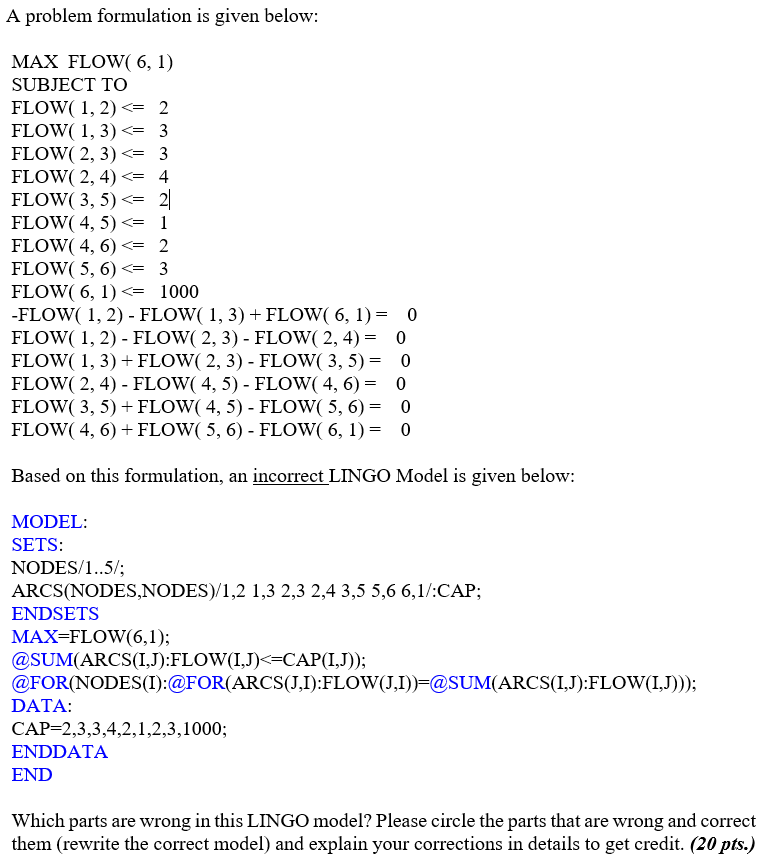
A problem formulation is given below: MAX FLOW(6, 1) SUBJECT TO FLOW( 1, 2) = 2 FLOW(1, 3)
Step by Step Solution
There are 3 Steps involved in it

Get step-by-step solutions from verified subject matter experts
 Study Help