







Question: A processor uses 24 bits for its memory addressing. How many possible distinct locations (in decimal) can the computer address? The computer memory address locations
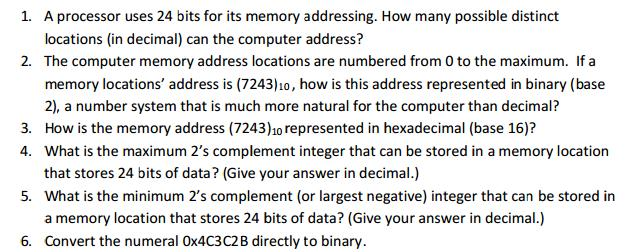
A processor uses 24 bits for its memory addressing. How many possible distinct locations (in decimal) can the computer address? The computer memory address locations are numbered from 0 to the maximum. If a memory locations' address is (7243)_10, how is this address represented in binary (base 2), a number system that is much more natural for the computer than decimal? How is the memory address (7243)_10 represented in hexadecimal (base 16)? What is the maximum 2's complement integer that can be stored in a memory location that stores 24 bits of data? (Give your answer in decimal.) What is the minimum 2's complement (or largest negative) integer that can be stored in a memory location that stores 24 bits of data? (Give your answer in decimal.) Convert the numeral 0x4C3C2 B directly to binary
Step by Step Solution
There are 3 Steps involved in it

Get step-by-step solutions from verified subject matter experts
 Study Help