







Question: A professor designing a class demonstration connects a parallel-plate capacitor to a battery, so that the potential difference between the plates is 255 V.
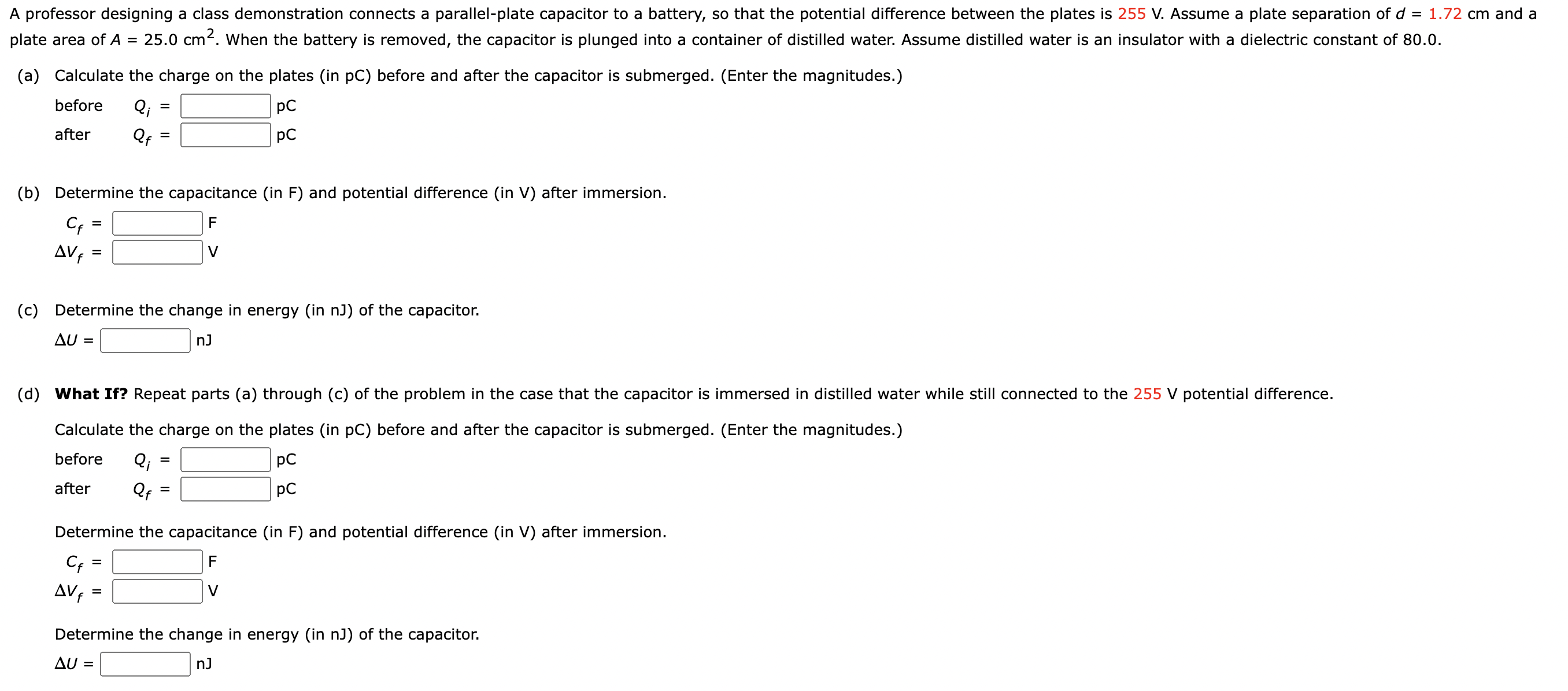
A professor designing a class demonstration connects a parallel-plate capacitor to a battery, so that the potential difference between the plates is 255 V. Assume a plate separation of d = 1.72 cm and a plate area of A = 25.0 cm. When the battery is removed, the capacitor is plunged into a container of distilled water. Assume distilled water is an insulator with a dielectric constant of 80.0. (a) Calculate the charge on the plates (in pC) before and after the capacitor is submerged. (Enter the magnitudes.) before Qi after Qf = = PC (b) Determine the capacitance (in F) and potential difference (in V) after immersion. (c) Cf = = V Determine the change in energy (in nJ) of the capacitor. AU = nJ (d) What If? Repeat parts (a) through (c) of the problem in the case that the capacitor is immersed in distilled water while still connected to the 255 V potential difference. Calculate the charge on the plates (in pC) before and after the capacitor is submerged. (Enter the magnitudes.) before Qi after Qf = = Determine the capacitance (in F) and potential difference (in V) after immersion. Cf AVf = = F Determine the change in energy (in nJ) of the capacitor. AU = nJ
Step by Step Solution
There are 3 Steps involved in it

Get step-by-step solutions from verified subject matter experts
 Study Help