







Question: (a) Prove Markov's Inequality: Let Y be a continuous random variable such that P(Y > 0) = 1 (i.e. f(y) = 0 for y 0
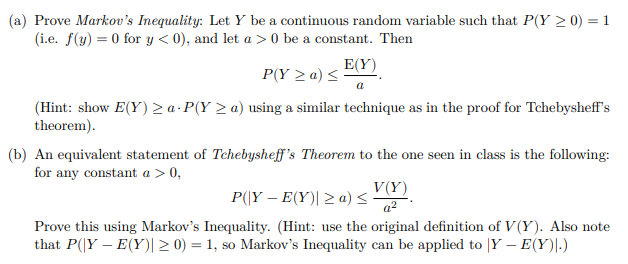
(a) Prove Markov's Inequality: Let Y be a continuous random variable such that P(Y > 0) = 1 (i.e. f(y) = 0 for y 0 be a constant. Then E(Y) P ( Y > a) 5 (Hint: show E(Y) 2 a - P(Y 2 a) using a similar technique as in the proof for Tchebysheff's theorem). (b) An equivalent statement of Tchebysheff's Theorem to the one seen in class is the following: for any constant a >0, P(Y - E(Y)| 2 a) s V(Y) a2 Prove this using Markov's Inequality. (Hint: use the original definition of V(Y). Also note that P(|Y - E(Y) | 2 0) = 1, so Markov's Inequality can be applied to |Y - E(Y)|.)
Step by Step Solution
There are 3 Steps involved in it
1 Expert Approved Answer
Step: 1 Unlock

Question Has Been Solved by an Expert!
Get step-by-step solutions from verified subject matter experts
Step: 2 Unlock
Step: 3 Unlock
 Study Help