







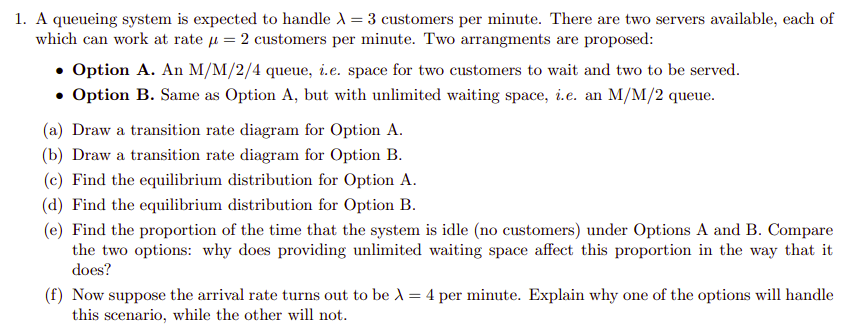
Question: A queueing system is expected to handle = 3 customers per minute. There are two servers available, each of which can work at rate =
A queueing system is expected to handle customers per minute. There are two servers available, each of
which can work at rate customers per minute. Two arrangments are proposed:
Option A An MM queue, ie space for two customers to wait and two to be served.
Option B Same as Option A but with unlimited waiting space, ie an MM queue.
a Draw a transition rate diagram for Option A
b Draw a transition rate diagram for Option B
c Find the equilibrium distribution for Option A
d Find the equilibrium distribution for Option B
e Find the proportion of the time that the system is idle no customers under Options A and B Compare
the two options: why does providing unlimited waiting space affect this proportion in the way that it
does?
f Now suppose the arrival rate turns out to be per minute. Explain why one of the options will handle
this scenario, while the other will not.
Step by Step Solution
There are 3 Steps involved in it
1 Expert Approved Answer
Step: 1 Unlock

Question Has Been Solved by an Expert!
Get step-by-step solutions from verified subject matter experts
Step: 2 Unlock
Step: 3 Unlock
 Study Help